



Use Wozber and land your dream job
Create CV
No registration required
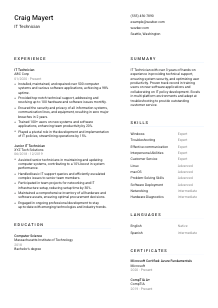
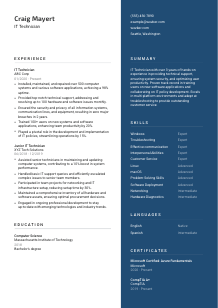
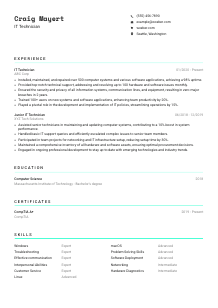
Solving tech glitches, but your CV has a bug? Check out this IT Technician CV example, put together with Wozber free CV builder. Learn how to align your digital dexterity with job requirements, ensuring your IT career runs as smoothly as bug-free code!
IT Technician CVs are read against real day-to-day support work. Hiring teams want to see whether you can keep systems running, troubleshoot across hardware and software, help end users without friction, and handle routine maintenance with enough discipline to protect uptime and security. Your CV should make that operational range easy to spot.
When the CV mirrors the language of the role, the first pass becomes much clearer. Wozber's free CV builder helps you shape an ATS-compliant CV around the employer's wording, so terms like Windows, Linux, help desk support, user training, and network connectivity issues show up where they belong. That makes it easier for the hiring team to quickly understand the environments you've supported and the problems you've solved.
For IT support roles, the header needs to be clean, professional, and easy to act on. This section will not win the job on its own, but it can remove friction immediately by showing who you are, what role you are targeting, and whether you meet practical requirements such as location and contact availability.
Your name should be the most visible item in the header, using a simple professional format. Avoid nicknames or decorative styling. In technical hiring, clarity matters. The goal is to make your identity easy to scan at the top of a CV that may already include systems, tools, and ticket-driven accomplishments.
Use the job title you are applying for when it reflects your actual background. For this opening, placing "IT Technician" directly under your name immediately aligns your profile with the support, maintenance, and troubleshooting work in the posting. If your previous title was slightly different, such as Junior IT Technician or IT Support Specialist, you can still use a matching headline if your experience supports it.
List a phone number you answer, a professional email address, and if relevant, a portfolio or LinkedIn URL that is current. IT roles often move quickly from CV review to screening call, especially when teams need support coverage. One typo in your email or phone number can cost you an interview before your technical experience is even reviewed.
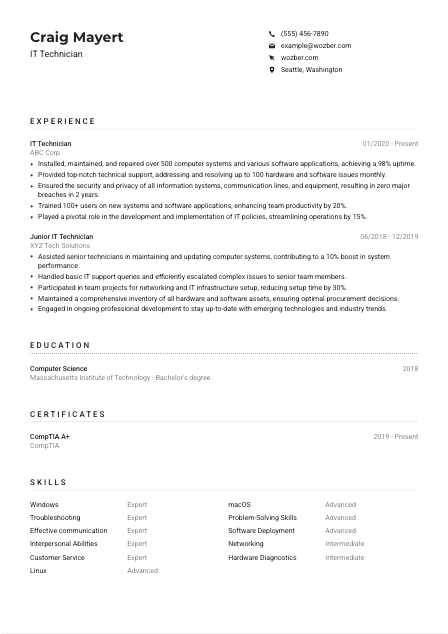
If the employer asks for someone based in Seattle or willing to relocate, say so in your location line. You do not need a full street address. City and state are enough. In the sample CV, listing Seattle, Washington works because it removes a common screening question early and shows immediate alignment with the posting's location requirement.
A LinkedIn profile or personal site can strengthen your application when it supports your CV with consistent job dates, certifications, or technical projects. Keep it polished. For an IT Technician, that might include system support work, hardware projects, lab environments, or certification details that reinforce hands-on credibility.
Your personal details should answer the first practical questions right away: who you are, what role you are pursuing, how to reach you, and whether you meet any stated location requirement. Once that is clear, the rest of the CV can stay focused on support work, system reliability, and user-facing results.




This is where IT Technician candidates separate themselves. Employers are not only looking for a list of duties. They want to know what systems you supported, what issues you resolved, how much volume you handled, and whether your work improved uptime, user productivity, or service quality.
Start by identifying the recurring work in the posting, then map your experience to it. Here, the priorities include installing and repairing systems, handling hardware and software support, resolving connectivity problems, protecting information systems, training users, and contributing to IT procedures. Those points should shape which accomplishments you choose and how you phrase them.
List your most recent role first, then work backward. For each position, include your title, company, and dates. In IT support hiring, that structure helps reviewers quickly see whether your background progressed from junior support tasks into broader ownership, such as system maintenance, user training, or policy participation.
Write bullets that show what you handled and what changed because of your work. Strong IT Technician bullets usually include ticket volume, system count, uptime, response speed, reduction in recurring issues, or user adoption after training. The sample CV does this well by pairing actions with outcomes, such as resolving up to 100 issues monthly and training 100+ users on new software.
Numbers help hiring teams understand scale. Include metrics such as number of devices supported, percentage uptime, incidents resolved per month, deployment volume, or performance gains after upgrades. A line like "maintained over 500 systems with 98% uptime" tells far more than "responsible for maintenance" because it shows both environment size and service reliability.
Prioritise work that sounds like the role you want next. For an IT Technician CV, infrastructure support, OS troubleshooting, user support, hardware diagnostics, software deployment, and security-minded maintenance matter more than unrelated administrative tasks. If you include broader experience, keep the bullets focused on the technical parts that translate directly to desktop support or internal IT operations.
Your experience section should show what kind of support environment you have worked in and how you performed in it. If a hiring manager can picture you handling tickets, fixing endpoint issues, supporting users, and keeping systems stable, this section is doing its job.
Education matters here because the posting asks for a bachelor's degree in Computer Science, Information Technology, or a related field. Even for hands-on support roles, this section helps confirm your technical foundation and gives context for how you built your knowledge of systems, networks, and troubleshooting.
If you have a bachelor's degree that matches or closely relates to the posting, list it clearly and without extra wording around it. In this case, a Bachelor's degree in Computer Science directly supports the requirement. That makes the education section more than background information. It also addresses a screening criterion.
Include the degree, school, field of study, and graduation year. Keep it clean and readable. Technical CVs already carry a lot of detail in experience and skills, so your education section should confirm credentials quickly rather than compete for space.
For IT Technician roles, the subject area often matters as much as the degree level. Computer Science, Information Technology, Information Systems, or a closely related field all help establish relevant academic grounding. In the sample CV, "Bachelor's degree, Computer Science" is enough to align with the requirement without overexplaining.
If you are early in your career or your work history is still developing, include coursework, labs, or academic projects tied to system administration, networking, operating systems, cybersecurity, or hardware support. That extra context can help show hands-on preparation, especially if your professional experience is under the mid-level range.
Honors, technical projects, or capstone work can strengthen this section when they support the role. A project involving Linux administration, endpoint deployment, network setup, or security controls is worth mentioning. Keep it brief and relevant. Academic detail should support your support background, not distract from it.
For this kind of role, education should quickly answer one question: do you have the formal foundation the employer asked for. Once that is clear, your experience and skills can carry the heavier weight of proving day-to-day support capability.
Certifications can sharpen an IT Technician CV because they show current technical focus outside of formal education. They are especially useful when they reinforce support fundamentals, operating systems, hardware, cloud platforms, or security practices that appear in the target role.
List certifications that strengthen your case for endpoint support, troubleshooting, administration, or platform knowledge. CompTIA A+ is a natural fit for many IT Technician roles because it maps well to hardware, software, and support fundamentals. Cloud or vendor certifications can also help when they match the environment you have worked in.
Do not list every training course you have ever taken. Focus on certificates that connect to the employer's needs. For this posting, credentials tied to troubleshooting, operating systems, Microsoft environments, or infrastructure support carry more weight than unrelated technical badges.
Add the year earned and, when applicable, the active date range. In IT hiring, recency matters because tools, security expectations, and support environments change quickly. The sample CV handles this well by showing current certifications with ongoing validity.
An updated certifications section tells employers that you keep your knowledge current as systems and support demands evolve. That matters in roles where you may be expected to troubleshoot across Windows, macOS, Linux, and connected services rather than stay within one narrow stack.
Use this section to support the picture already built by your experience. Relevant certifications can strengthen your case in troubleshooting, endpoint support, and platform familiarity, especially when they are current and clearly tied to the work in the posting.
The skills section should read like a technician's working toolkit. It needs to reflect the systems you support, the problems you solve, and the communication needed to help users through issues without creating more confusion.
Read the job description for explicit skills and implied ones. Here, the obvious technical terms include Windows, macOS, Linux, troubleshooting, hardware and software support, and network connectivity. Just as important are customer service, written English, and interpersonal communication, because many IT Technician roles sit close to end users and internal stakeholders.
If the employer says "troubleshooting," use that term instead of a vague substitute. If they mention operating systems, list the ones you actually support. The sample CV does this well by naming Windows, Linux, macOS, networking, hardware diagnostics, and customer service rather than hiding them inside longer descriptions.
A long skill dump can weaken an IT CV if core capabilities get buried. Put the most important skills first, especially the ones tied to the role's daily work. For an IT Technician, that usually means operating systems, support, diagnostics, deployment, networking basics, security awareness, documentation, and user communication. Keep every listed skill defensible in an interview.
Your skills section should quickly tell a reviewer what environments you can handle and how you operate when issues come in. If the list reflects real support tasks, operating system breadth, and user-facing communication, it will reinforce both ATS alignment and hiring confidence.
Language skills matter more in IT support than many candidates assume. Clear spoken and written communication affects ticket updates, user instructions, documentation, escalation notes, and training. If the posting calls out English proficiency, this section should address that directly.
When strong written and verbal English is required, list English first and show your level clearly. That helps confirm you can handle support conversations, documentation, and written troubleshooting steps without ambiguity.
Terms like Native, Fluent, Advanced, or Intermediate work well because they are widely understood. In the sample CV, English is listed as Native, which directly supports the communication requirement and fits the customer-facing nature of the job.
Additional languages can strengthen an IT support CV when you may work with diverse user groups, internal teams, or customer populations. They are a bonus, not a substitute for the core technical qualifications. Spanish, for example, can be useful in user-facing environments if you can actually support conversations at that level.
Do not inflate language proficiency. If you can read documentation but not troubleshoot live with users, choose a lower level. Honest language ratings help employers understand where you can contribute, especially in support desks where communication mistakes can slow resolution.
Unless multilingual support is central to the role, languages should stay concise. This section exists to support your broader profile, particularly your communication ability, not to take attention away from your technical work and support results.
For an IT Technician, language skills matter when they improve ticket handling, user support, documentation, and training. Keep this section clear, honest, and aligned with the communication demands of the job.
The summary should give a fast, grounded picture of the kind of IT support professional you are. In a few lines, it should cover your level of experience, the environments you have worked in, and the kinds of technical and user-facing responsibilities you handle well.
Before writing, pull out the themes that define the role. Here, that includes IT support experience, operating system coverage, troubleshooting, system maintenance, security awareness, user training, and communication. Your summary should reflect the priorities that appear repeatedly, not a generic statement about loving technology.
Start with a direct line that states who you are professionally and how much experience you bring. For example, "IT Technician with 3+ years of experience supporting end users and maintaining multi-platform environments" gives immediate context and matches how this field is commonly evaluated.
Follow with capabilities that matter for the target position, such as hardware and software troubleshooting, Windows and Linux support, user training, security-minded maintenance, or help desk response. The sample summary works because it combines hands-on support, system security, and user productivity instead of staying abstract.
Aim for a short paragraph that sounds credible when read beside the rest of the CV. Avoid broad claims that your experience does not support. A concise summary with concrete terms from the job description will do more for an IT Technician than a longer paragraph filled with general strengths.
A well-written summary should make the reader expect solid support experience, multi-platform troubleshooting, and dependable user-facing work. When those themes are clear from the opening lines, the rest of the CV has a strong frame to build on.
An effective IT Technician CV makes practical support work easy to recognize. It shows the systems you have maintained, the issues you have resolved, the users you have supported, and the reliability or efficiency gains your work produced.
With Wozber's AI CV builder, you can tailor each section around the job description, strengthen ATS optimisation with role-specific wording, and organise everything in an ATS-friendly CV format that hiring teams can scan quickly. The finished CV should make one thing clear fast: you can step into the support environment and handle the work.




