




Use Wozber and land your dream job
Create CV
No registration required
Juggling tech troubles, but your CV's on hold? Check out this Service Desk Manager CV example, created with Wozber free CV builder. Learn how to present your leadership and IT expertise to match job expectations, ensuring your career journey isn't kept on the help line!
Service desk management sits at the point where user experience, incident flow, and team performance all meet. Hiring teams want to see more than general IT support experience. They need a CV that shows you can run daily support operations, improve service desk processes, coach analysts, and keep business disruption low when systems fail.
The first review often comes down to whether your CV makes your management scope and service delivery results easy to spot. Using Wozber's free CV builder helps you shape an ATS-compliant CV around the role's language, so metrics like customer satisfaction, ticket resolution efficiency, team size, and ITIL-based process improvement come through clearly from the start.
For a Service Desk Manager, the top of the CV should feel clean, professional, and ready for business communication. This section is simple, but it still carries useful signals, especially when the employer has stated location, communication, or title expectations.
Use your full name in a larger, easy-to-read font so it stands out immediately. For a management role tied to team leadership and senior reporting, a polished header sets the right tone before the reader reaches your experience.
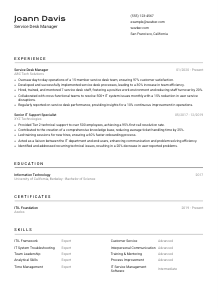
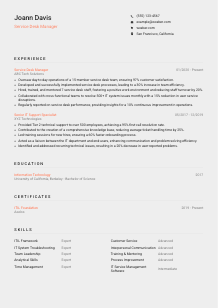
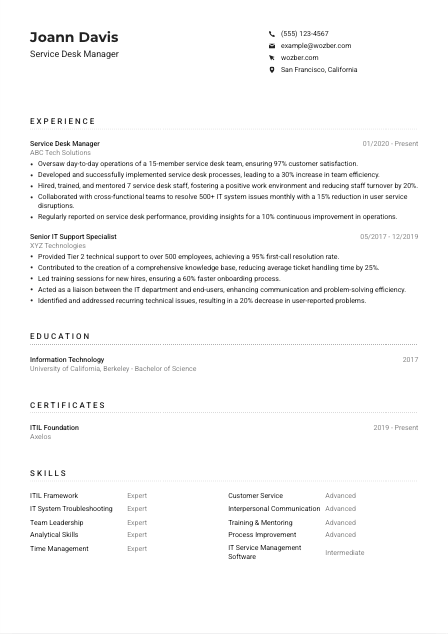
Use the job title "Service Desk Manager" if that is the role you are targeting. This creates immediate alignment with the posting and avoids ambiguity with adjacent titles like IT Support Lead or Help Desk Supervisor. In the example, the title is placed directly under the candidate's name, which keeps the positioning clear.
Include a reliable phone number and a professional email address in a simple format. Since this role depends on written and verbal communication with users, vendors, and senior management, even basic details should reflect professional standards.
If the employer asks for a specific location or relocation readiness, include your city and state clearly. Here, listing "San Francisco, California" directly addresses a stated requirement. If you are relocating, make that clear without turning the header into a long explanation.
A LinkedIn profile or professional website can support your CV if it is current and consistent with your work history. For service desk leaders, this is especially useful when it reinforces experience with IT operations, leadership scope, certifications, or service management tools.
Your header should remove basic questions right away: who you are, what role you are targeting, how to contact you, and whether you meet any stated location requirement. That keeps the reader focused on your service desk leadership experience instead of missing details.




This section carries the most weight for a Service Desk Manager. Employers want to see operational ownership, team leadership, service improvement, and measurable support outcomes. Strong bullets show how you handled ticket volume, coached staff, worked across IT teams, and improved service levels over time.
Start by identifying the recurring themes in the job description. For this role, those include overseeing day-to-day service desk operations, improving processes, managing staff, coordinating with cross-functional teams, and reporting performance to leadership. These ideas should appear in your experience section through real accomplishments, not copied phrases.
Lead with your most recent and most relevant positions so the hiring team can quickly follow your progression into service desk management. For many candidates, that means showing the move from hands-on support or Tier 2 work into team leadership, service ownership, and operational reporting.
A Service Desk Manager CV needs bullets that show service delivery results. The example does this well with points like leading a 15-member team, achieving 97% customer satisfaction, and resolving 500+ IT issues monthly. Those statements tell the reader about scale, leadership, and service quality in one line.
Numbers help hiring teams understand the size and effect of your work. Use metrics that fit service desk management, such as CSAT, first-call resolution, SLA performance, ticket backlog reduction, average handling time, team size, escalation volume, or process efficiency gains. A 30% increase in efficiency or a 20% drop in turnover says far more than "improved operations."
Prioritise work that supports the target role: incident management, user support operations, ITSM process improvement, staff development, stakeholder communication, and reporting. Earlier experience can still stay on the CV, but give the most space to achievements that show you can manage a service desk function and not just work within one.
After reading your experience section, a hiring manager should understand the size of the teams you led, the support environment you managed, the process improvements you introduced, and the service results you delivered. That is the core proof for this role.
For this opening, education is a stated baseline rather than a background detail. The employer wants a bachelor's degree in Information Technology or a related field, so your education section should make that easy to confirm in seconds.
When a posting names a degree requirement, list that qualification clearly and accurately. Here, a bachelor's degree in Information Technology or a related field is part of the screening criteria, so it should appear without buried formatting or extra filler.
List the degree, school, field of study, and graduation year or date. Clean formatting matters because this is often checked quickly during an early review, especially when the role has formal education requirements.
If your degree directly matches the posting, spell it out. The sample CV's "Bachelor of Science" in "Information Technology" is a good illustration because it mirrors the requirement closely and removes guesswork for the reviewer.
Most experienced Service Desk Managers do not need to list classes, but relevant coursework can help if you are earlier in your management career or if your degree title is broader. Topics like IT service management, systems administration, networking, or information systems can add useful context.
Academic honors, capstone projects, or leadership activities are worth mentioning only when they support your current positioning. For a management-level IT support CV, keep the emphasis on items that relate to service operations, technical problem-solving, or team coordination.
Your education section should quickly confirm that you meet the posted degree requirement and that your academic background supports work in IT operations and service management.
Certifications matter in service desk leadership when they connect to process discipline, platform knowledge, or operational oversight. They are especially useful when the employer calls out a framework directly, as this posting does with ITIL.
Put the most relevant credentials first. For this type of position, ITIL certification belongs near the top because it directly supports work in incident management, service improvement, and best-practice-based operations. The example's ITIL Foundation certification is a strong fit for that reason.
A short list of certifications that support service desk management is usually stronger than a broad inventory of loosely connected technical badges. Prioritise credentials that reinforce IT service management, cloud administration, support tooling, or operational leadership.
Certification dates help show whether your knowledge is current, especially for frameworks, platforms, and vendor credentials that evolve over time. Use a consistent format so the section stays easy to scan.
Service desk environments change with tooling, automation, cloud platforms, and support workflows. Keeping certifications current or adding new ones signals that you stay engaged with how modern IT operations are run, not just how they were run a few years ago.
Relevant certifications reinforce that your management approach is grounded in recognized service practices and current technical knowledge. For a role that mentions ITIL specifically, this section can add immediate credibility.
A Service Desk Manager needs a mix of operational, technical, and people-management skills. This section should show that you can run the support function, improve the process behind it, and lead a team that delivers consistent service to users.
Use the job description to identify the skills that matter most. In this case, that means service desk operations, ITIL knowledge, process improvement, technical troubleshooting, cross-functional collaboration, team leadership, and communication. Those are stronger choices than generic skill fillers.
A hiring team expects both technical fluency and managerial ability. Pair hard skills such as ITIL Framework, IT System Troubleshooting, or IT Service Management Software with people-focused skills like Team Leadership, Training and Mentoring, Customer Service, and Interpersonal Communication. The sample CV shows that balance well.
List the skills most relevant to service desk performance rather than every tool or trait you have ever used. A focused skills section supports ATS optimisation and helps the reviewer quickly connect your background to the role's core needs, especially around service quality, support operations, and team effectiveness.
This section should support the story told in your experience, not repeat it mechanically. When chosen well, your skills list confirms that you can lead the desk, improve the workflow, and communicate effectively across users, analysts, and management.
Service desk leadership depends on clear communication during incidents, escalations, reporting, and coaching. Language skills matter most when a posting names one directly, but additional languages can also be useful in organizations with diverse user groups or distributed teams.
Start with any language requirement listed in the job description. Here, proficiency in English is explicitly required, so your CV should state your English level clearly rather than leaving it implied.
When a language is necessary for stakeholder communication, user support, or reporting, list it at the top of this section with an accurate proficiency level. That makes it easy for the reviewer to confirm you can operate in the communication environment of the role.
Extra languages are worth listing when they support service delivery, user communication, or collaboration with broader teams. In the example, Spanish adds helpful range, especially in support environments that serve varied employee or customer populations.
Terms like Native, Fluent, Intermediate, and Basic work well because they set clear expectations. For a management role involving escalations and reporting, overstating language ability can create problems later, so accuracy matters.
If the role supports multiple offices, international users, or a varied internal workforce, language capability can become a practical advantage. Include it when it reflects how you actually work, not just as an extra line item.
For Service Desk Managers, language skills support the communication side of the job as much as the technical side. At minimum, this section should confirm required English proficiency. Beyond that, it can show added flexibility in user-facing environments.
The summary should quickly position you as someone who can lead a service desk operation, not just participate in one. In a few lines, show your level of experience, your management scope, and the kind of service outcomes you are known for.
Read the posting closely before writing this section. For a Service Desk Manager, your summary should reflect service operations, team leadership, process improvement, and support quality. That keeps the opening aligned with what the employer is actively hiring for.
Start with a direct statement of who you are professionally. A line such as "Service Desk Manager with 6+ years of experience" gives immediate context and works especially well when your background includes both management and hands-on support progression, as shown in the example.
Choose strengths that are central to service desk leadership. Good examples include leading cross-functional teams, improving service desk processes, maintaining high-quality technical support, or developing staff performance. The sample summary uses these themes effectively without trying to cover everything at once.
Aim for a short paragraph that reads cleanly and stays grounded in real work. Avoid broad claims like "results-driven professional" unless you immediately back them with specifics such as service improvement, customer satisfaction, or operational leadership.
Your summary should make the next reader expect solid service metrics, team leadership, and process ownership in the experience section. When it is tailored well, the rest of the CV feels consistent from the first line.
A Service Desk Manager CV needs to show operational control, team leadership, ITIL-informed process thinking, and measurable support results. When those points are clear across your summary, experience, skills, and certifications, hiring teams can quickly see whether you can lead the desk, improve service levels, and communicate with senior stakeholders.
Use Wozber's free CV builder to tighten structure, tailor language to the posting, and create an ATS-friendly CV format that keeps your management scope and service metrics easy to read. Wozber's ATS CV scanner can also help surface missing requirements and strengthen alignment before you apply.
At that point, your CV should make one thing clear: you can run a service desk operation with discipline, visibility, and strong user support outcomes.




