



Use Wozber and land your dream job
Create CV
No registration required
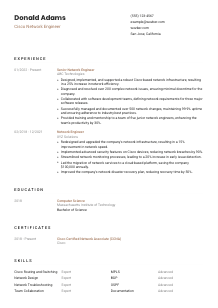
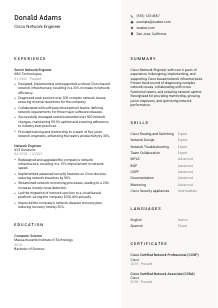
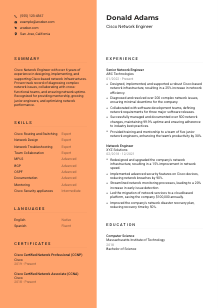
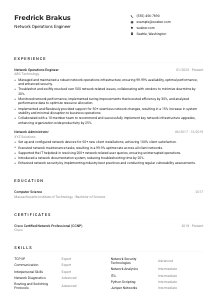
Routing packets, but your CV's getting lost in translation? Navigate this Cisco Network Engineer CV example, created with Wozber free CV builder. Learn how to sync your networking skills with job requirements, ensuring your career path stays as interconnected as your networks!
Cisco Network Engineer CVs are read through an operations lens. Hiring teams want to see whether you have handled live routing and switching environments, kept outages contained, and made network changes without putting uptime at risk. General infrastructure language is rarely enough here. Your CV needs to show the scale of the networks you supported, the protocols you worked with, and the operational results you delivered.
The first screen often comes down to whether your background clearly matches the Cisco stack in the posting. Using Wozber's free CV builder helps you shape an ATS-compliant CV around the exact language of the role, from BGP and OSPF to change documentation and mentoring, so the reader quickly sees where your experience overlaps with the network environment they need to support.
For network engineering roles, the header does more than identify you. It confirms practical basics fast, including role alignment, reliable contact information, and any location requirement that could affect interview flow or start date.
Place your name at the top in a clear, readable format. Keep it slightly more prominent than the rest of the header so a hiring manager can immediately connect your CV to interview notes, certification records, or internal candidate tracking.
Add "Cisco Network Engineer" directly under your name when that is the role you are pursuing. Matching the job title helps frame the rest of the CV around Cisco infrastructure work rather than broader IT support or generic network administration.
Include a current phone number and a professional email address. Check them carefully. If a team wants to schedule a technical screen about routing, security appliances, or troubleshooting depth, you do not want a typo to block that follow-up.
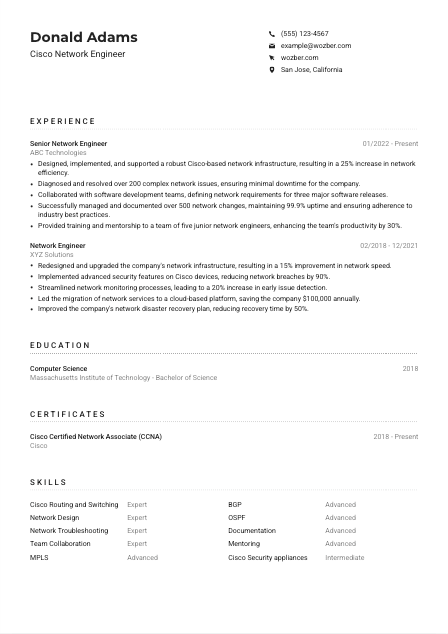
If the posting requires a specific location, include it in your header. In this example, listing "San Jose, California" immediately answers a stated requirement and removes doubt about local availability. For other openings, only include location details that genuinely help your candidacy.
A LinkedIn profile, portfolio site, or professional webpage can help if it supports your CV with certifications, project details, or a fuller technical background. Keep it current and consistent with the network engineering experience you describe on the page.
This section should settle the basics in seconds: who you are, what role you are targeting, how to reach you, and whether you meet any practical requirement such as location. For a Cisco Network Engineer, that quick clarity keeps the reader focused on your infrastructure experience instead of administrative questions.




This is the section most likely to decide whether you move forward. Cisco Network Engineer hiring depends on concrete operating history: network design work, protocol knowledge, incident response, change control, uptime, and collaboration across infrastructure and application teams.
Read the posting and identify the engineering work it emphasizes. Here, the clear anchors are Cisco routing and switching, MPLS, BGP, OSPF, Cisco security appliances, troubleshooting, documentation, and cross-functional support. Those themes should guide which achievements you feature and how you phrase them.
List your most recent network engineering positions first, with job title, company, and dates. A hiring manager should be able to trace your progression from hands-on network support into broader ownership of design, implementation, escalation, and operational stability.
Focus each bullet on work that matches the opening: designing Cisco-based infrastructure, resolving incidents, managing network changes, and supporting business-critical services. The sample CV does this well by leading with infrastructure design, issue resolution, and collaboration with software teams instead of generic IT duties.
Numbers carry weight when they reflect how network teams are measured. Uptime, reduction in downtime, issue volume handled, efficiency gains, breach reduction, recovery time, and cost savings all strengthen your case. In the example, results such as 99.9% uptime, 200+ issues resolved, and a 25% efficiency gain make the work easier to evaluate.
Keep the section focused on work that supports the target role. Bullets about unrelated systems, broad help desk tasks, or tools with no relevance to Cisco environments can crowd out stronger material about routing, security, migrations, and change management.
A Cisco Network Engineer CV should make it easy to see the environments you supported and the operational results you delivered. When your bullets connect protocols, infrastructure changes, troubleshooting, and measurable uptime or performance outcomes, your experience reads like production-ready engineering work.
Education carries less weight than hands-on network work at this level, but it still matters when the posting asks for a specific degree. Keep this section straightforward and aligned with the baseline technical background expected for infrastructure roles.
If the job asks for a bachelor's degree in Computer Science, Information Technology, or a related field, make sure that information is easy to spot. A Bachelor of Science in Computer Science, as shown in the example, checks that requirement cleanly.
List degree, field of study, school, and graduation year or date. This section does not need extra styling. Clear formatting works best, especially when the rest of the CV already carries the technical depth through network engineering experience.
When your degree directly supports the role, name it precisely. Computer Science, Information Technology, or closely related fields reinforce that you built your networking knowledge on a formal technical foundation rather than arriving from an unrelated background.
For early-career candidates, relevant coursework in networking, security, systems, or distributed computing can strengthen this section. For someone with 5+ years of experience, projects belong here only if they add something your work history does not already show.
Honors, technical societies, or standout university projects can be useful when they connect to networking or systems work. If you are already established in production environments, keep these details brief so they do not distract from operational achievements.
For this profession, education should confirm the required foundation and then step aside. Once the degree is clear, the CV should return attention to the network environments, protocols, and results that define your day-to-day engineering value.
Certifications matter more in network engineering than in many adjacent IT roles because they map directly to vendor technology and expected knowledge depth. If a posting asks for Cisco credentials, this section should answer that requirement without delay.
When a job calls for certifications such as CCNA, CCNP, or CCIE, list the ones you hold prominently. That immediate match matters because it confirms recognized Cisco knowledge before the reviewer gets into your detailed experience.
Put the most relevant certifications first. For a Cisco-focused network engineering role, CCNA and CCNP should sit ahead of broader or less relevant certifications because they speak directly to routing, switching, and enterprise network operations.
Include the year earned and, when appropriate, active status or renewal range. Cisco environments evolve, and current credentials reassure employers that your knowledge has stayed aligned with modern platforms, configurations, and best practices.
If you are working toward a higher-level Cisco certification or related security or cloud networking credential, include it only when the progress is real and clearly labeled. Continuous learning matters in roles that span on-prem infrastructure, security controls, and hybrid environments.
This section should quickly establish that you meet the vendor-specific expectations of the job. For a Cisco Network Engineer, recognized Cisco certifications reinforce the technical credibility already shown in your routing, troubleshooting, and infrastructure accomplishments.
A useful skills section for this role is tightly curated. It should reflect the protocols, platforms, and working habits that appear in Cisco network engineering work, not a long inventory of every tool you have touched.
Start with the terms the employer used. In this case, that includes Cisco Routing and Switching, MPLS, BGP, OSPF, Cisco Security appliances, teamwork, and independent problem-solving. Those phrases tell you what should appear in your skills section if you genuinely use them.
Only list skills you can discuss at a practical level. If BGP troubleshooting, MPLS design, or security appliance configuration appear on your CV, expect follow-up questions about implementation choices, failure scenarios, and operational tradeoffs.
Place the most central capabilities first. Cisco routing and switching, network design, troubleshooting, and the named protocols should usually come before broader strengths like documentation or mentoring, even though those matter too. The sample CV handles this well by foregrounding core infrastructure skills before secondary competencies.
A hiring team should be able to glance at this section and recognize a match for the network environment they run. Prioritised Cisco technologies, routing protocols, security exposure, and relevant collaboration skills create that quick technical read.
Language skills usually sit behind technical depth for Cisco Network Engineer hiring, but they can still help when the role involves cross-regional teams, vendor coordination, or support across multilingual environments.
If the job specifies a language, include it clearly with your proficiency level. Here, excellent English is explicitly required, so English should be easy to find on the CV rather than implied.
Lead with the language that matters to the role. For this opening, English belongs at the top because it supports documentation, escalation, collaboration, and training responsibilities.
Additional languages can be useful in global support environments or diverse organizations, but they are secondary unless the role calls for them. Spanish in the example adds breadth without distracting from the core Cisco engineering profile.
Use clear levels such as Native, Fluent, Intermediate, or Basic. Network engineering often involves documentation, incident updates, and coordination during outages, so realistic proficiency matters more than optimistic labeling.
If you have used another language in vendor communication, regional support, or team training, that can be worth reflecting elsewhere in the CV. The key is to show practical usefulness, not just personal background.
This section should support the job, not compete with the technical core of the CV. For a Cisco Network Engineer, clear English proficiency is often the main requirement, and any additional languages should add practical communication value.
The summary should quickly establish your level, your Cisco focus, and the kind of infrastructure results you bring. A vague opener wastes space. A targeted summary gives the reader a fast technical and operational snapshot before they reach the detailed bullets.
Before writing, identify the few themes the opening stresses most. Here, the essentials are Cisco-based infrastructure, network support and troubleshooting, collaboration, documentation, and mentoring. Your summary should reflect that mix rather than trying to cover every skill you have.
Start with your years of experience and your area of network engineering focus. The example summary works because it immediately establishes more than 6 years in designing, implementing, and supporting Cisco-based network infrastructures, which matches the level of the job.
Choose strengths that are central to the posting, such as diagnosing complex network issues, supporting uptime, working across teams, or guiding junior engineers. Keep the language specific enough to sound grounded in production environments.
Aim for a short paragraph that reads clearly in one pass. Three to four sentences are usually enough. Save deeper detail for the experience section, where you can back up claims with protocols, outcomes, and operational metrics.
When written well, the summary tells the reader exactly what kind of Cisco Network Engineer you are before they scan the rest of the page. It should frame your experience around network infrastructure ownership, troubleshooting depth, and the operational consistency teams rely on.
Your CV should now read like it was written for real Cisco network engineering work: supporting production infrastructure, handling routing and switching complexity, documenting changes carefully, and improving stability over time.
Use Wozber's AI CV builder and ATS-friendly CV format to tighten the language around the posting, reflect the right Cisco terminology, and keep the final document easy for both ATS screening and technical reviewers to process.
That gives hiring teams a clear answer to the question that matters most here: can you step into their network environment and operate with confidence from day one?




