



Use Wozber and land your dream job
Create CV
No registration required
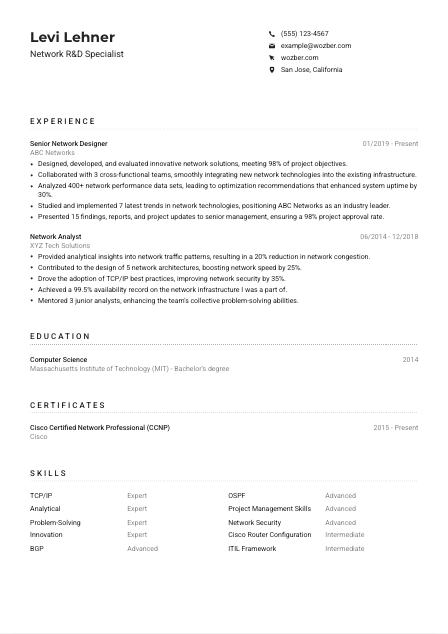
Deep into networks, but your CV seems disconnected? Explore this Network R&D Specialist CV example, created with Wozber free CV builder. Learn how to connect your research acumen with job expectations, forming a career path that's as fluid as your data flow!
Network R&D work sits where architecture, experimentation, and operational reality meet. Hiring teams want to see whether you can move from protocol-level knowledge to practical network design decisions, performance analysis, and recommendations that improve reliability, scalability, or adoption of new technology.
That becomes much easier to judge when the CV mirrors the language of the role and keeps the technical story easy to parse. Wozber's free CV builder helps shape that content into an ATS-compliant CV, so keywords such as TCP/IP, BGP, OSPF, network optimisation, and cross-functional integration surface clearly for both automated screening and the people deciding whether you can lead meaningful network innovation.
For a Network R&D Specialist, the header needs to do more than identify you. It should immediately confirm role alignment, professional credibility, and any practical requirement that could affect interview selection, including location when a posting asks for it.
Place your name at the top in a clean, readable format. In technical hiring, reviewers often skim quickly before moving into architecture experience, protocol knowledge, and research work, so your header should be unmistakable at first glance.
If you are applying for a Network R&D Specialist opening, use that title directly under your name when it reflects your background. This helps frame the rest of your CV around network design, R&D, and performance analysis rather than broader infrastructure or support work.
List a phone number and email address that you actively monitor. Senior or specialist network roles often move through multiple interview rounds involving engineering managers and cross-functional stakeholders, so missed messages can slow the process.
Some network roles require local presence because of lab access, on-site collaboration, or infrastructure responsibilities. Here, the San Jose, California requirement should appear clearly in the personal details section if it applies to you.
Include a LinkedIn profile, portfolio, or professional site only if it reinforces your CV. For this field, the most useful links usually show network architecture work, technical publications, project summaries, certifications, or conference participation.
A Network R&D Specialist CV should keep attention on technical capability, project outcomes, and role requirements. Personal details such as age, marital status, or unrelated identifiers do not improve that picture and should be omitted.
This section should remove friction, not add it. If your header clearly shows who you are, how to reach you, and whether you meet practical requirements such as location, the reader can move straight to the network work that matters most.




In this field, experience is judged by the quality of the technical work and the outcomes it produced. A hiring manager wants to see how you designed solutions, evaluated performance data, worked across teams, and turned research or analysis into network improvements that held up in real environments.
Start by identifying the capabilities the employer is asking for, then make sure your bullets reflect those same areas if you have done them. For this kind of role, that usually means network design, architecture, protocol knowledge, optimisation work, collaboration with engineering teams, and reporting findings to decision-makers.
Use reverse chronological order and give each role a clean structure with title, company, and dates. That makes it easier to follow your progression from analyst or engineer work into more advanced design, architecture, or R&D responsibilities.
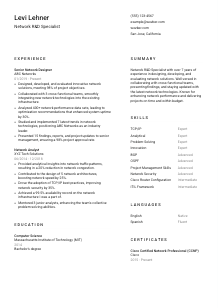
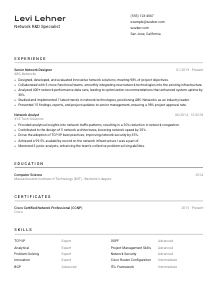
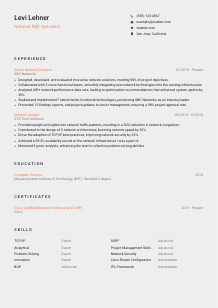
Network R&D CVs benefit from metrics that reflect engineering impact. Good examples include uptime gains, congestion reduction, latency improvements, throughput increases, project objective completion, adoption of new technologies, or the volume of performance data analysed. In the sample CV, results such as enhancing uptime by 30% and analysing 400+ data sets make the work far more concrete.
Do not stop at listing tasks. Explain what changed because of your contribution. That could mean integrating new routing approaches, improving security through TCP/IP best practices, supporting better availability, or helping the organisation adopt emerging network technologies. These are the results that separate research-oriented network work from routine maintenance.
Keep your experience section focused on work that supports a Network R&D Specialist position. Older roles or side duties can stay brief unless they directly strengthen your case in areas like protocol expertise, network architecture, experimentation, optimisation, or technical leadership.
After this section, a reviewer should understand the level of network complexity you have handled, the technologies you worked with, and the business or operational outcomes your design and analysis produced.
For a Network R&D Specialist, education usually establishes the technical foundation behind later architecture and research work. It matters most when it clearly supports your understanding of computing, networking concepts, and analytical problem-solving.
Lead with the degree that best matches the role's baseline requirement. For this posting, a bachelor's degree in Computer Science, Information Technology, or a related field is the expected starting point, so that should be easy to spot.
Keep the education entry straightforward. Technical CVs already carry a lot of dense information in the experience and skills sections, so your degree details should be easy to read in one line or a short block.
If your coursework, capstone, or academic focus included networking, distributed systems, computer architecture, or performance analysis, mention it when it strengthens your fit. This is especially useful for candidates whose early-career experience is lighter on design ownership.
Projects, lab work, thesis research, or university collaborations can help if they show network experimentation, architecture thinking, or analytical rigor. For a more experienced candidate, these details should stay selective and support the main story rather than compete with professional achievements.
Academic honors, leadership roles, or notable distinctions can stay if they support your technical credibility, but they should not crowd out more relevant professional proof. As experience grows, the education section should become tighter.
This section needs to confirm that you meet the role's academic requirement and support the technical depth shown elsewhere. Once that is clear, let your architecture work, protocol knowledge, and results carry the heavier weight.
In network R&D hiring, certifications can reinforce that your knowledge is current and grounded in recognized standards. They are especially useful when the role calls for specific platform expertise or advanced networking competence, as this one does with CCNP.
When a posting specifically asks for CCNP or an equivalent credential, list that certification prominently. It immediately supports your credibility in routing, switching, and network implementation at a level relevant to specialist work.
Choose certifications that reinforce your value in network architecture, design, security, or advanced administration. A shorter list of directly relevant credentials is more persuasive than a long list of unrelated coursework badges.
Dates help show whether a certification is current, active, or part of a longer pattern of professional development. In the sample CV, listing CCNP with an active date range gives the reviewer a clearer sense of currency.
Network R&D changes with new standards, automation approaches, performance tooling, and infrastructure models. Updating this section with current certifications or advanced training shows that your knowledge is not frozen at the point when you first learned BGP, OSPF, or enterprise routing design.
Certifications work best when they support the same picture your experience already shows: that you can operate at a high level in network design, evaluation, and implementation, using standards that matter in production environments.
A Network R&D Specialist skills section should read like a focused technical inventory, not a generic list. Hiring teams scan here for protocol knowledge, analysis capability, architecture-related tools, and the supporting strengths needed to move projects from concept to deployment.
Pull the core technical requirements from the job description and reflect them naturally in your skills list. For this role, TCP/IP, BGP, OSPF, analytical problem-solving, and project management all deserve attention because they sit close to the actual work being hired for.
Do not limit the section to technical keywords alone. Network R&D specialists also need to interpret performance data, present recommendations, and work across teams that may include operations, security, systems, and management. That is why analytical ability, problem-solving, and project management belong beside routing and protocol knowledge.
Place the strongest and most relevant skills first. If a hiring manager is looking for someone who can evaluate new network solutions, they should see the protocol stack, architecture-related skills, and performance analysis capabilities before lower-priority tools or general IT terms.
This section should confirm that you speak the technical language of the role and have the practical abilities to apply it. When arranged well, it supports both ATS optimisation and a faster technical read from hiring managers.
Language skills matter most when they affect day-to-day collaboration, reporting, and stakeholder communication. For a Network R&D Specialist, that usually means documenting findings clearly, discussing technical tradeoffs with cross-functional teams, and presenting updates to management in a precise, professional way.
If the job description states that English proficiency is fundamental, list English clearly and use an accurate proficiency label. This matters because the role includes presenting findings, writing reports, and collaborating across functions.
Additional languages can be useful when teams, vendors, or stakeholders work across regions. They are not usually a deciding factor for network R&D roles, but they can strengthen your profile when communication across cultures or markets is part of the environment.
Avoid overstating your proficiency. Standard labels are enough as long as they are accurate and easy to interpret. Technical roles often require exact communication, and the way you describe language ability should reflect that same precision.
If the company operates across regions or the role involves global teams, multilingual ability can help with technical coordination, documentation reviews, or vendor communication. Include that context only if it genuinely adds value to your application.
Treat languages as supporting information, not a centerpiece, unless communication across multiple regions is central to the role. The main purpose here is to confirm required proficiency and show any additional range that could support teamwork.
For this role, language details should make one thing easy to confirm: that you can communicate technical findings clearly in the environments where the work gets done.
The summary sets the technical direction for the whole CV. In a few lines, it should establish your level of experience, the kind of network work you handle, and the outcomes or specialties that make your background relevant to the opening.
Before writing, identify the few requirements that truly define the position. Here, that includes network design and evaluation, protocol knowledge, analytical strength, collaboration across teams, and keeping pace with new network technologies.
Your first sentence should quickly establish who you are professionally. Mention your title or specialization, your years of experience, and the type of network environments or responsibilities you have handled.
Use the next line or two to show what distinguishes your work. That could be improving uptime, reducing congestion, integrating new technologies, or presenting recommendations that gain stakeholder approval. Keep the examples close to the responsibilities in the posting.
A summary should be short enough to scan quickly and specific enough to guide the reader into the rest of the CV. Avoid generic claims about being hardworking or results-driven when you could mention protocols, network design scope, or measurable performance improvements instead.
When your summary is doing its job, the reader enters the rest of the CV already expecting strong network design work, credible protocol knowledge, and practical R&D contributions backed by results.
A Network R&D Specialist CV should leave little doubt about three things: your depth in network design and analysis, your command of protocols and architecture concepts, and your ability to turn research or evaluation into measurable improvements. Wozber's AI CV builder can help you tighten that alignment, organise your content in an ATS-friendly CV format, and surface the keywords and phrasing that matter for the role.
Before you apply, run one more check on the details that drive selection for this kind of position: years of relevant experience, protocol expertise, certification match, measurable network outcomes, and any stated requirement such as location or English proficiency. The final version should make your readiness for advanced network R&D work easy to judge.




