



Use Wozber and land your dream job
Create CV
No registration required
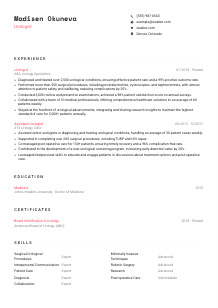
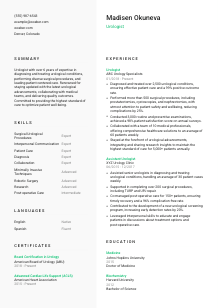
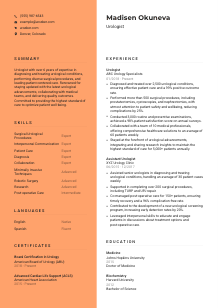
Delving into bladders and but a urologist CV is nowhere in sight? Probe into this Urologist CV example, crafted with Wozber free CV builder. Understand how to surgically align your specialty with job requisites, ensuring your career stays as fluid as urine flow!
Urology hiring tends to move quickly once a CV makes the right things easy to see. Hospitals and specialty groups want a physician who can manage a broad patient panel, perform procedures safely, and communicate clearly with patients and referring clinicians. Your CV should show that clinical judgment, procedural scope, and patient outcomes are already part of your day-to-day practice.
Screening often narrows first on specialty credentials, procedure experience, and whether your background matches the practice's case mix. Wozber's free CV builder helps shape that information into an ATS-compliant CV, so board status, surgical techniques, and patient-care results are easy to read by both hiring teams and applicant tracking systems. That makes it easier for a practice to quickly understand where you can contribute from day one.
In physician hiring, the top of the CV should answer practical questions fast. A medical group does not need flair here. It needs accurate identity, clean contact information, and any location detail that affects scheduling, licensing, or relocation planning.
Use your full name exactly as it appears on your medical credentials and licensure records. Keep it prominent and easy to scan. For physicians, consistency matters because recruiters may cross-check your CV against board certification, hospital privileges, publications, or state licensing information.
Place "Urologist" directly under your name unless you are targeting a more specific variation such as Pediatric Urologist or Reconstructive Urologist. Mirroring the role title helps position your application correctly at first glance and keeps your CV aligned with the language used in the posting.
List a reliable phone number and a professional email address. Double-check both. Physician hiring often involves credentialing coordinators, practice administrators, and medical directors, so missed calls or an unprofessional email address can create unnecessary friction in a process that already includes multiple review stages.
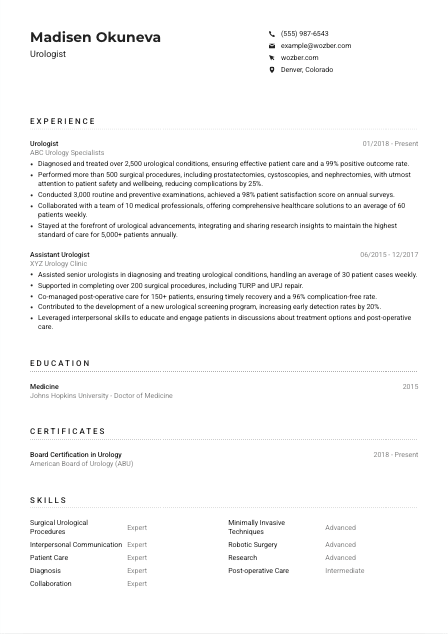
If the employer specifies a location requirement, include your city and state or note relocation readiness. In the example, listing Denver, Colorado directly supports a stated requirement and removes an avoidable question early in the review process. Use that approach when geography affects immediate eligibility or interview logistics.
Include a LinkedIn profile, professional webpage, or publication page only if it reinforces your clinical identity. For a urologist, useful links might show academic appointments, research, conference presentations, or physician profile details that match the scope described in your CV.
Your personal details should remove administrative doubt in seconds. A hiring team should be able to see who you are, how to reach you, and whether location creates any barrier to moving forward.




The experience section carries the most weight on a Urologist CV. This is where a practice looks for the kind of patients you treat, the procedures you perform, the pace you can sustain, and the results you achieve with colleagues across surgery, imaging, anesthesia, and follow-up care.
Start by marking the responsibilities and requirements that define the role. Here, that includes diagnosing and treating urological conditions, performing procedures such as prostatectomies, cystoscopies, and nephrectomies, interpreting tests, and collaborating across care teams. Build your bullets around those real duties instead of relying on generic physician language.
List positions in reverse chronological order with job title, employer or practice name, and dates. That format helps reviewers quickly understand your post-residency timeline, attending-level experience, and progression from support or assistant roles into independent surgical and patient-care responsibility.
Choose bullet points that show both scope and result. The example works because it does not stop at broad claims. It shows 2,500+ diagnosed and treated conditions, 500+ surgeries, and measurable patient outcomes. That combination gives a far clearer picture of practice volume and effectiveness than general statements about providing excellent care.
Use numbers that reflect how your performance is actually evaluated: procedure volume, complication rates, patient satisfaction, weekly case load, screening impact, or post-operative outcomes. Metrics like a 25% reduction in complications or a 20% increase in early detection rates are especially strong because they connect your work to safety and clinical value.
Keep the section tightly focused on relevant clinical work. Prioritise attending, fellowship, and closely related physician experience over unrelated early-career roles. If you include supporting positions, frame them around diagnostic exposure, procedural assistance, post-operative care, or program development that still strengthens your case for the target practice.
By the end of this section, a reviewer should understand the complexity of your patient population, the procedures you can handle, and the outcomes you help deliver. That is the core of a credible Urologist CV.
For physicians, education is not a decorative section. It confirms the foundation of your practice. Medical groups use it to verify degree level, training path, and whether your background supports the specialty work described elsewhere on the CV.
When a posting asks for a medical degree and urology residency, make those elements easy to find. Your Doctor of Medicine should appear before earlier degrees, and if your CV format allows it, your residency training should be visible as well because it directly supports specialty qualification.
List degree, field, institution, and graduation year in a standard order. Clean structure matters here because reviewers may be checking your academic path quickly alongside board status, years since training, and whether your background aligns with the practice's care model.
Use exact educational wording such as "Doctor of Medicine" rather than abbreviations only. If your training included a urology residency or subspecialty focus, make that explicit. In a field where training path matters, specificity carries more value than abbreviated shorthand.
Additional detail can help when it relates directly to the role. Relevant examples include urology research, surgical training distinctions, or academic work in oncologic, reconstructive, or minimally invasive care. Add these only if they sharpen your specialty story instead of crowding the section.
If you held leadership roles, earned honors, or contributed to specialty research groups during medical school or residency, include the strongest items. For academic or research-oriented practices, these details can reinforce your engagement with the field beyond required training.
Your education section should confirm that your path into urology is solid, relevant, and easy to verify. Save the deeper clinical story for experience, but make the credentials unmistakable here.
In urology, certification is one of the first filters. Practices want to know whether you meet specialty standards now or are on a clear path to doing so. List credentials in a way that answers that question immediately and shows ongoing clinical currency.
If the role asks for Board Certification or board eligibility in Urology, lead with that credential. It is a primary screening item, not a secondary detail. Make it one of the first certifications visible so reviewers do not have to hunt for it.
Include certifications that support your present scope of practice. "Board Certification in Urology" belongs here immediately. Credentials such as ACLS can also support your profile, especially when your work includes surgical care, perioperative responsibility, or hospital-based practice.
Dates matter because they help a recruiter or medical administrator understand whether a credential is current, active, or recently obtained. The example handles this well by showing ongoing board certification status rather than listing the credential without timeframe.
If you complete training related to robotic surgery, minimally invasive techniques, men's health, stone disease, or updated procedural protocols, include the most relevant items. Urology evolves through technology, research, and technique, so ongoing development supports your candidacy.
This section should quickly confirm that you meet the specialty bar and stay current in practice. For many employers, that clarity affects whether the CV moves forward to physician review or credentialing discussions.
A Urologist skills section works best when it reflects real practice. Recruiters and medical leaders are looking for a mix of procedural ability, diagnostic competence, patient communication, and collaboration across the care team, not a long inventory of vague strengths.
Read the posting for both explicit and implied skills. In this case, surgical urological procedures, minimally invasive and robotic techniques, interpretation of imaging and lab results, and communication with patients and staff all belong near the top because they are central to daily work.
Your list should show the full practice profile. Hard skills might include robotic surgery, cystoscopy, nephrectomy, post-operative management, or diagnostic evaluation. Soft skills should reflect realities of the role, such as patient counseling, interdisciplinary collaboration, and clear communication during care planning.
Do not overload the section with every capability you have developed in medicine. Prioritise the abilities most relevant to the opening. The example is effective because it foregrounds surgical procedures, patient care, diagnosis, and robotic techniques rather than filling space with generic competencies.
A reviewer should be able to scan this section and immediately picture the kind of urology practice you can support. Relevance matters more than length.
Language proficiency matters more in medicine than in many other fields because it affects informed consent, treatment discussions, post-operative instructions, and teamwork across clinical settings. Present your language skills in a way that supports safe communication and practical patient care.
If the job specifically requires English proficiency, list English first and state your level clearly. That directly answers a stated requirement and signals that you can handle patient conversations, documentation, and collaboration with medical staff in the expected language.
For physician roles, the main working language should never be buried. If English is native or fluent, place it at the top of the section. Hiring teams need to know quickly that you can manage consultations, charting, and care coordination without a communication barrier.
Additional languages can strengthen your application when they help with a diverse patient population. In the example, Spanish adds practical value because it can support patient education, treatment explanations, and follow-up discussions in many clinical settings.
Describe proficiency with straightforward labels such as Native, Fluent, Conversational, or Basic. In a medical setting, overstating language ability can create real clinical risk, especially when discussing symptoms, consent, or post-operative instructions.
Even when not required, another language can support rapport, access, and patient understanding. That matters most when it reflects how you actually practice, whether in consultations, community outreach, or coordination with families and caregivers.
This section should show whether you can communicate safely and effectively with the patient population and care team the role involves. Keep it accurate and easy to interpret.
The summary sets the clinical tone of the CV. For a Urologist, it should quickly establish years of practice, specialty scope, procedural strength, and the kind of patient care you are known for. It needs to read like a physician profile, not a generic career objective.
Start by identifying the patterns in the job description. Here, the employer wants post-residency experience, surgical capability, strong communication, and up-to-date clinical practice. Those points should shape the summary instead of broad statements about passion or dedication.
Your first line should clearly state that you are a Urologist and include your level of experience. A phrase such as "Urologist with 6+ years of experience" gives immediate context and helps the reader place the rest of the CV.
Use the next lines to connect your strongest qualifications to the opening. The example does this well by combining diagnosis and treatment, diverse surgical procedures, team collaboration, and patient-centered care. If your background includes robotics, oncology, stone disease, or reconstructive work, bring in the specialties most relevant to the role.
Aim for a summary that is brief enough to scan quickly but detailed enough to feel grounded. Three to five lines is usually enough to cover your specialty identity, years of experience, procedural or clinical strengths, and a clear patient-care focus without repeating the experience section.
After reading these lines, a hiring team should already understand your level, your core urology strengths, and the kind of care environment you are prepared to step into.
A well-tailored Urologist CV should now show the essentials clearly: training, board status, procedural capability, patient-care results, and communication strength. When those pieces are expressed in the same language the employer uses, your background becomes much easier to evaluate in a busy physician hiring process.
Wozber's free CV builder can help you organise that story in an ATS-friendly CV format, refine role-specific wording with AI support, and use its ATS CV scanner to check alignment with the posting before you apply. The finished CV should make one thing clear right away: you are ready to deliver safe, effective urologic care in the setting you are targeting.




