



Use Wozber and land your dream job
Create CV
No registration required
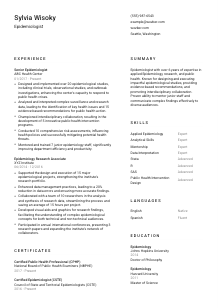
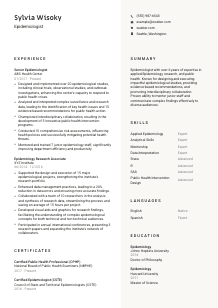
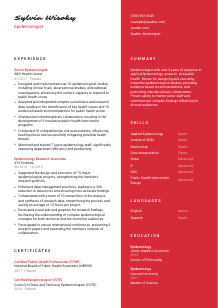
Unraveling health mysteries, but your CV is feeling obscure? Check out this Epidemiologist CV example, built with Wozber free CV builder. It shows how to match your disease-detecting expertise to job prerequisites, ensuring your career trajectory stays well-mapped within the realm of public health!
Epidemiology work is judged in real-world outcomes. Hiring teams want to see whether you can turn surveillance data, study design, and risk assessment into decisions that protect communities, inform programs, and hold up under scientific scrutiny. Your CV should make that visible quickly, especially if your background spans research, outbreak response, clinical studies, or public health operations.
A tailored CV changes how your experience is read. When your summary, skills, and experience use the same language as the posting, it becomes much easier to distinguish applied epidemiology work from broader research support or general public health analysis. Wozber's free CV builder helps you shape that alignment into an ATS-compliant CV, so your study design, statistical software fluency, and public health recommendations are easy to recognize from the first scan.
For epidemiology roles, the header does not need personality flourishes. It needs to establish professional identity, accurate contact access, and any practical detail that affects eligibility, such as location when the posting names it. Keep this section clean so the hiring team can move straight to your technical and public health experience.
Use your full name as the most prominent text in the header. In a field where publications, conference presentations, surveillance reports, and cross-agency work often matter, consistency in how your name appears helps employers connect your CV with your broader professional record.
Place "Epidemiologist" directly under your name if that is the role you are pursuing. This immediately frames the rest of the document around study design, data analysis, outbreak investigation, and public health action rather than leaving your profile to be interpreted as a general research or analyst background.
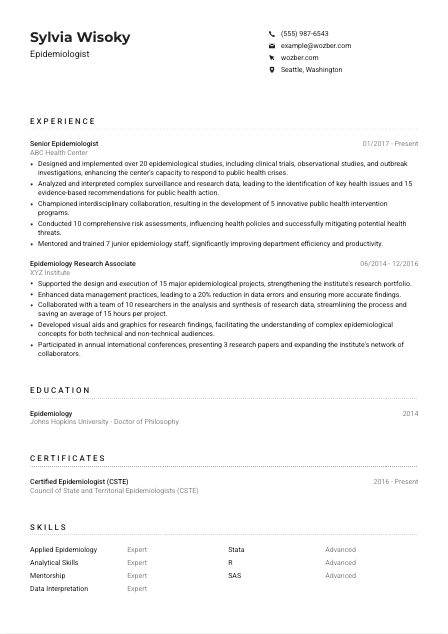
If the posting specifies a location requirement, include your city and state. Here, Seattle, Washington is worth stating because it addresses a practical hiring filter right away. If you are relocating, make that clear in a way that removes doubt without turning the header into a full explanation.
Include LinkedIn or a professional site if it strengthens your candidacy with publications, presentations, research projects, or public health work. Make sure it matches your CV in titles, dates, and credentials. For an epidemiologist, even a short profile with study topics, software, and conference activity can add useful depth.
Your personal details should answer the practical questions immediately: who you are, what role you are targeting, how to reach you, and whether any stated location requirement is already covered. Once that is clear, the rest of the CV can focus on your epidemiology work.




This section carries the most weight for an epidemiologist because employers need to see how you have used methods, data, and judgment in actual public health or research settings. The strongest entries show the type of studies you handled, the datasets or surveillance work involved, the recommendations you produced, and the effect those recommendations had on programs, policy, or response efforts.
Start by marking the duties that define the role. For this position, the important threads are applied epidemiology, study design, surveillance analysis, public health recommendations, risk assessment, and mentorship. Those themes should shape which bullets you keep, rewrite, or cut so the section reflects real overlap with the target role rather than a general research timeline.
Use reverse chronological order and make each entry easy to scan: employer, title, dates, and accomplishment bullets. That format helps hiring teams quickly trace your progression from research support into independent epidemiologic work, team leadership, or broader public health responsibility.
Each bullet should show what you investigated, what you analysed, and what changed because of your work. Good epidemiology bullets often mention study type, surveillance or research data, intervention design, policy input, or outbreak response. The sample CV does this well by naming clinical trials, observational studies, outbreak investigations, and evidence-based recommendations instead of relying on vague phrases like "responsible for analysis."
Metrics help employers understand scale and credibility. In this field, that can mean number of studies designed, recommendations delivered, risk assessments completed, staff mentored, time saved in data workflows, or error rates reduced. The example's "over 20 epidemiological studies" and "20% reduction in data errors" work because they reflect common measures of scope and operational improvement in epidemiology teams.
Prioritise experience that supports applied epidemiology in a public health context. If older work leans more toward general lab support, academic administration, or unrelated analysis, trim it or reframe it around methods and outcomes that still matter here. Hiring teams should be able to see, within seconds, that your background lines up with study execution, interpretation of findings, cross-functional collaboration, and public health decision support.
Your experience section should make it easy to picture you designing studies, analysing surveillance data, advising interventions, and guiding junior staff. If the bullets show scope, methods, and public health impact in plain language, the match becomes much easier to recognize.
Academic training matters in epidemiology because employers are often hiring for work that depends on study design, biostatistics, causal reasoning, and population health methods. Your education section should show that foundation clearly, especially when the posting sets a minimum degree level in epidemiology or a related field.
If the job asks for a master's or doctoral degree in Epidemiology or a related field, make sure your highest relevant credential is impossible to miss. A doctorate in Epidemiology or a master's in the same field immediately confirms formal preparation for analytic and applied public health work.
List degree, field, institution, and graduation year in a clean structure. That is usually enough for experienced epidemiologists. Clear formatting matters more than extra explanation, especially when reviewers are quickly checking for field relevance and level of study.
Use the official wording of your degree and field. If your credential is "Master of Science in Epidemiology" or "Doctor of Philosophy in Epidemiology," say so directly. That kind of exact alignment helps when the role explicitly names Epidemiology as the preferred academic background.
Early-career candidates can include thesis topics, capstone work, or advanced coursework in areas such as infectious disease epidemiology, biostatistics, surveillance systems, or clinical research methods. For someone with several years of applied experience, these details are usually only worth adding if they closely match the target work.
Honors, fellowships, or research activities can stay if they support your epidemiology profile. Choose details that reinforce scientific training, publication activity, or public health engagement rather than filling space with unrelated campus involvement.
This section should confirm that you meet the role's academic threshold without forcing a reviewer to search for it. When the degree, field, and institution are clearly presented, your formal training supports the rest of your applied epidemiology story.
Certifications can carry real weight in epidemiology, especially when a posting names one directly. They show current professional standing and, in some cases, can move you past an early screening checkpoint before your experience is reviewed in detail.
If the employer asks for an active epidemiology certification, place it near the top of this section and use the full credential name. In this case, a CSTE certification should be easy to spot because it is a stated requirement, not a nice-to-have.
List certifications that support epidemiology, public health practice, research compliance, or related analytical work. A shorter list of directly relevant credentials is usually stronger than a long list of loosely connected courses or one-time trainings.
Include issue dates and, when relevant, active date ranges or renewal status. That matters for certifications tied to current practice because hiring teams may need to confirm that the credential is still valid.
Public health methods, surveillance standards, and reporting expectations change over time. Updated certifications can reinforce that you stay engaged with current practice, whether through epidemiology credentials, public health certifications, or specialised training that supports your target role.
A clearly presented certification section can answer an eligibility question in seconds. When a required credential is active and easy to find, reviewers can move on to judging your study work, analysis, and public health impact.
A useful epidemiologist skills section does more than repeat broad strengths. It should reflect how the work gets done: statistical analysis, interpretation of surveillance data, study execution, communication of findings, and collaboration with public health or clinical teams. Choose skills that connect directly to those workflows.
Read the job description for explicit requirements and implied day-to-day work. Here, statistical software, analytical strength, communication across audiences, and applied epidemiology all deserve space because they sit at the centre of the role.
List software such as Stata, R, or SAS only if you can work in them comfortably. Add methodological strengths that belong in epidemiology, such as outbreak investigation, surveillance analysis, study design, risk assessment, or data interpretation. The sample CV balances both by pairing software skills with applied areas like public health intervention design.
Place the most job-relevant capabilities first instead of mixing core requirements with lower-value extras. For many epidemiologist roles, applied epidemiology, statistical analysis, surveillance interpretation, and communication of findings should appear before generic workplace traits. That ordering helps both ATS parsing and human review.
Your skills section should read like the toolkit of someone who can investigate health events, analyse data responsibly, and translate findings into action. If the listed tools and methods match the posting and your experience supports them, this section does its job well.
Language ability matters differently across epidemiology roles. Some positions need only clear English communication for reports, stakeholder briefings, and team collaboration. Others benefit from additional languages that support community engagement, field work, or multilingual health communication. Present this section according to what the job actually asks for.
If the posting states English proficiency, list English clearly and use an accurate proficiency level. This is especially important for roles that involve writing findings, presenting recommendations, and translating technical analysis for non-technical audiences.
Lead with your native or strongest professional language so there is no ambiguity about your communication baseline. For epidemiologists, that affects everything from technical documentation to partner meetings and training sessions.
Additional languages can be valuable in community-based studies, public health outreach, and cross-cultural communication. If you speak another language well, include it. In the example, Spanish adds useful context because it can support broader public health communication, though it is not a universal requirement for every epidemiologist position.
Choose ratings that reflect how you actually communicate, whether that means native, fluent, conversational, or basic. Overstating language ability can create problems quickly in interviews, stakeholder settings, or field assignments.
If the employer works with multilingual communities, refugee health, international populations, or region-specific outreach efforts, language skills may deserve more visibility. If not, keep this section concise and factual.
List language skills when they answer a stated requirement or add credible value to the work. For epidemiology roles, clarity matters more than volume. One required language stated accurately is better than a long list with inflated proficiency.
The summary is where you establish your level, focus, and relevance before the reader reaches the details. For an epidemiologist, that usually means naming your years in applied work, the kind of studies or public health environments you know well, and the analytical or communication strengths that match the role.
Pull out the few themes the employer cares about most and build the summary around them. In this case, applied epidemiology, public health setting experience, statistical software, data interpretation, and communication across audiences are stronger anchors than generic statements about being results-driven.
Start with your professional identity and years of experience. A line such as "Epidemiologist with 6+ years of experience in applied epidemiology and public health research" works because it gives immediate context and positions the rest of the summary around field-relevant work.
Use the next sentences to highlight the parts of your background that map most closely to the job, such as designing epidemiologic studies, analysing surveillance data, producing evidence-based recommendations, or mentoring junior staff. The sample summary works because it stays close to those priorities instead of trying to cover every accomplishment.
Aim for 3 to 5 sentences with enough detail to separate you from adjacent profiles like public health analysts, research coordinators, or biostatistics support staff. Short summaries work best when every phrase points to applied epidemiology, technical competence, and practical public health contribution.
By the time someone finishes your summary, they should understand your level of epidemiology experience, the kind of analytical work you handle, and the value you bring to public health decisions. That gives the rest of the CV a clear frame.
An effective epidemiologist CV makes three things easy to confirm: you meet the academic and certification requirements, you can work with epidemiologic data and methods in practice, and your findings have informed real public health action. Review each section with that standard in mind, then cut anything that does not support it.
Wozber can help you turn that review into a sharper final draft. Use Wozber's free CV builder, ATS-friendly CV templates, and ATS CV scanner to align your language with the posting, strengthen ATS optimisation, and present your work in a clean format that highlights study design, analysis, and public health impact. The finished CV should make your readiness for the role easy to judge.




