




Use Wozber and land your dream job
Create CV
No registration required
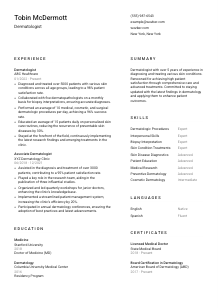
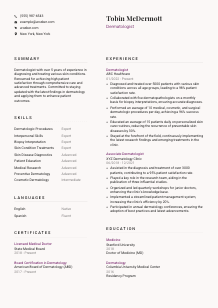
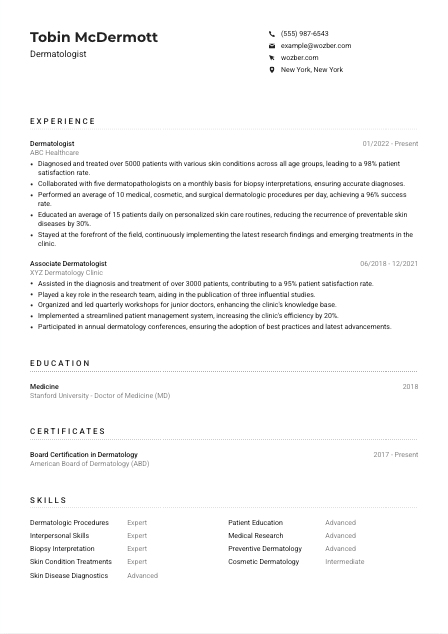
Scripting skin solutions, but your CV looks patchy? Check out this Dermatologist CV example, created with Wozber free CV builder. It shows how you can smoothly align your clinical credentials with job requirements, ensuring your career glows with the radiance of a well-nurtured complexion!
Dermatology CVs are reviewed through a clinical lens. Hiring teams want to see whether you can evaluate lesions accurately, manage medical and procedural treatment plans, communicate clearly with patients of different ages, and work comfortably with biopsy workflows, follow-up care, and prevention counseling. A CV for this specialty needs to make that day-to-day practice visible quickly.
When the content is tailored well, your background reads less like a general physician profile and more like a dermatologist who can step into clinic flow, patient education, and procedure volume with confidence. Wozber's free CV builder helps organise that experience into an ATS-compliant CV, so core terms like board certification, dermatologic procedures, biopsy interpretation, and skin condition treatment are easy to surface for both screening systems and medical hiring teams.
For physicians, the header is brief but important. It should confirm who you are, how to reach you, and, when relevant, whether you already meet practical requirements that could affect interview consideration.
Use your full name in a larger, clean font so it is easy to identify at a glance. For a dermatologist, the header should feel professional and clinical, consistent with how your name appears on licenses, board records, and publications if you include them elsewhere.
Place the role title directly under your name and match the wording of the opening when it fits your background. If you are applying for a Dermatologist position, say "Dermatologist" rather than a broader label like "Physician." That immediately frames the rest of the CV around skin exams, procedures, patient management, and specialty training.
List a current phone number and a professional email address that you check regularly. Medical hiring can move quickly when a clinic needs coverage, procedural support, or a full-time addition, so accuracy matters. If you maintain a professional site or profile with publications, speaking work, or clinical interests, include it only if it is current and relevant.
If the posting requires local presence, include your city and state. In the example role, "New York, New York" helps confirm that a location-specific requirement is already met. Use this only when it genuinely supports your candidacy, especially for positions tied to licensing, in-person clinic schedules, or immediate start expectations.
A LinkedIn page, physician profile, or personal website can strengthen this section if it reflects your clinical work accurately. Focus on useful content such as board status, practice areas, publications, presentations, or patient education interests. Skip outdated links or anything that looks more promotional than professional.
This section should confirm the basics without distractions. A clear title, accurate contact details, and any relevant location match make it easier for the employer to move on to the parts that prove your dermatology practice.




In dermatology, experience is where employers look for proof of judgment, treatment breadth, procedural confidence, and patient-facing care. Your bullets should show what kinds of cases you handled, how you worked with other specialists, and what outcomes followed from your care.
Read the job description and pull out the actual work: skin examinations, diagnosis, treatment across age groups, dermatologic procedures, patient education, and collaboration on biopsy interpretation. Then make sure your bullets speak to those activities directly. In the example CV, diagnosing and treating thousands of patients and working with dermatopathologists maps closely to what the employer asked for.
List your most recent position first with job title, employer, and dates. This format works well for physicians because it lets employers track your clinical progression quickly, from associate roles to independent practice, higher procedure volume, or broader responsibility in patient management and research participation.
Generic lines like "responsible for patient care" miss the point. Show what you treated, performed, improved, or coordinated. A stronger bullet names the patient population, clinical activity, and outcome, such as managing a high volume of skin condition diagnoses, performing daily medical and cosmetic procedures, or reducing recurrence through patient education on preventive skin care.
Numbers work especially well in medical CVs when they reflect real clinical scope. Patient volume, procedure count, satisfaction scores, recurrence reduction, research output, or efficiency improvements all help employers gauge your pace and impact. The sample CV does this effectively with figures like 5000+ patients treated, 10 procedures per day, and a 30% reduction in preventable disease recurrence.
Keep the section focused on specialty-relevant work. If a bullet does not support your clinical judgment, procedural ability, patient communication, interdisciplinary collaboration, or contribution to dermatology operations, it likely does not belong. This is where specialization should be obvious line by line.
Employers should finish this section with a clear sense of your case volume, treatment range, procedure experience, and patient care style. That is what turns a listed job title into a credible dermatology hire.
Dermatology hiring starts with training credibility. Your education section should make the medical school degree, specialty residency, and academic progression easy to follow without forcing the reader to piece together your qualifications.
For this specialty, the essential credentials belong at the top. Include your MD or DO from an accredited medical school and your dermatology residency clearly. The job description specifically asks for both, so those entries should be impossible to miss.
List school, degree, field, and graduation year in a consistent format. Reverse chronological order usually works best, especially when your residency is central to the role. In physician hiring, clarity beats creativity every time.
Be specific about your residency rather than leaving it implied. Writing "Residency Program, Dermatology" or the exact institutional wording makes your post-graduate preparation easy to identify. In the example, the dermatology residency entry directly supports the employer's minimum training requirement.
Most experienced dermatologists do not need to list courses. Early-career candidates may benefit from including advanced dermatopathology exposure, surgical dermatology rotations, research concentrations, or other specialty-specific training when it adds context that the work history has not yet established.
Honors, research recognition, leadership roles, or medically relevant extracurriculars can add value if they support your specialty profile. Keep them tied to dermatology, medicine, or clinical leadership rather than filling space with general student activities.
This section should leave no doubt that you completed the medical and specialty path required for dermatology practice. If the employer can confirm that in seconds, the rest of the CV gets read in the right context.
In a physician CV, certifications do more than decorate the page. They confirm that you meet the professional standard to practice, maintain specialty standing, and treat patients with current credentials.
Start with the certifications or licenses most relevant to the opening. For a dermatologist, board certification from the American Board of Dermatology, or clearly stated board eligibility if that is your status, should appear before less relevant credentials. That matches a core requirement in the posting immediately.
If you hold several credentials, feature the ones that affect your ability to practice in the role. State medical licensure, dermatology board certification, and any meaningful subspecialty or procedure-related credentials belong ahead of broader training certificates or general CME records.
Dates help employers understand whether a certification is active and current. This matters for board certification, licensure, and any credential with renewal cycles. In the sample CV, date ranges such as "2017 - Present" and "2018 - Present" make ongoing status easy to read.
Dermatology changes with new therapies, procedural techniques, and diagnostic guidance. If your certifications or continuing education reflect current engagement with the field, that supports the employer's expectation that you stay up to date with research and emerging treatments.
A well-ordered certifications section tells the employer that your specialty standing is current, relevant, and easy to verify. That matters in a field where clinical authority and patient safety are inseparable.
The skills section should read like the working toolkit of a dermatologist, not a generic physician keyword list. Focus on competencies that connect directly to diagnosis, treatment decisions, procedures, patient communication, and clinical collaboration.
Start with the language in the posting and translate it into skill terms you genuinely use. This may include skin condition diagnosis, dermatologic procedures, patient education, preventive dermatology, biopsy coordination, or collaboration with dermatopathologists. That keeps the section aligned with both ATS screening and the realities of clinic work.
Only include strengths you can support elsewhere on the CV. If you list Dermatologic Procedures, Skin Disease Diagnostics, or Patient Education, your experience bullets should show procedure volume, diagnostic range, or measurable education outcomes. The example CV does this well by pairing skills with treatment counts, procedure success rates, and recurrence reduction.
Group the most relevant skills near the top, especially the ones tied to the opening. Specialty-specific clinical abilities should usually come before broad soft skills. Interpersonal strength matters in dermatology, but it lands better when it sits beside patient counseling, treatment planning, and diagnostic work rather than replacing them.
A hiring team should be able to scan this list and recognize the profile of a practicing dermatologist. Prioritised correctly, your skills reinforce the clinical scope already shown in experience, training, and certification.
Dermatology is highly visual, but patient care still depends on clear conversation. Language skills matter when you are explaining diagnoses, discussing biopsy results, giving skin care instructions, or helping patients follow long-term treatment plans.
If the job asks for English fluency, make that easy to find. Use a direct proficiency label such as "Native" or "Fluent" based on your actual ability. For this opening, English belongs at the top because it is a stated requirement and central to patient communication and documentation.
Additional languages can be a real advantage in dermatology, especially in practices serving diverse communities. If you can discuss symptoms, aftercare, prevention, and follow-up instructions in another language, include it. The sample CV lists Spanish fluency, which would be useful in many urban clinical settings, though it is not a universal requirement.
Be accurate about what you can actually do in a medical context. There is a big difference between basic conversational ability and being able to discuss treatment options, informed consent, or medication use. Choose labels that reflect real patient-facing competence.
This section carries more weight when the language skill supports better care. Multilingual communication can help with patient trust, education adherence, and accurate symptom reporting, particularly in outpatient dermatology where prevention and follow-up instructions matter.
Think about the population you serve or hope to serve. In some settings, one additional language can improve continuity of care and patient satisfaction meaningfully. Include languages that strengthen your value in that context, rather than listing every partial familiarity.
Language skills matter most when they improve patient understanding and follow-through. Presented clearly, they add another practical layer to your ability to deliver effective dermatologic care.
The summary should give a quick, grounded picture of your clinical identity. For dermatology, that usually means years in practice, core treatment scope, procedural or diagnostic strengths, and one clear point about patient care, research, or outcomes.
Your summary should respond to the role, not repeat a generic professional bio. Review the posting for the biggest priorities, whether that is broad patient age coverage, procedures, board status, collaboration, or patient education, and reflect the most relevant points in your first few lines.
Start with a direct statement of who you are. A line such as "Dermatologist with over 5 years of experience" works because it establishes specialty and tenure immediately. From there, add one or two specifics that define your practice.
Choose details that mirror the role's demands, such as diagnosing and treating varied skin conditions, performing medical or cosmetic procedures, educating patients on prevention, or staying current with emerging treatments. In the sample summary, the emphasis on high patient satisfaction and updated clinical knowledge supports the rest of the CV well.
Aim for a short paragraph that can be read in seconds. Avoid vague traits and avoid retelling your full career. Focus on specialty, scope, and a few differentiators that make someone want to keep reading the experience section.
A focused summary helps the employer understand your practice before they read the details. For a dermatologist, that means making your experience level, treatment scope, and patient care strengths clear from the start.
A dermatologist CV works when it makes your medical training, board standing, diagnostic range, procedural work, and patient communication easy to connect. Each section should support the same conclusion: you can step into practice and deliver sound dermatologic care.
Use Wozber's AI CV builder to refine wording, strengthen ATS optimisation, and shape your experience into an ATS-friendly CV format that reflects the language of the role without losing clinical accuracy. The finished CV should make one thing clear quickly: you are prepared to treat patients, perform the work, and contribute as a dermatologist from day one.




