



Use Wozber and land your dream job
Create CV
No registration required
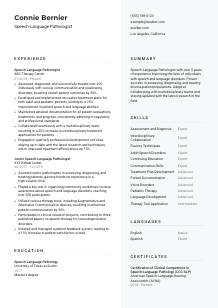
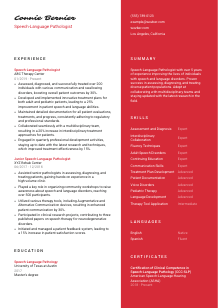
Unraveling communication quandaries, but your CV doesn't articulate your expertise? Try this Speech-Language Pathologist CV example, created with Wozber free CV builder. It shows how to present your interventions in line with job expectations, ensuring your career story resonates as clearly as your clients' speech.
Speech-language pathology work is judged in practice by clinical judgment, treatment planning, and the quality of patient progress you can support over time. Hiring teams want to see that your CV reflects real caseload experience with communication and swallowing disorders, accurate documentation, and collaboration with families, teachers, or care teams, not just a list of therapy settings.
A tailored CV changes how quickly your clinical scope becomes clear. When your wording mirrors the target role's terminology, an ATS-compliant CV built in Wozber's free CV builder helps surface matches such as assessment, diagnosis, treatment plans, and interdisciplinary care, so the employer can quickly understand where you have worked, which populations you serve, and how you contribute to outcomes.
In speech-language pathology, the header should confirm who you are, where you practice, and how to reach you without adding noise. Keep this section clean and professional so the hiring team can immediately connect your identity to licensed clinical work.
Use your full name in a larger, easy-to-read font so it anchors the page clearly. In healthcare CVs, clarity matters more than styling. Your name should sit above the rest of the header and immediately frame you as a clinician, not a general applicant.
Place "Speech-Language Pathologist" directly under your name if that is the role you are targeting. This helps both recruiters and ATS tools categorize your application correctly. If you hold a more junior title in your current role, you can still align your header with the target opening as long as the experience below supports it.
List a current phone number and a professional email, ideally based on your name. In a field where interview scheduling may move quickly between clinic hours, school calendars, or patient care blocks, easy contact details matter. If you include a website, make sure it points to something relevant, such as a professional profile or portfolio.
If the employer needs someone based in a specific area, include your city and state. Here, listing Los Angeles, California directly addresses a stated requirement. That location note is about availability and hiring logistics, not about claiming that one city automatically gives you stronger cultural or clinical competence.
Do not add age, marital status, photo, or other details unrelated to licensure, patient care, or employment eligibility. Speech-language pathology hiring decisions should focus on your qualifications, clinical experience, and communication skills. A focused header keeps attention there.
Your personal details should confirm that you are reachable, professionally presented, and aligned with the role's logistics. Once that is clear, the rest of the CV can focus on the work that matters most, your patient care, documentation, and treatment results.




This section carries the most weight because it shows how you practice, not just where you worked. For a speech-language pathologist, that means making your patient populations, treatment responsibilities, collaboration habits, and measurable outcomes easy to spot in each role.
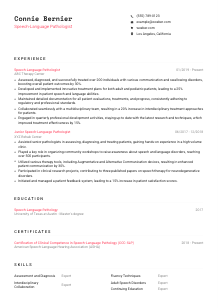
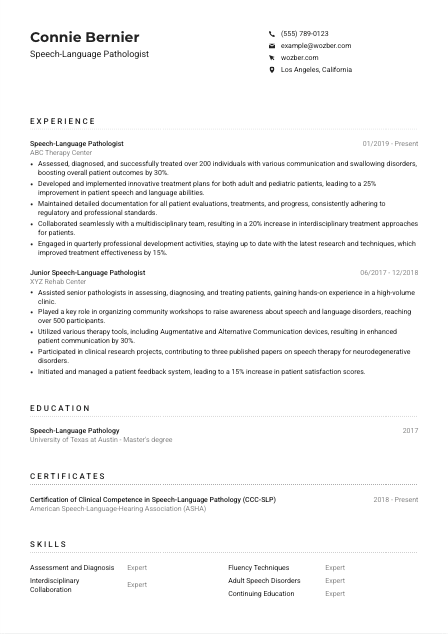
Start by identifying the clinical actions the employer repeats or emphasizes, such as assessing, diagnosing, treating communication and swallowing disorders, developing treatment plans, documenting progress, and working with interdisciplinary teams. Then shape your bullets so those same responsibilities appear naturally through your own work history. In the example CV, bullets around assessing and treating more than 200 individuals and maintaining compliant documentation map directly to the target role.
Use a consistent structure for every role: job title, organisation name, and dates in reverse-chronological order. That format helps hiring teams understand your progression from supervised or junior practice into more independent clinical work. It also improves ATS readability, especially when your roles span rehab, outpatient, school-based, or mixed settings.
Focus your bullet points on outcomes and scope, not generic duties. Good speech-language pathology bullets show volume, populations served, intervention areas, or treatment improvement. The sample does this well by pairing actions with results, such as improving patient speech and language abilities by 25% and increasing interdisciplinary treatment approaches by 20%.
Prioritise achievements tied to evaluation, treatment, progress tracking, caregiver communication, AAC use, swallowing care, pediatric language development, adult neurogenic disorders, or similar practice areas that match your target role. Cut bullets that do not add anything about your clinical judgment or service delivery. Every line should help the reader understand the kind of caseload and outcomes you can handle.
Do not stop at standard responsibilities. If you introduced a new therapy approach, improved documentation workflows, supported research, built patient education materials, or expanded community outreach, include it. In the example, organising community workshops and contributing to published research adds depth beyond direct treatment and helps show initiative within the profession.
Your experience section should read like a concise history of patient care, treatment planning, and professional growth. When the bullets show clinical scope and outcomes clearly, the employer can quickly picture you managing a caseload in their setting.
For speech-language pathology, education is a required credential, not a background detail. Your degree section needs to confirm that you meet the academic standard for practice and do it in a format that is immediate for both screeners and ATS systems.
If the posting asks for a Master's degree in Speech-Language Pathology, place that entry first and make the field of study unmistakable. This is one of the first requirements many employers check before they spend time on the rest of the application. In the example, the master's degree is listed clearly and directly matches the job description.
List the degree, field, school, and graduation year in a clean format. Hiring teams do not need long descriptions here unless a program detail is unusually relevant. They need to confirm that your academic background supports licensure and clinical training.
If you completed practica, research, or focused coursework in pediatric language disorders, dysphagia, neurogenic communication, AAC, voice, or fluency, include that only when it supports the target setting. Keep it selective. The goal is to reinforce your clinical preparation, not to recreate a transcript.
Honors, leadership roles, or major student projects can help if you are early in your career or if they connect to clinical work, research, or community service. For experienced clinicians, these details matter less unless they point to something distinctive, such as a thesis related to dysphagia management or bilingual language development.
Formal degrees belong in education, while ongoing CEUs, workshops, and specialty training often fit better in certifications or separate professional development mentions. If your post-graduate training is substantial and highly relevant, you can reference it here briefly, especially when a role values current practice methods and evidence-based care.
This section should remove any doubt that you meet the academic threshold for licensed speech-language pathology practice. Once the master's degree is clear, the employer can move on to the clinical experience and credentials that distinguish you.
In this profession, certifications and licenses are hiring filters, not optional extras. If the role requires active state licensure and CCC-SLP, those credentials should be impossible to miss on your CV.
List your CCC-SLP and your active state speech-language pathology license prominently. These are often checked early because they determine whether you can practice independently in the role. In the example, both the ASHA credential and the state license are listed clearly, which directly supports the posting's requirements.
Prioritise certifications that influence patient care, supervision eligibility, or hiring eligibility. A long list of minor workshop completions weakens this section. If you have specialty training in areas like dysphagia, AAC, autism, or voice, include it only when it adds meaningful clinical relevance.
Show when a credential was issued and whether it is current. In regulated healthcare roles, employers want to know your license and certifications are active now, not simply earned in the past. A date range such as "2018 - Present" works well when it accurately reflects active standing.
Speech-language pathology changes with research, reimbursement expectations, and treatment methods. If you have recent continuing education tied to your target population or setting, mention it to show that your practice stays current. That is especially useful when applying to employers who value evidence-based intervention and continuing education participation.
Your certifications section should confirm that you are licensed, professionally recognized, and current in your field. When these details are easy to find, the employer can move straight to evaluating your clinical judgment and treatment results.
A speech-language pathology skills section should read like a summary of your clinical toolkit. It works best when it combines treatment capabilities, evaluation strengths, documentation habits, and collaboration skills that match the setting you are targeting.
Start with the language used in the posting and translate it into skills you genuinely use. Here, that includes assessment and diagnosis, treatment planning, patient documentation, interdisciplinary collaboration, and strong written and verbal communication. The most effective skills lists mirror the role while staying grounded in actual practice.
Mix broad clinical strengths with specialties that help define your profile. A useful list might include fluency, voice, language development, dysphagia, cognitive-communication, pediatric therapy, adult speech disorders, or AAC, depending on your background. The example does this well by combining foundational skills such as assessment and diagnosis with population-specific strengths like pediatric therapy and adult speech disorders.
Do not overload this section with every method or soft skill you have ever used. Choose the abilities most relevant to the target role and present them in a clean sequence. Grouping them around evaluation, intervention, documentation, and collaboration often makes more sense than listing them randomly.
Your selected skills should help the reader understand how you evaluate patients, build treatment plans, document care, and work with others. When the list is targeted, it strengthens the story already told in your experience section.
Language ability can shape rapport, access, and treatment effectiveness in speech-language pathology. This section matters most when a posting names a required language or when your additional fluency helps you serve the patient population more effectively.
If the employer specifies spoken and written English, place English first and label your proficiency accurately. In healthcare and education settings, written communication matters as much as conversation because evaluations, progress notes, and care plans all need to be clear and professional.
Include other languages when they are relevant to the community you serve or the populations common in the setting. In a market such as Los Angeles, Spanish may be valuable for patient rapport, caregiver communication, and interdisciplinary coordination. That does not make it universal for every speech-language pathology job, but it can be a meaningful advantage where population needs support it.
Describe each language with realistic levels such as "Native," "Fluent," or "Intermediate." Overstating language proficiency can create problems during patient interaction, family conferences, or written documentation. Clear labels help the employer understand how you can contribute.
When a second language is important to your candidacy, make it clear why. Bilingual ability can improve education for caregivers, reduce communication barriers, and support more accurate rapport-building during therapy. Keep the point practical and tied to service delivery.
This section should show communication range, not just personal background. In speech-language pathology, each additional language may expand who you can evaluate, counsel, and support more effectively. Present that value directly.
List only the languages you can use confidently and label them with care. When those abilities match the employer's needs or patient population, they add real value to your profile.
Your summary should give a quick read on your experience level, clinical focus, and the kind of outcomes you support. For speech-language pathology roles, the best summaries immediately clarify patient population, treatment scope, and collaboration style without slipping into broad claims.
Start with a direct statement that identifies you as a speech-language pathologist and gives your years of experience. That immediately sets expectations for your level of independence and caseload readiness. The sample summary opens this way and quickly establishes a clinician with more than 5 years in the field.
Use the next sentence or two to highlight work that matches the target opening, such as assessing and treating communication disorders, supporting swallowing cases, serving adult or pediatric populations, or collaborating across disciplines. Choose two or three strengths that align closely with the role rather than trying to cover your entire background.
Aim for a short paragraph that can be read in seconds. Four concise sentences are usually enough to cover experience, patient scope, treatment capability, and one differentiator. Avoid vague descriptions like "passionate professional" when you could name a real strength such as documentation accuracy, evidence-based treatment planning, or multidisciplinary coordination.
Finish with a line that reflects how you work. That might be a strength in family education, bilingual service delivery, neurogenic communication treatment, school collaboration, or current evidence-based practice. In the example, the closing emphasis on multidisciplinary teamwork and staying current with research gives the summary a more grounded professional identity.
A good summary helps the employer understand your practice before they reach the rest of the page. When it names your experience, patient scope, and treatment strengths clearly, the rest of the CV reads with more context and confidence.
A strong speech-language pathologist CV makes a few things easy to confirm right away: you meet the credential requirements, you have relevant clinical experience, and your work has improved patient care, communication outcomes, or team coordination in measurable ways. Each section should support that picture with clear language tied to assessment, treatment planning, documentation, and collaboration.
Wozber helps you turn that experience into a structured, ATS-friendly CV format with targeted wording, practical ATS optimisation, and tools such as the ATS CV scanner to align your content with the role. When the tailoring is done well, the hiring team can quickly see that you are prepared to step into the caseload, documentation standards, and interdisciplinary work the position requires.