



Use Wozber and land your dream job
Create CV
No registration required
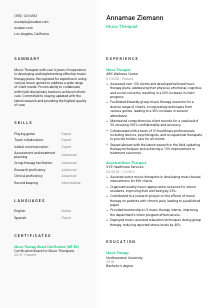
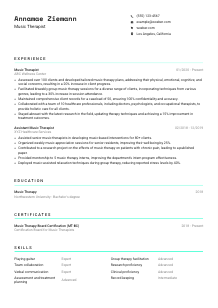
Harmonizing hearts, but your CV isn't striking the right chord? Check out this Music Therapist CV example, created with Wozber free CV builder. Learn how to align your therapeutic talents with job requirements, setting your career on a tune-fulfilling path!
Music therapy work is judged in practice by how well you translate musical skill into structured care. Hiring teams want to see that you can assess client needs, build treatment plans, lead sessions that match clinical goals, and document progress in a way that supports real outcomes across physical, emotional, cognitive, and social domains.
When your CV is tailored well, the reader can quickly separate general music experience from actual therapeutic practice. Wozber's free CV builder helps you shape that distinction into an ATS-friendly CV format by aligning your language with the posting, so your work with treatment planning, session delivery, documentation, and interdisciplinary care comes through clearly.
In music therapy hiring, the header is simple but important. It should confirm who you are, what role you do, and any practical requirement that could affect eligibility before the employer gets into clinical experience or treatment outcomes.
Use your full name as the most visible text in the header. Keep it clear and professional. This role often involves clinical documentation, interdisciplinary communication, and client-facing trust, so even your header should read cleanly and without clutter.
Place "Music Therapist" directly under your name if that is the role you are pursuing. It immediately tells the employer that your background is in therapeutic practice, not general music instruction or performance. That matters in a field where the difference between musician, educator, and clinician is significant.
Include a phone number and professional email address that you check regularly. If you add a website or LinkedIn profile, make sure it supports your application with relevant credentials, clinical work, presentations, or professional affiliations rather than unrelated creative material.
If the employer names a location requirement, reflect it in your header. In the example here, listing Los Angeles, California helps confirm alignment with the posting's location filter. For other applications, only include city and state when it helps address a practical hiring requirement.
A profile link is useful when it reinforces your practice as a therapist. That could mean professional recommendations, board certification visibility, conference participation, or work tied to healthcare, schools, or community programs. Skip it if it does not deepen the employer's understanding of your therapeutic work.
This section does not need personality flourishes. It needs to confirm identity, role, and any practical requirement that would matter before a hiring manager reviews your treatment planning, session work, and client outcomes.




This is the section most likely to decide whether you move forward. Music therapy employers look for evidence that you have worked with clients directly, led interventions with purpose, documented care accurately, and collaborated with other professionals in settings where outcomes matter.
Read the job description closely and mark the responsibilities that define day-to-day practice. For a Music Therapist, that usually includes assessment, individualized treatment planning, group and individual sessions, record keeping, and collaboration with clinicians or educators. Those themes should be visible across your bullets, not buried in vague statements about helping clients.
List your positions in reverse chronological order and make the setting clear. Employers want to know whether your work happened in a wellness centre, hospital, school, behavioral health program, senior care environment, or another care-focused setting. That context helps them understand your client population, caseload, and interdisciplinary exposure.
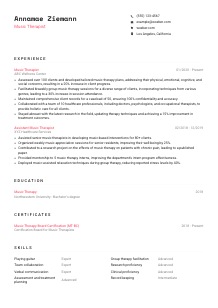
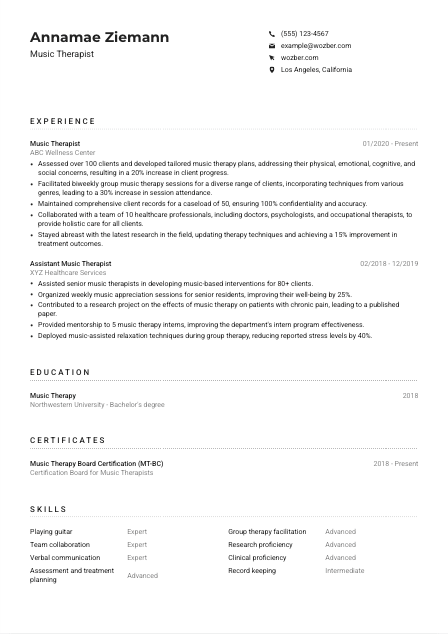
Each bullet should show what you did, who it supported, and what changed. The example CV does this well with points like assessing more than 100 clients, building individualized plans, and improving client progress by 20%. That structure works because it connects therapeutic activity to measurable results rather than stopping at duties.
Metrics are especially useful when they show caseload, attendance, treatment response, documentation volume, or collaboration scale. Examples include the number of clients assessed, the size of your caseload, changes in attendance or stress levels, or the number of professionals on the care team. Choose figures that match how your work is actually evaluated.
Keep the focus on music therapy practice and adjacent experience that strengthens it, such as assistant roles, clinical internships, or care-based programming. If you include unrelated jobs, keep them brief unless they add something directly relevant like group facilitation, documentation, or work with the same client population.
A hiring manager should be able to see your caseload, your interventions, your collaboration style, and your results from this section alone. If those details are clear, your experience will read as current clinical practice rather than general music-related work.
Education matters in music therapy because it establishes the academic foundation behind assessment, intervention design, and therapeutic use of music. The degree line should quickly confirm that your training aligns with the employer's stated requirement.
Check the exact education language before editing this section. Here, the employer asks for a bachelor's degree in Music Therapy, Music, or a related field. If your degree is a direct match, make that obvious instead of forcing the reader to infer it.
List the degree, school, field of study, and graduation year or date range. Keep the entry simple and consistent. Education is usually scanned quickly in this profession, especially once the employer has confirmed your clinical experience and board certification.
If you hold a bachelor's degree in Music Therapy, say so exactly. The sample CV handles this well by listing "Bachelor's degree" with the field "Music Therapy," which mirrors the requirement closely and removes ambiguity.
Most experienced candidates do not need a long list of classes. Add details only if they strengthen your application, such as coursework in psychology, child development, neurologic music therapy, special education, or clinical practicum work that connects to the target population.
Honors, relevant research, recital projects with therapeutic relevance, or leadership in music therapy organizations can be worth mentioning early in your career. Once you have stronger clinical experience, keep these details selective and tied to practice rather than general student activity.
This section should answer one question fast: do you have the training expected for therapeutic work with clients. Once that is clear, the employer can focus on your certification and applied experience.
Certification carries real weight in this field because it marks recognized professional standing. When a posting names MT-BC, employers are looking for current, clearly stated board certification, not a vague reference to training or ongoing study.
Before editing, identify which credentials are mandatory and which are optional. In this posting, Board Certification in Music Therapy, or MT-BC, is a stated requirement. That means it should appear clearly and exactly in your certificate section.
List certifications that directly support your work as a therapist. MT-BC belongs at the top. If you hold additional credentials relevant to your setting, such as CPR, behavioral health training, or population-specific therapy certifications, include them when they strengthen the application.
Use dates in a way that makes recency clear, especially for credentials that must remain active. The example CV lists "2018 - Present" for MT-BC, which helps the reader understand that the certification is current and maintained.
Music therapy practice evolves with research, standards of care, and client needs. Staying current on renewals, continuing education, and field developments shows that your methods are informed by present-day practice rather than training that has gone stale.
If certification is required, do not make the employer search for it. A clear MT-BC entry signals professional standing immediately and supports the credibility of everything else on the page.
The skills section should read like the toolkit of a practicing Music Therapist. Employers are looking for a mix of musical ability, therapeutic judgment, communication, documentation, and teamwork that fits the setting where you will be working.
Review the job description for stated and implied skill needs. In this case, instrument proficiency, familiarity with different music genres, interpersonal communication, and collaboration with multidisciplinary teams all deserve space. Make sure your skills list reflects actual therapeutic work, not just general musical talent.
Include role-specific skills such as client assessment, treatment planning, group facilitation, individual session delivery, progress note writing, and interdisciplinary collaboration. The example CV pairs "Assessment and treatment planning" with "Team collaboration" and "Verbal communication," which creates a fuller picture of day-to-day practice.
Choose skills you can support elsewhere in the CV. "Playing guitar" is stronger than saying "musical ability," and "record keeping" is more useful than a vague phrase like "administrative skills." A shorter, targeted list usually carries more weight than a long inventory of generic strengths.
A school, hospital, wellness centre, or senior care program needs more than a capable musician. Your skills should show that you can run purposeful sessions, document care, and work effectively with clients and care teams.
Language ability matters in music therapy because trust, instruction, and documentation all depend on clear communication. If a posting names a required language, treat it as a practical qualification rather than a minor extra.
Start with the posting. Here, proficiency in English is explicitly required, so your CV should state your English level clearly. That matters for client interaction, documentation, progress notes, and communication with doctors, psychologists, teachers, or occupational therapists.
List the required language at the top of the section and use a clear proficiency label. If English is essential, do not bury it under other languages even if you are multilingual.
Additional languages can strengthen your application when they help you work with a broader client population or community. The sample CV includes Spanish, which can be valuable in many care settings, though extra languages should be presented as added capacity, not as a substitute for the required one.
Terms like "Native," "Fluent," "Intermediate," and "Basic" are easy to scan and set accurate expectations. Keep the labels honest. In care-based roles, overstatement can create problems quickly once you are in sessions or team meetings.
Some music therapy roles serve multilingual schools, hospitals, community clinics, or regional populations where language range matters more. If language use is likely to affect rapport, family communication, or care coordination, this section can carry more weight than it would in a less client-facing role.
If language proficiency affects sessions, documentation, or teamwork, your CV should say so plainly. That gives employers a better sense of how you will function with clients and across the care team.
The summary should sound like the opening assessment of your professional profile. In a few lines, it needs to tell the employer what kind of Music Therapist you are, how much experience you bring, and which parts of your practice are most relevant to the role.
Before writing, identify the two or three themes that define the role. Here, those include individualized therapy planning, session facilitation, interdisciplinary collaboration, and current best practices. Build the summary around the parts of your background that line up most closely.
Lead with a direct statement of who you are professionally. The sample summary begins with "Music Therapist with over 4 years of experience," which works because it immediately establishes profession and tenure without unnecessary buildup.
Follow the opening with the practice areas you want the employer to notice first. That could include developing music therapy plans, working across age groups, using multiple music genres purposefully, or collaborating with psychologists, physicians, educators, or rehabilitation teams.
Aim for three to five lines. Focus on therapeutic scope, setting, and impact rather than broad personal traits. A short summary that mentions client needs, treatment planning, and interdisciplinary care will carry more weight than one filled with generic passion statements.
Your summary should make the rest of the CV easier to read by establishing your therapeutic scope from the start. When it is specific, the employer can move into your experience already knowing the kind of practice you bring.
A Music Therapist CV works best when every section points to the same professional story: qualified training, current certification, hands-on client work, purposeful session delivery, and reliable collaboration with the broader care team.
Use Wozber to tighten that story into an ATS-compliant CV, strengthen wording with role-specific terminology, and present it in an ATS-friendly CV template that keeps your treatment planning, documentation, and client impact easy to read. The finished CV should make one thing clear right away: you are ready to practice, document, and collaborate as a Music Therapist from day one.