




Use Wozber and land your dream job
Create CV
No registration required
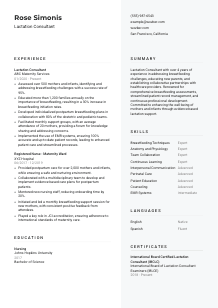
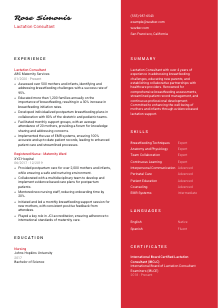
Helping newborns with first latches, but your CV feels like cluster feeding? Check out this Lactation Consultant CV example, created with Wozber free CV builder. It shows how to blend your nurturing nature, lactation knowledge, and job requirements, so your career can grow as satisfyingly as a full milk supply!
Lactation consulting sits at the intersection of clinical assessment, parent education, and postpartum support. Hiring teams want to see whether you can evaluate feeding challenges, guide families through practical techniques, and document care in a way that fits a medical setting. Your CV should make that work visible through patient volume, counseling scope, collaboration with obstetric and pediatric teams, and evidence-based lactation support.
A tailored CV quickly separates candidates who have broad maternity experience from those who have delivered focused breastfeeding care. Using Wozber's free CV builder and an ATS-friendly CV format helps you match the posting's language around IBCLC certification, EMR documentation, perinatal knowledge, and family education, so both the ATS and the clinical team can immediately see your readiness to support mothers and infants well.
In lactation consulting, first impressions are practical. This section should show that you are easy to contact, professionally presented, and available for the setting and location the employer needs.
Place your full name at the top, followed immediately by the professional title you are targeting. If the posting uses "Lactation Consultant," use that exact wording so the role is clear before the reader reaches your clinical experience.
Put "Lactation Consultant" under your name rather than a broader title such as nurse or maternal health specialist, unless the target role truly calls for that. This helps distinguish you from general postpartum care candidates and aligns with how the position is classified in screening.
Include a reliable phone number and a professional email address. In a patient-facing role that depends on trust and clear communication, even small details like an outdated email or missing phone number can make your application feel less polished than your clinical work deserves.
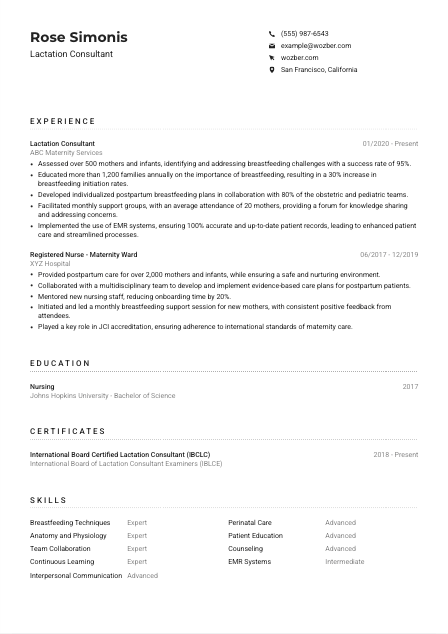
If the employer requires you to be in a certain city or open to relocation, state that clearly. In the example, listing "San Francisco, California" immediately addresses a location filter and prevents unnecessary uncertainty before the employer reviews your qualifications.
A LinkedIn profile or professional website can work well if it reinforces your clinical background, certifications, and maternal-child health experience. Make sure the information matches your CV, especially titles, dates, and credentials such as IBCLC.
This section should remove basic friction. When your title, contact details, and location are clear, the reader can move straight to your lactation experience and patient care background.




For lactation consultants, experience is where employers look for proof of judgment, teaching ability, and clinical follow-through. Your bullet points should show what kinds of mothers and infants you supported, how you handled feeding challenges, and what changed because of your work.
Start by identifying the work patterns the employer repeats. Here, that includes assessing mothers and infants, educating families, building postpartum feeding plans, documenting in EMR systems, and collaborating with physicians and care teams. Use those priorities to decide which responsibilities and outcomes belong in your top bullets.
List positions in reverse chronological order with your title, employer, and employment dates. For healthcare roles, clear chronology matters because it helps the employer track your progression from broader maternity or nursing work into specialised lactation consultation.
Focus each bullet on a result, scope, or care outcome rather than a generic task. The sample CV does this well by moving from "assessed mothers and infants" to "assessed over 500 mothers and infants" and linking that work to a 95% success rate in addressing breastfeeding challenges. That kind of phrasing shows both clinical activity and effectiveness.
Use metrics that naturally fit lactation and postpartum care. Patient volume, family education reach, breastfeeding initiation rates, support group attendance, care-plan participation, and documentation accuracy all help hiring teams understand your scope. Quantified examples such as educating 1,200 families annually or maintaining 100% accurate patient records give substance to your claims.
Choose experience that supports the target role first. Lactation consulting employers will care most about breastfeeding assessment, parent counseling, postpartum education, and interdisciplinary coordination. Earlier nursing experience can still help, especially if it includes maternity, newborn, or postpartum care, but frame it through the parts that connect to feeding support and maternal-infant care.
After reading your experience section, a clinical employer should understand the scale of your lactation work, the families you have supported, and how confidently you operate in postpartum care, education, and documentation.
Education matters here because it anchors your clinical credibility. Keep this section straightforward, and make it easy to connect your degree background to lactation counseling, nursing care, and perinatal support.
If the posting asks for a Bachelor's or Master's degree in Nursing, Health Science, or a related field, make that easy to spot. In the example, a Bachelor of Science in Nursing directly supports the role and should be listed without extra wording that hides the match.
List your degree, field of study, school name, and graduation year. This is enough for most experienced lactation consultants. The section should read quickly so the employer can confirm your educational baseline and move on to your IBCLC credential and clinical background.
If your education included concentration areas tied to maternal-child health, women's health, neonatal care, or public health, include them when they genuinely strengthen your fit. That context is especially useful when your degree title alone does not fully show your connection to lactation practice.
Relevant coursework can help if you are earlier in your career or if your program included subjects closely tied to the role, such as anatomy and physiology, perinatal care, infant nutrition, or breastfeeding support. Keep it brief and only add courses that deepen the employer's understanding of your preparation.
Honors, academic projects, or student leadership can stay if they connect to healthcare delivery, patient education, or maternal-infant care. For experienced candidates, this section should stay compact unless an academic achievement is unusually relevant to lactation research or clinical practice.
Your education section should confirm that you meet the role's academic requirement and that your training supports safe, informed care for mothers and infants.
This section carries real weight for lactation roles because certification often marks the difference between adjacent candidates. Present credentials in a way that makes your professional qualification unmistakable.
If the role asks for IBCLC certification, list it at the top of this section with the full credential name. The example does this correctly by naming the International Board Certified Lactation Consultant designation in full, which makes ATS matching and human review easier.
Use this section for certifications that support lactation practice, maternal-child care, patient education, or related clinical work. Irrelevant credentials dilute the section and draw attention away from the qualification the employer is most likely screening for first.
Show when each certification was earned and, if relevant, whether it remains current. That matters in regulated healthcare environments where current credentials affect patient care responsibilities and hiring eligibility.
If you have completed additional continuing education in breastfeeding medicine, perinatal support, infant feeding challenges, or postpartum counseling, include it when it strengthens your profile. Employers value consultants who stay current with evidence-based practice, especially in a field shaped by changing clinical guidance and patient education standards.
A hiring team should be able to confirm your lactation qualification in seconds. Lead with IBCLC, keep the section relevant, and show that your knowledge stays current.
The best lactation consultant skills sections feel grounded in real practice. They should reflect the mix of clinical knowledge, family communication, and care coordination that the role depends on every day.
Pull the terms that define day-to-day work and clinical expectations. In this case, that includes breastfeeding techniques, perinatal care, anatomy and physiology, interpersonal communication, counseling, and EMR use. Matching these terms naturally helps both ATS screening and human review.
Place the most role-defining skills first. For lactation consultants, that usually means feeding assessment, breastfeeding support, family education, counseling, maternal-infant care knowledge, and interdisciplinary collaboration. Secondary tools and general traits should come later.
Avoid long, generic skill inventories. A tighter list gives more weight to the capabilities that matter in this field. The sample CV balances clinical skills like breastfeeding techniques and perinatal care with operational strengths such as EMR systems and team collaboration, which is a useful model for how to mix direct care and workplace effectiveness.
Every skill you list should connect to breastfeeding support, patient education, documentation, or coordinated postpartum care. If it would not matter in a lactation consult, it probably does not belong here.
Language skills can strengthen a lactation consultant CV because care often depends on trust, clarity, and culturally responsive communication. Present them accurately, especially when the posting names a required language.
If the employer specifies English proficiency, include it directly in this section. For patient education and one-on-one counseling, clear communication is part of safe care, not just a preference.
Additional languages can be valuable in maternity and postpartum settings where families may be more comfortable receiving feeding guidance in their preferred language. In the example, Spanish adds meaningful value because it can support broader family communication, though the importance of any second language will depend on the patient population served.
Use honest labels such as Native, Fluent, Advanced, or Conversational. Overstating fluency can create real problems in a role where technique instruction, reassurance, and health education must be clearly understood.
If you are applying to hospitals, community clinics, or maternal health programs serving multilingual populations, language ability may strengthen your candidacy well beyond a basic line on the CV. It can support patient comprehension, reduce friction in counseling, and improve continuity of care.
Only include languages you can genuinely use in a professional setting. For lactation consultants, language ability matters when it helps explain feeding positions, address concerns, and build confidence with new parents during a vulnerable period.
Done well, this section shows that you can communicate with families clearly and inclusively. That matters in lactation work because reassurance and instruction often need to land in real time.
Your summary should quickly tell the reader whether you bring focused lactation expertise or mainly adjacent experience. Keep it short, specific, and tied to the work this profession is hired to do.
Review the posting before you write. For lactation consultants, the summary should usually speak to clinical breastfeeding assessment, family education, postpartum support, collaboration with healthcare providers, and current lactation knowledge. Those points give the reader a usable snapshot of your practice.
State your professional identity and level right away. A line such as "Lactation Consultant with 4+ years of experience" tells the employer immediately whether you meet the role's experience threshold and whether your background is specialised enough for the position.
Highlight the work you are most trusted to do. The sample summary works because it points to breastfeeding challenges, parent education, provider collaboration, patient record management, and evidence-based support. You can also reference outcomes when they are strong enough to stand out, such as improved initiation rates or high documentation accuracy.
Skip broad claims about passion or helping people unless they are attached to specific practice areas. Use the summary to show what kind of lactation consultant you are, what settings you have worked in, and what results or care strengths a clinical team can expect from you.
By the end of this section, the employer should know that you are qualified to assess feeding issues, educate families, work alongside medical teams, and support postpartum care with current lactation expertise.
Your CV should now show the full shape of your lactation practice: clinical assessment, breastfeeding education, postpartum care coordination, documentation, and the credentialing that supports patient trust. Keep the language close to the posting, especially around IBCLC status, EMR experience, and maternal-infant support.
Wozber's free CV builder can help you organise these details into an ATS-compliant CV, and its ATS CV scanner can help you catch missing terms or weaker wording before you apply. The finished document should make one thing easy to judge: you can step into a lactation consultant role and support families with confidence, accuracy, and evidence-based care.




