



Use Wozber and land your dream job
Create CV
No registration required
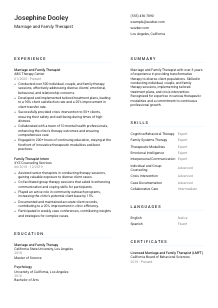
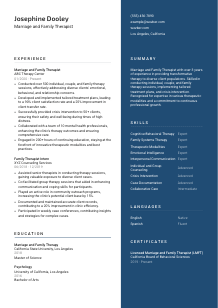
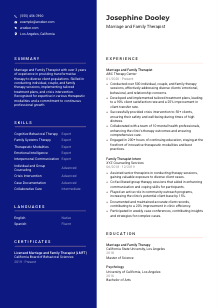
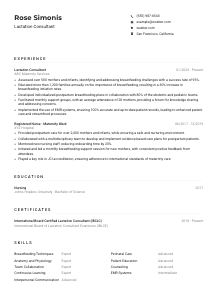
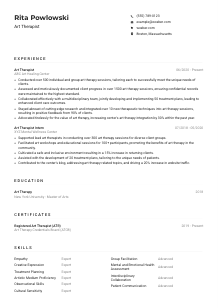
Unraveling relationship knots, but your CV feels tangled? Check out this Marriage and Family Therapist CV example, untangling your counseling expertise with Wozber free CV builder. Learn how to weave your therapeutic talents to meet job needs, paving a career path as harmonious as a well-blended family portrait!
Marriage and Family Therapist hiring usually turns on one practical question fast: can this person work clinically with individuals, couples, and families while keeping treatment grounded, ethical, and goal-directed. A CV for this field needs to make that visible through supervised experience, client population, treatment planning, crisis response, and the therapeutic approaches you actually use in practice.
Screening gets much easier when those details are written in the language of the role. Wozber's free CV builder helps you shape an ATS-compliant CV that reflects the posting's terminology, from therapeutic modalities to licensure and care coordination, so a hiring team can quickly understand where you have worked, who you have treated, and how you support client progress.
This section is simple, but in mental health hiring it still carries weight. Employers need to confirm who you are, how to reach you, whether your title matches the role, and in some cases whether you meet a location requirement for licensure, scheduling, or in-person care delivery.
Use your full name in a clear, easy-to-scan format. It should read cleanly on the page and stand apart from the rest of the header, since every credential, license, and clinical role on the CV will be tied back to that name.
Place your professional title directly under your name and keep it aligned with the target opening. If you are applying to a Marriage and Family Therapist role, use that title when it accurately reflects your license or current position. That immediate match helps both ATS screening and human review.
List a phone number you answer reliably and an email address that looks professional in a healthcare setting. Double-check both. Missed callbacks happen, and therapy employers often move quickly when scheduling interviews with licensed clinicians.
If the employer specifies a city or state, include yours clearly. Here, Los Angeles, California is part of the stated requirement, so showing that in the header removes an avoidable question about availability, local licensure context, or commute for in-person sessions.
Do not add age, marital status, gender, photo, or other personal details unrelated to clinical practice. This space is better used for information that supports the hiring decision, such as your title, contact details, and location when required.
A well-structured personal details section tells an employer that the basics are in order before they even reach your experience. That matters in a field built on professionalism, accuracy, and trust.




For Marriage and Family Therapists, experience is where employers look for proof of real clinical work. They want to see the settings you have worked in, the populations you have treated, the modalities you used, and the outcomes or responsibilities that show you can handle therapy sessions, documentation, crisis situations, and coordinated care.
Before rewriting your bullets, identify the responsibilities the employer repeats or emphasizes. For this role, that includes individual, couple, and family therapy, treatment planning, crisis intervention, collaboration with other providers, and ongoing professional development. Build your experience section around those core functions so the match is obvious in both ATS results and recruiter review.
List positions in reverse chronological order and give the most space to roles involving direct counseling, case formulation, and treatment delivery. A title such as "Marriage and Family Therapist" should appear prominently when you have held it. Earlier training roles, such as an internship, still matter when they show supervised exposure to therapy sessions, documentation, and case conferences.
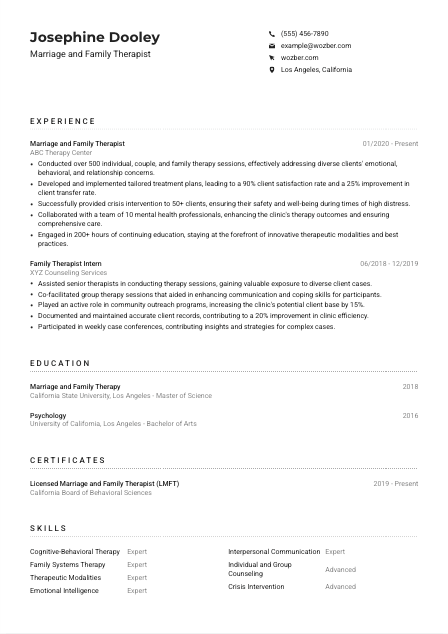
Focus each bullet on a concrete part of the job: session volume, treatment plans, client concerns addressed, crisis response, or interdisciplinary collaboration. The example CV does this well by showing more than 500 therapy sessions across individuals, couples, and families, which immediately communicates clinical range and sustained caseload experience.
Use numbers where they reflect real practice. Session count, client satisfaction, continuing education hours, number of crisis interventions, or operational improvements in documentation can all strengthen credibility. A result like a 90% client satisfaction rate or 50+ crisis interventions works because it connects your clinical work to outcomes an employer can understand.
Each accomplishment should help answer whether you can do the work described in the posting. Prioritise therapy delivery, treatment planning, rapport with diverse clients, crisis management, and team-based care. If a bullet does not strengthen one of those points, trim it or rewrite it with more relevant clinical detail.
When your experience section clearly shows caseload exposure, therapeutic work, and coordinated care, the hiring team can quickly picture you in sessions, in treatment planning, and in multidisciplinary collaboration.
In this profession, education is more than a formality. Your degree establishes whether you meet the academic foundation for licensure and whether your training aligns with marriage, family, and relational therapy work.
Put the master's degree first when it is the credential that qualifies you for the role. The posting asks for a master's degree in Marriage and Family Therapy or a related mental health field, so your degree title and field should appear exactly and clearly enough to be recognized in a quick scan.
List degree, field of study, school, and graduation year in a clean format. That allows employers to confirm your academic background quickly, especially when they are reviewing many licensed or license-eligible clinicians in one round.
A Master of Science in Marriage and Family Therapy should be more prominent than broader undergraduate study because it ties directly to supervised clinical preparation and therapeutic training. The example CV handles this correctly by placing the MFT master's ahead of the psychology bachelor's degree.
If you are early in your career or the role calls for a particular modality, selected coursework can help. Keep it relevant to clinical work, such as family systems, couples counseling, psychopathology, trauma treatment, or crisis intervention. For more experienced therapists, work history usually carries more weight than a long list of classes.
Honors, thesis work, research, or practicum distinctions can be useful when they point to therapy-relevant strengths. Keep them if they support your clinical profile, especially for newer therapists, and leave them out if they distract from stronger professional experience.
This section should let an employer confirm, without digging, that your academic background supports the therapy work and licensure track the role requires.
For Marriage and Family Therapists, certifications are not decorative. Licensure often determines whether you can practice independently, bill appropriately, or be considered at all for the position.
Lead with the credential the employer asked for. In this case, that means listing LMFT licensure prominently, including the issuing board. If the job allows a closely related board certification instead, present the one you hold in clear, recognizable language.
Include licenses and certifications that strengthen your ability to perform the work, such as trauma-informed care, CBT training, crisis intervention, or family therapy specializations when they are substantial and current. Do not overcrowd this section with unrelated short courses.
For licenses, include the year issued and, when relevant, note that the credential is current. The example CV's "2019 - Present" format works because it quickly communicates active standing, which is one of the first things a therapy employer needs to confirm.
The posting calls for continued professional development, so keep this section current as your training expands. If your recent learning is better represented in experience through CE hours, that also works. The important point is to show that your clinical methods are current and professionally maintained.
A concise, current certification section removes doubt about whether you can step into the role and practice within the employer's clinical and regulatory requirements.
A Marriage and Family Therapist skills section should sound like a clinician's toolkit, not a generic list of strengths. Employers are looking for therapeutic methods, clinical judgment, documentation ability, and the interpersonal skills needed to work with complex family systems and diverse clients.
Read the job description for explicit terms and implied capabilities. Here, cognitive-behavioral therapy, family systems therapy, rapport-building, communication, crisis intervention, treatment planning, and coordinated care all belong in your skills inventory if they reflect your actual background.
Name the modalities and practice areas that match the work. "Cognitive-Behavioral Therapy" and "Family Systems Therapy" are strong examples because they mirror the posting and communicate how you structure treatment. Support them with related skills such as crisis intervention, case documentation, and collaborative care.
Do not turn this section into a catalogue. Choose the skills that best support the target role and that you can back up in your experience bullets. In the example CV, the list works because it balances modalities with practical therapy functions and communication strengths instead of listing every soft skill imaginable.
When this section reflects your real methods, client work, and care coordination abilities, it reinforces the same clinical story told in the rest of the CV.
Language ability can matter significantly in therapy settings, especially when rapport, nuance, and emotional clarity shape treatment quality. Present languages in a way that shows what level of client communication you can genuinely support.
If the job specifies English proficiency, list English clearly with an accurate proficiency level. That requirement should never be left implied, especially in roles built around assessment, counseling, documentation, and therapeutic dialogue.
Additional languages can strengthen your application when they support work with the community the practice serves. For example, Spanish fluency may be especially useful in many Los Angeles clinical settings, though that depends on the employer and population served rather than the profession as a whole.
Choose terms such as Native, Fluent, Professional, Conversational, or Basic and use them consistently. In therapy, overstating language ability can create real problems in sessions, consent discussions, safety planning, and documentation.
If the employer serves multilingual families, children, couples, or community referrals from varied backgrounds, language skills may carry more weight. Include them when they help explain how you build rapport and maintain effective communication across cultural contexts.
If bilingual or multilingual work is relevant to your career path, continued improvement can widen the populations you can serve and strengthen therapeutic engagement. Add new proficiency only when you are comfortable using it in a clinical or professional setting.
Handled well, this section shows whether you can support communication needs that directly affect rapport, treatment delivery, and access to care.
The summary sits at the top of the CV, so it needs to answer the most important questions fast. For Marriage and Family Therapists, that means your years of experience, client focus, therapeutic approaches, and the kinds of clinical responsibilities you can take on from day one.
Use the posting to decide what belongs in your first three lines. If the job centers on couples and families, supervised clinical experience, and treatment planning, your summary should introduce you through that lens rather than with broad statements about helping people.
Start with your professional identity and your approximate years of practice. A line like "Marriage and Family Therapist with over 3 years of experience" works because it gives immediate context and matches how employers sort applicants by licensure stage and clinical depth.
Mention the areas that match the role most closely, such as conducting individual, couple, and family therapy, building tailored treatment plans, using modalities like CBT or family systems therapy, and handling crisis intervention when needed. The example summary succeeds because it combines scope of care with modality expertise and professional development in just a few lines.
Aim for a short paragraph that a clinical director can absorb quickly. Skip generic adjectives and focus on what you treat, how you work, and what level of responsibility you already handle. The rest of the CV can supply the detailed proof.
A precise summary gives the reader an immediate sense of your therapeutic scope, your methods, and your level of responsibility before they move into the full CV.
A Marriage and Family Therapist CV works best when every section supports the same hiring picture: qualified education, active licensure, direct therapy experience, relevant modalities, and clear communication with diverse clients. That is what employers need to see when they decide who can step into sessions, manage treatment plans, and collaborate across care teams.
Wozber's free CV builder, ATS-friendly CV template, and ATS CV scanner can help you organise that story with stronger ATS optimisation and cleaner role-specific wording. Use them to build a CV that makes your clinical readiness, licensure status, and therapeutic scope easy to recognize.