



Use Wozber and land your dream job
Create CV
No registration required
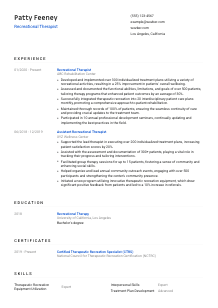
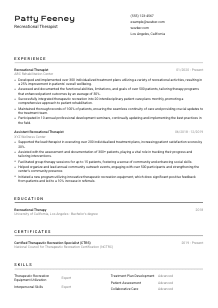
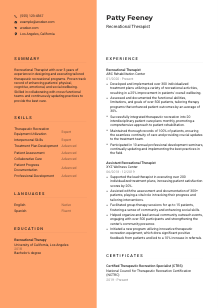
Crafting leisurely activities, but your CV feels out of play? Check out this Recreational Therapist CV example, created with Wozber free CV builder. It shows how to bring your therapeutic talents and job requirements together, making your career path as engaging as the activities you organise!
Recreational therapy CVs need to make one thing clear fast: you know how to turn activity-based interventions into real patient progress. Hiring teams look for clinicians who can assess function, set therapeutic goals, adapt programs for different ages and abilities, and document outcomes in a way that fits broader care plans.
A tailored CV changes how quickly that clinical picture comes through, especially when an employer is screening for rehabilitation experience, treatment planning, and CTRS credentials. Wozber's free CV builder helps you shape that story into an ATS-compliant CV, so the first read highlights the work that matters most in recreational therapy.
This section is brief, but it still carries practical screening value. For a Recreational Therapist role, clean contact details, the right title, and location alignment help remove avoidable friction before a hiring manager gets to your treatment planning or patient work.
Use your full name in a clear, easy-to-read format at the top of the page. Keep it more prominent than the body text so your CV feels organised from the first line, much like your clinical documentation should.
Place "Recreational Therapist" directly under your name if that is the role you are pursuing. This helps position you correctly for both ATS screening and human review, especially when employers are sorting candidates across therapy disciplines such as occupational, physical, and recreational therapy.
List a current phone number and a professional email address. Accuracy matters here. If a hiring team wants to follow up after reviewing your experience with patient assessments, care coordination, or group sessions, they should not hit a dead end because of a typo.
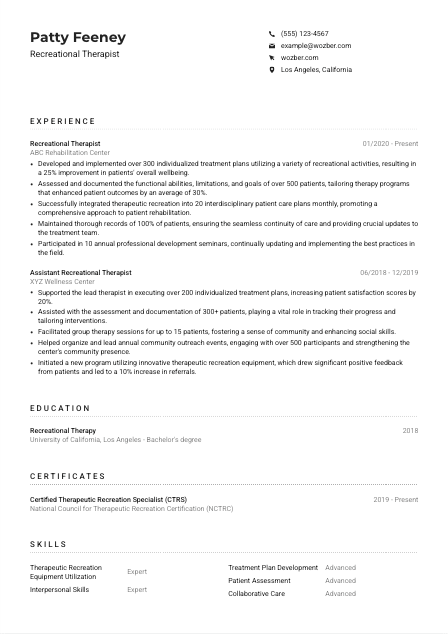
If the employer specifies a location requirement, reflect that clearly. In this example, listing "Los Angeles, California" immediately supports the local requirement and avoids questions about relocation or availability.
Include a LinkedIn profile or professional website only if it adds something useful, such as volunteer work, clinical projects, presentations, or community programming related to therapeutic recreation. Keep the content consistent with your CV so your professional profile tells one coherent story.
Your personal details should confirm availability, professionalism, and role focus without distracting from the clinical substance of the CV. Get this section right, and the reader can move straight to your patient care experience.




For Recreational Therapists, experience is where your CV earns credibility. Employers want to see how you assess patients, build activity-based interventions, work with interdisciplinary teams, and track progress across physical, cognitive, emotional, or social goals.
Read the posting closely and mark the responsibilities that define day-to-day work. Here, that includes individualized treatment plans, patient assessment, care team collaboration, progress documentation, and ongoing professional development. Those themes should show up clearly in your bullet points, using language that matches the role without copying it word for word.
List positions in reverse chronological order and include your title, employer, and dates. For therapy roles, the title matters because it tells the reader whether you carried a full caseload, supported a lead therapist, or worked in a rehabilitation, behavioral health, long-term care, or community-based setting.
Your bullets should show what you planned, delivered, assessed, and improved. The sample CV does this well by tying treatment plan development to measurable gains in patient wellbeing and by showing how assessments informed tailored interventions. That kind of detail tells a hiring team how you practice, not just where you worked.
Quantify your work where the numbers are meaningful. Useful measures in recreational therapy include number of treatment plans developed, patient caseload, group session size, care plans supported, outcome improvement, patient satisfaction, or referral growth tied to program innovation. Metrics such as "300 treatment plans" or "20 interdisciplinary care plans monthly" give your work scale and credibility.
Prioritise experience that shows clinical or rehabilitative work, since that is a common filter for these roles. If you include adjacent experience, connect it to patient engagement, adaptive programming, documentation, family communication, or therapeutic group facilitation so the relevance is obvious.
A hiring manager should be able to trace your clinical judgment through this section, from assessment to intervention to documented progress. That is what separates general activity coordination from therapeutic recreation practice.
Recreational therapy is one of those fields where education is a real qualification screen, not a background detail. Your degree tells employers whether you meet the training baseline for treatment planning, patient assessment, and therapeutic recreation practice.
If the posting asks for a bachelor's degree in Recreational Therapy, Therapeutic Recreation, or a related field, place that qualification clearly and consistently. In the example, "Bachelor's degree in Recreational Therapy" directly supports the stated education requirement.
List the degree, field of study, school, and graduation year in a straightforward structure. This section should be easy to scan, especially when employers are confirming required credentials before spending more time on your experience section.
When your degree aligns closely with the posting, use the exact field name shown on your transcript or diploma. If your degree is in a related discipline, make sure the rest of the CV reinforces relevant coursework, internships, or patient-facing therapeutic work so the connection is clear.
You do not need to turn this into a class list, but relevant study in adaptive recreation, behavioral health, rehabilitation, human development, activity analysis, or treatment planning can help if you are early in your career or moving into a new care setting.
Student associations, practicum placements, research projects, or volunteer work tied to disability services, rehabilitation, or therapeutic programming can support your profile when they connect directly to recreational therapy practice.
Your education section should quickly confirm that you meet the academic foundation for the work. Once that box is clear, the rest of the CV can focus on how you apply that training with patients and care teams.
In this field, certification often functions as a frontline requirement rather than a nice extra. If you hold credentials that confirm professional standing and current practice standards, they should be easy to find and easy to verify.
Feature certifications that are explicitly requested in the posting, especially the Certified Therapeutic Recreation Specialist credential. For this job, CTRS is not optional, so it should appear prominently and in the correct form.
Only include certifications that strengthen your recreational therapy profile. Prioritise credentials tied to therapeutic recreation, rehabilitation, behavioral health, adaptive programming, or patient safety rather than filling the section with loosely related training.
If a certification has an active period, renewal cycle, or issue date that matters, include it. The sample CV lists the CTRS certification with an ongoing date range, which helps show that the credential is current.
If you have additional training in areas such as trauma-informed care, dementia programming, adaptive sports, group facilitation, or documentation standards, add it when it supports the setting you are targeting. That signals active engagement with evolving practice, not a one-time credential check.
A clear certificates section tells employers that your qualifications are current and relevant to patient care. In recreational therapy, that can move your application forward quickly.
The best skills sections for Recreational Therapists are built around actual treatment work. That means balancing clinical capabilities, patient-facing strengths, and the coordination skills needed to operate within a rehabilitation or healthcare team.
Start with the posting and identify both the stated and implied skills. Here, that includes therapeutic recreation equipment, individualized treatment planning, patient assessment, documentation, interdisciplinary collaboration, and strong interpersonal communication across different age groups and abilities.
Put the skills with the strongest hiring value first. If the employer emphasizes clinical or rehabilitative experience, lead with treatment planning, assessment, adaptive intervention design, and progress documentation before more general strengths.
A Recreational Therapist needs both. Skills such as "Therapeutic Recreation Equipment Utilization" and "Patient Progress Documentation" show technical range, while "Interpersonal Skills" and "Collaborative Care" show how you build rapport and work within a treatment team. The sample CV strikes that balance well.
This section should reinforce how you deliver care, not read like a generic therapy keyword list. Choose skills that reflect your actual interventions, documentation habits, and collaboration style in clinical settings.
Language ability can matter in recreational therapy because rapport, instructions, motivation, and emotional support all depend on communication. In many care settings, the languages you speak can shape how effectively you connect with patients and families.
Look first for any language requirement in the job description. This one calls for high proficiency in English, so your CV should state that clearly and early in the languages section.
List English first and mark your proficiency accurately, such as "Native" or "Fluent." That makes it easy for the reviewer to confirm you can document care, explain activities, and communicate with colleagues and patients in the required language.
If you speak additional languages, include them when you can use them in patient or family interactions. In some rehabilitation and community health settings, bilingual ability can support trust, participation, and continuity of care.
Use clear labels such as Native, Fluent, Intermediate, or Basic. In therapy roles, overstating language ability can create problems in real patient interactions, so accuracy matters.
Tailor this section to the setting when appropriate. For example, if you have experience serving multilingual communities, an additional language such as Spanish may be worth listing because it can support engagement during assessments, group sessions, or family updates.
If language ability helps you communicate more effectively with patients, families, or care teams, make that visible. In the right setting, it can strengthen both your therapeutic reach and your value to the employer.
The summary needs to establish your clinical identity quickly. For a Recreational Therapist, that means leading with therapeutic practice, patient population or setting when relevant, and the kind of outcomes your work supports.
Use the posting to decide what belongs in the opening lines. For this role, the summary should touch on rehabilitation or clinical experience, individualized treatment planning, patient assessment, collaboration with care teams, and documented patient progress where applicable.
Start with a direct line that covers your title, years of experience, and core focus. The example does this effectively by identifying the candidate as a Recreational Therapist with more than 3 years of experience designing tailored therapeutic recreation programs.
Use the next sentence to show what your work improves. That could be physical function, emotional wellbeing, social participation, patient engagement, or interdisciplinary care support. Keep the claims grounded in the kind of outcomes your experience section can back up.
Aim for a short paragraph that captures your therapeutic scope without repeating the whole CV. Three to five lines is usually enough to establish your practice area, strengths, and value in a rehabilitation or clinical environment.
When this section is working, a hiring manager can quickly tell what kind of Recreational Therapist you are, what settings you know, and what patient outcomes your work supports. That sets up the rest of the CV well.
A well-tailored Recreational Therapist CV should show more than compassion or enthusiasm. It should connect your education, CTRS credential, clinical experience, patient assessment, treatment planning, and documentation habits into a clear picture of how you contribute to care.
Use Wozber's free CV builder, ATS-friendly CV template, and ATS CV scanner to tighten that alignment and surface the language employers are already using in their postings. The final result should make it easy to judge your readiness for patient-centered therapeutic recreation work.




