



Use Wozber and land your dream job
Create CV
No registration required
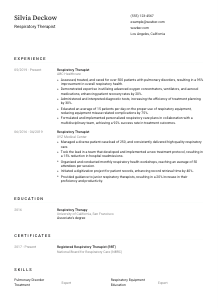
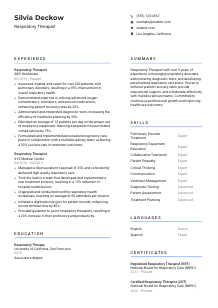
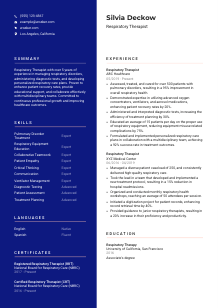
Helping lungs, but feeling breathless about your CV? Inhale this Respiratory Therapist CV example, created with Wozber free CV builder. Learn how to present your therapy talents to fit the job requirements, leaving your career as refreshed and recovered as the patients you care for!
Respiratory therapy hiring moves quickly because the work carries immediate clinical responsibility. A CV for this field needs to make patient-facing judgment visible fast, especially your experience assessing pulmonary conditions, managing respiratory equipment, interpreting diagnostic testing, and working alongside physicians and nursing teams on care plans.
When that information is tailored to the posting, reviewers can quickly separate broad bedside experience from true respiratory care depth. Wozber's free CV builder helps you shape an ATS-compliant CV around the language employers use for licensure, NBRC credentials, ventilator management, and patient education, so the first read already shows where you can contribute in clinical practice.
In healthcare hiring, missing contact or credential context can slow down an application before anyone reviews your clinical background. Keep this section clean, professional, and easy to scan so the employer can immediately place you as a licensed Respiratory Therapist with the right location and communication basics covered.
List your full name in a clear, readable format at the top of the CV. In a clinical hiring workflow where applications are reviewed quickly, your header should be easy to identify and consistent with your license, certifications, and any hospital credentialing records.
Place "Respiratory Therapist" directly under your name so your target role is clear from the first line. This matters when employers are hiring across several allied health functions and need to distinguish respiratory care candidates from broader patient care or technician profiles.
Include a reliable phone number and a professional email address you check often. Hiring teams may contact you about interviews, shift availability, licensing follow-up, or onboarding steps, so accuracy here is operational, not cosmetic.
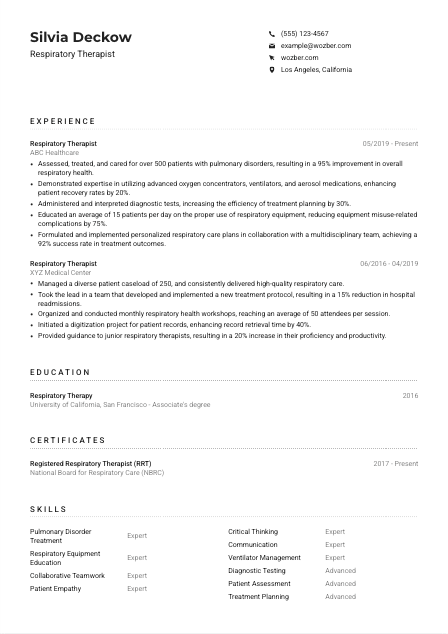
If the employer requires local availability or relocation, include your city and state. In the provided example, "Los Angeles, California" works well because it answers the posting's location requirement immediately and removes uncertainty about whether you can report on site.
A LinkedIn profile or professional webpage can be useful if it matches your CV and adds clinical credibility, such as certifications, continuing education, or recommendations from healthcare leaders. Skip it if it is outdated or thinner than the CV itself.
This section should confirm who you are, how to reach you, and whether key logistics are already covered. Clean personal details keep attention on your patient care background, licensure, and readiness for the respiratory therapy role.




Respiratory therapy CVs stand out when the experience section goes beyond duties and shows how you handled patient volume, equipment, testing, education, and care planning. Hiring teams want to see the pace, complexity, and outcomes of your clinical work, not a generic list of responsibilities copied from a job description.
Start by identifying the work the employer emphasizes most, then mirror that language where it matches your background. For a Respiratory Therapist opening, that often includes pulmonary assessment, ventilator and oxygen therapy use, diagnostic testing, patient education, and multidisciplinary care planning. The sample posting is a good example of how clearly these priorities can be stated.
For each position, include employer, title, and dates in reverse chronological order. Then make the bullets do the real work by showing setting, patient population, treatment scope, or operational contribution so a reviewer can understand how your practice developed across roles.
Respiratory care work is easier to judge when your bullets connect actions to patient or unit results. Instead of saying you used ventilators or administered aerosol medications, show what changed. The example CV does this well by linking advanced equipment use to a 20% improvement in recovery rates and patient education to a 75% drop in equipment misuse-related complications.
Quantify your experience with numbers that fit the setting, such as patient volume, readmission reduction, treatment success rate, education load, protocol adoption, or efficiency gains in treatment planning. Figures like "assessed over 500 patients" or "educated 15 patients per day" give employers a better sense of scale than broad claims about being experienced.
Keep bullets focused on respiratory care responsibilities that matter to the job, especially assessment, treatment, equipment management, diagnostics, collaboration, and patient instruction. If you include broader hospital contributions, make sure they still strengthen your case, such as leading a treatment protocol update or improving record access in a clinical workflow.
A strong experience section tells the employer what kind of respiratory therapist you have been in real settings. Patient load, equipment expertise, diagnostic work, and measurable care outcomes should all be clear by the time this section ends.
Education matters in respiratory therapy because it is directly tied to eligibility for licensure and certification. This section does not need decoration, but it does need precision so the employer can immediately confirm that your training meets the baseline for clinical practice.
If the posting asks for graduation from an accredited Respiratory Therapy program with at least an Associate's degree, state that information plainly. The example CV handles this well with "Associate's degree" in "Respiratory Therapy," which directly matches the stated requirement.
List the school, degree, field of study, and graduation year in a straightforward order. Healthcare recruiters and credentialing teams often scan this section quickly, so clean formatting helps them confirm your qualification without having to interpret extra wording.
Use the formal wording of your degree and field rather than a shortened or casual version. In a licensed clinical profession, exact educational labeling matters because it connects to exam eligibility, regulatory standards, and employer screening requirements.
If you are early in your career, selected coursework can help fill in clinical relevance. Choose classes tied to respiratory practice, such as ventilator management, cardiopulmonary assessment, neonatal or critical care concepts, or pulmonary diagnostics. More experienced candidates can usually leave coursework out.
Academic achievements can add value when they show commitment to the field, especially if they relate to clinical excellence, research, or leadership in healthcare training. Keep them concise and relevant so they support, rather than crowd, your core qualifications.
This section should make your training path easy to confirm at a glance. When the degree, program, and institution are stated clearly, reviewers can move straight to your clinical experience and credentials.
For Respiratory Therapists, certifications are not an optional extra. They are often one of the first items checked because they confirm national credentialing status and help employers verify that you meet the practice standard expected for the role.
Place the certifications most relevant to the job first. In the provided posting, NBRC recognition as an RRT or CRT is specifically requested, so those credentials belong at the top of the section and should be written in full for clarity.
List the credentials that directly strengthen your candidacy for respiratory care work. A shorter list of highly relevant certifications is more effective than a longer list that mixes in unrelated training with little clinical value.
If a certification is active, recently earned, or has a renewal timeline, include the date range or issue date. The example CV uses "2017 - Present" and "2016 - Present," which helps show that the credentials are current and maintained.
Respiratory care changes with new equipment, protocols, and patient populations, especially in acute care and critical care settings. Reviewing this section regularly helps ensure your CV reflects current credential status and any additional training that supports your practice.
Your certifications should confirm clinical standing without forcing the reader to search for them. When the right NBRC credential and active dates are visible, your application clears one of the most important early screens.
The skills section works best when it reflects how respiratory therapists are actually evaluated on the job. Focus on abilities tied to patient assessment, therapeutic equipment, diagnostics, education, and team-based care rather than filling the section with broad traits that could belong on any healthcare CV.
Review the job description for both direct care and team-based requirements. In this case, that includes pulmonary disorder treatment, ventilator and oxygen device use, diagnostic testing, patient and family education, communication, and collaboration with a multidisciplinary team. These are the skills that should shape your list.
A respiratory therapy skills section should show both technical proficiency and bedside effectiveness. Include hard skills such as ventilator management, lung function testing, treatment planning, and patient assessment, then support them with relevant interpersonal strengths such as communication, empathy, and collaborative teamwork. The sample CV strikes that balance well.
Choose skills you can support elsewhere in the CV through experience, credentials, or summary language. A concise list of respiratory-specific capabilities is more useful than a long inventory of vague strengths, especially when employers are checking quickly for clinical alignment.
Every skill you list should connect back to real respiratory care work. If the employer can match your skills to equipment use, diagnostics, patient education, and teamwork in the experience section, this part of the CV is doing its job.
Respiratory therapy often involves urgent instruction, reassurance, and equipment education, so language skills can matter far beyond a checkbox. The right language section helps employers understand whether you can communicate clearly with patients, families, and care teams in the settings they serve.
If the posting states that professional English communication is essential, list English at the top with an accurate proficiency level. That immediately addresses a stated requirement and supports your ability to document care, explain treatment, and coordinate with clinicians.
Include additional languages when you can use them confidently in patient-facing situations. In some markets and care settings, Spanish can be especially useful for respiratory education and discharge instruction, which is why it strengthens the example CV, but treat that as context-specific rather than universal.
Use clear labels such as Native, Fluent, Intermediate, or Basic. Avoid overstating your ability, particularly in healthcare, where misunderstandings around treatment instructions, equipment use, or symptom reporting can affect patient outcomes.
Multilingual ability has practical value in respiratory therapy because the role often involves demonstrating inhaler use, explaining oxygen therapy, or coaching breathing techniques. If another language helps you do that safely and clearly, it is worth including.
Language skills carry more weight when they match the community or facility environment. If your target employer serves a diverse patient base, bilingual ability can support education, trust, and continuity of care, especially in high-contact outpatient or hospital settings.
This section should clarify how you communicate in clinical settings, not simply broaden your profile. Accurate language details can strengthen your case when patient education and family communication are central parts of the job.
Hiring teams usually read the summary before they get into your bullets, so this section needs to establish your level quickly. For a Respiratory Therapist, that means years of practice, clinical focus, key equipment or diagnostic strengths, and the kind of patient care outcomes you regularly influence.
Before writing, note the experience level, credentials, and care responsibilities that show up most clearly in the job description. If the employer wants 2+ years of experience, pulmonary care expertise, diagnostic testing, and collaborative care planning, those points should shape your opening lines.
Lead with a direct professional introduction such as "Respiratory Therapist with over 5 years of clinical experience." This works well because it immediately gives the reader your practice level and anchors everything that follows.
Use the next sentence to name two or three role-specific strengths supported elsewhere in the CV. The example summary does this effectively by referencing respiratory disorder management, diagnostic testing, personalized care plans, patient education, and multidisciplinary collaboration.
Aim for a short paragraph that can be read in seconds. Skip broad statements about passion or hard work unless they are backed by clinical detail. A concise summary focused on care scope, technical capability, and outcomes will carry more weight.
Your summary should quickly tell the employer whether your background fits their patient population and care environment. When it clearly states your experience level, respiratory care strengths, and contribution to treatment outcomes, the rest of the CV lands with more force.
A Respiratory Therapist CV should make your clinical qualifications easy to confirm and your patient care impact easy to understand. When your experience, education, NBRC credentials, and core respiratory skills are aligned with the posting, employers can quickly see whether you are ready for their care environment.
Use Wozber's free CV builder to organise that information into an ATS-friendly CV format that stays readable for both hiring teams and software screening. With careful tailoring, your final CV should show exactly what matters most: safe respiratory care, sound clinical judgment, and the ability to contribute from day one.




