



Use Wozber and land your dream job
Create CV
No registration required
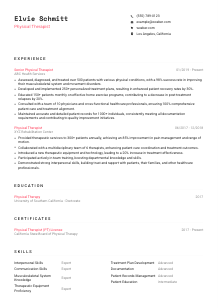
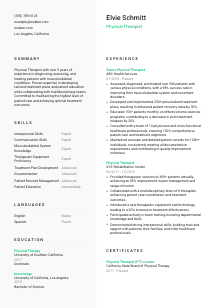
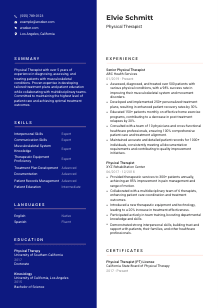
Restoring motion, but your CV feels static? Glide through this Physical Therapist CV example, created with Wozber free CV builder. Learn how to showcase your therapeutic talent in line with job requirements, helping your career move as fluidly as your patients!
Physical therapy CVs work best when they show how you move patients from evaluation to measurable functional improvement. Hiring teams look for clinicians who can assess movement limitations, build treatment plans, educate patients on home programs, document progress accurately, and work smoothly with physicians and rehab staff. If those core responsibilities are buried under generic healthcare language, your clinical value is easy to miss.
A tailored CV changes which parts of your background surface first. When the language reflects the posting's priorities, whether that is musculoskeletal treatment, patient education, multidisciplinary collaboration, or licensure, an ATS-compliant CV is far more likely to pass early screening and reach clinical reviewers with the right context. Wozber's free CV builder helps you align phrasing, structure, and ATS optimisation so your CV quickly shows where your treatment experience matches the role.
In healthcare hiring, the top of the CV needs to answer basic eligibility questions fast. For a Physical Therapist, that means clear identity, reachable contact information, professional title, and, when relevant, location that matches the employer's staffing need.
Use your full name as the visual anchor of the page so it is easy to spot in a stack of clinical applications. Keep it larger than the body text and professionally formatted. In a field built on patient trust and licensed practice, the heading should look clean and credible, not decorative.
Place "Physical Therapist" directly under your name if that is the role you are targeting. This removes ambiguity for recruiters and rehab leaders scanning quickly across candidates in adjacent disciplines like occupational therapy, athletic training, or chiropractic care. If you hold a senior-level title, you can still lead with the role you want most clearly.
List a current phone number and a professional email address you check regularly. Healthcare employers often move quickly when coordinating interviews across clinic managers, physicians, and HR, so inaccurate contact details can stall an otherwise qualified application. If you include a website or LinkedIn profile, make sure the information matches your CV.
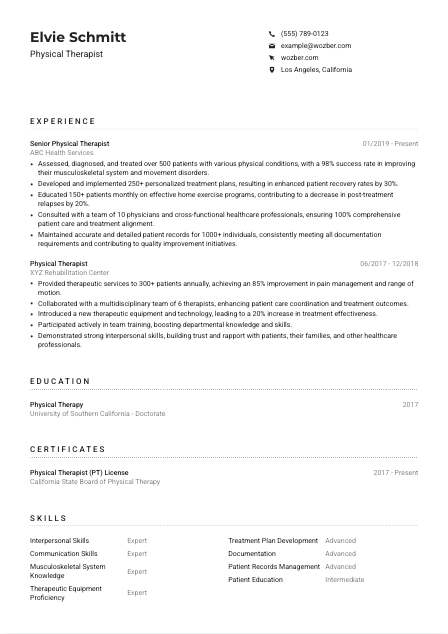
If the posting specifies a location requirement, include your city and state. Here, "Los Angeles, California" immediately addresses a stated need and reduces concern about relocation timing or licensing logistics. For other physical therapy roles, location matters most when it affects commute, state authorization, or on-site patient care availability.
A LinkedIn profile, clinic biography, or professional website can help if it reinforces your clinical background, specialties, or continuing education. Skip empty or outdated links. If you include one, it should support your CV with relevant information such as practice areas, patient populations, presentations, or professional association activity.
Your personal details should make it easy to confirm who you are, where you are based, and how to reach you for a clinical interview. Keep this section simple, accurate, and aligned with the role's practical requirements.




This is where a Physical Therapist CV earns attention. Employers want to see the kind of patients you treated, the interventions you managed, the teams you worked with, and the outcomes you influenced, from recovery rates to documentation quality and patient adherence.
Start by marking the responsibilities and requirements that matter most in the posting. For physical therapy roles, that usually includes patient assessment, treatment planning, movement or musculoskeletal care, home exercise instruction, documentation, and collaboration with physicians or interdisciplinary teams. Once those priorities are clear, shape your bullets around matching clinical work rather than listing routine duties.
Lead with your most recent clinical position and work backward. For each role, include employer, title, and dates, then focus your bullets on patient care scope, treatment environment, and progression in responsibility. If you moved from staff therapist work into senior therapist, lead therapist, or specialty rehab roles, make that growth easy to see.
Numbers help clinical experience feel real. Include patient volume, caseload size, recovery metrics, improvement in pain or range of motion, adherence to home programs, or documentation scale when you can support them. The sample CV does this well with figures such as 500+ patients treated, 250+ treatment plans developed, and reduced relapse rates through patient education.
Use terminology that reflects how physical therapy is actually delivered. Phrases such as "assessed and treated musculoskeletal conditions," "developed individualized treatment plans," "educated patients on home exercise programs," and "collaborated with physicians and multidisciplinary teams" immediately connect your experience to common hiring criteria. Accurate terminology also improves ATS matching without sounding forced.
Prioritise bullets that show treatment decisions, patient progress, care coordination, use of therapeutic equipment, and recordkeeping standards. Trim unrelated administrative work unless it supports clinic operations, compliance, or quality improvement. A rehab employer learns more from your role in improving mobility outcomes or documenting 1000+ patient records than from a vague note about being hardworking.
Your experience section should show that you can manage real patient care, not just hold the title. When the bullets connect assessment, treatment planning, collaboration, education, and measurable outcomes, your background reads like a clinician ready to contribute from day one.
For Physical Therapists, education is a licensing and credibility checkpoint, not a formality. Hiring teams need to see quickly that your academic path supports safe clinical practice and meets the role's degree expectations.
If the job calls for a Master's or Doctorate in Physical Therapy, present that credential plainly and high in the section. Do not make reviewers hunt for it. In the example, a Doctorate in Physical Therapy aligns directly with the stated requirement, while the Kinesiology degree adds useful context to the broader clinical foundation.
List institution, degree, field of study, and graduation year in a straightforward format. That is usually enough for experienced clinicians. A hiring manager reviewing multiple therapy CVs should be able to confirm your academic qualifications in seconds.
Write the degree as it was awarded, such as "Doctorate in Physical Therapy" or "Master of Physical Therapy." Precise wording matters in healthcare hiring because education, licensure, and scope of practice are closely linked. Small wording choices can also affect ATS interpretation.
If you are early in your career, relevant honors, clinical rotations, research, or student leadership can strengthen this section, especially in orthopedics, sports rehab, neuro rehab, or acute care. For more experienced Physical Therapists, those details usually matter less than current patient outcomes and licensure unless they support a specialty focus.
Continuing education can be especially valuable when it supports the job target, such as coursework in manual therapy, fall prevention, pain science, vestibular rehab, or evidence-based exercise prescription. Add it if it strengthens your recent clinical profile, not simply to make the section longer.
This section should make your academic qualification for physical therapy practice immediately clear. Once degree level, institution, and relevant training are easy to verify, employers can focus on your clinical work and treatment outcomes.
In physical therapy hiring, certifications are not decorative. They confirm legal eligibility to practice, show current professional standing, and can highlight added training that supports a specialty population or treatment approach.
Start with the credential that determines whether you can practice in the role, typically your Physical Therapist license. If the job requires a valid state license, name the issuing board and state clearly. In this case, listing the California PT license directly addresses a core requirement.
Only include certifications that strengthen your candidacy for the physical therapy position. Specialty credentials, continuing competence courses, or population-specific certifications can help if they relate to the setting. A focused list is more persuasive than a crowded section with marginally related items.
Include issue date, renewal date, or "Present" when relevant so employers can see the credential is active. In licensed healthcare roles, missing dates can create unnecessary follow-up questions. Clear timing helps recruiters and compliance teams move your application forward faster.
If you are building expertise in a clinical niche, add certifications that support that path, such as orthopedics, geriatrics, sports rehab, balance training, or dry needling where applicable and permitted. This works best when the added credential supports the actual patient population or treatment model in the job.
Your certificates section should confirm that you are licensed, current, and professionally invested in your practice area. For physical therapy roles, that combination strengthens both eligibility and clinical credibility.
The best skills sections for Physical Therapists read like a concise clinical toolkit. They should reflect how you evaluate patients, deliver treatment, communicate with care teams, and manage the practical demands of documentation, equipment, and patient education.
Start with the language in the job description, then match it against your real work. Common examples include musculoskeletal assessment, treatment plan development, therapeutic equipment use, patient education, clinical documentation, and communication with physicians or rehab teams. This gives you a skills list grounded in both ATS relevance and actual practice.
Order skills by hiring importance, not by what sounds impressive. For many physical therapy roles, core clinical competencies should come before broad soft skills. In the example, musculoskeletal knowledge, therapeutic equipment proficiency, treatment planning, and documentation all support the day-to-day responsibilities described in the posting.
Choose skills that a rehab director or clinic manager would expect to see tied to patient care delivery. Avoid padding the section with generic traits that are already implied elsewhere. A shorter list with clinically relevant terms will carry more weight than a long list mixing therapy skills with vague descriptors.
This section should give a quick, accurate view of the clinical and operational abilities you bring to treatment. If the list mirrors real therapy work and the employer's priorities, it strengthens both ATS alignment and human review.
Language skills matter more in physical therapy than in many roles because treatment depends on clear instruction, rapport, safety cues, and patient understanding. If you can communicate well across different patient populations, that can directly affect adherence and outcomes.
If the job requires effective communication in English, list English at the top with an honest proficiency level. This is especially relevant in physical therapy, where patient intake, exercise instruction, progress documentation, and interdisciplinary communication all depend on accuracy and clarity.
Include additional languages when you can use them in a clinical or patient-facing setting. In some communities, bilingual ability can improve trust, reduce communication barriers during home exercise instruction, and make family education more effective. Spanish, for example, may be especially useful in many California care settings, though it is not automatically required unless the posting says so.
Use straightforward labels such as "Native," "Fluent," "Intermediate," or "Basic." Overstating language ability can create problems quickly in patient education, informed communication, or team coordination. Clear proficiency levels set the right expectations.
List languages because they help you treat patients more effectively, not just because they look impressive. If a second language helps with intake conversations, mobility instructions, pain descriptions, discharge planning, or caregiver education, that is the value to emphasize mentally as you decide what to include.
Think about the setting and patient mix for the role. Outpatient ortho, community clinics, hospital systems, and rehab centers can all serve different populations. When extra language ability supports the people you are most likely to treat, it becomes a meaningful advantage rather than a side note.
For a Physical Therapist, language ability can support safer instruction, better patient engagement, and smoother care coordination. Keep the section honest and relevant to the population you may be serving.
Your summary should quickly tell a rehab employer what kind of Physical Therapist you are, how much clinical experience you bring, and where your strengths show up in patient care. Keep it focused on treatment work, outcomes, and the environments where you add value.
Before writing the summary, identify the two or three themes the employer emphasizes most. For physical therapy roles, that often means assessment and treatment of movement disorders, individualized care plans, patient education, interdisciplinary coordination, and accurate documentation. Your summary should foreground the areas where your experience overlaps most clearly.
Start with your title and years of experience, then add the clinical scope that defines your work. A line such as "Physical Therapist with 5+ years of experience treating musculoskeletal conditions in rehabilitation settings" gives immediate context and is much stronger than a vague statement about being passionate about healthcare.
Choose strengths that are central to the role and supported elsewhere in your CV. Good options include treatment plan development, home exercise instruction, therapeutic equipment use, collaboration with physicians, or measurable improvement in mobility, pain management, or recovery rates. The example summary succeeds because it ties experience directly to diagnosis, tailored treatment, and team-based care.
Aim for a compact paragraph of about three to five lines. Skip broad claims and make every sentence pull clinical weight. By the end of the summary, the reader should already understand your setting, patient-care strengths, and why your background fits the role.
Your summary should give a hiring team a fast, accurate read on your clinical background and the kind of care you deliver well. When it is tailored tightly to the target role, it sets up the rest of the CV with clear therapeutic direction.
A strong Physical Therapist CV makes the essentials easy to confirm: the right degree, active licensure, relevant clinical experience, patient outcomes, and collaboration across the care team. When those details are clear and backed by specific treatment work, your application reads like a clinician who can step into the caseload with confidence.
Use Wozber's free CV builder to shape that experience into an ATS-friendly CV format, strengthen role-specific wording with AI support, and check alignment with an ATS CV scanner before you apply. The result should make one thing immediately clear to the employer: you can evaluate, treat, educate, and document at the standard the role requires.




