



Use Wozber and land your dream job
Create CV
No registration required
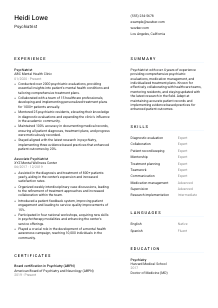
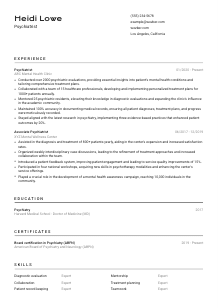
Working through minds, but your CV feels off track? Navigate this Psychiatrist CV example, created with Wozber free CV builder. Learn how to showcase your therapeutic insights and medical acumen to match job expectations, blending both your professional and personal sides to find career serenity!
Psychiatry hiring turns quickly on whether your CV makes clinical scope easy to understand. Employers need to see how you assess patients, manage medication, document care, and work within treatment teams, because those are the day-to-day responsibilities that shape patient safety and continuity of care.
A tailored CV also helps separate psychiatrists with broad diagnostic exposure from candidates whose experience is narrower or less current. Using Wozber's free CV builder and an ATS-friendly CV format makes it easier to align your wording with the posting, surface requirements such as residency, licensure, and board status, and show where your practice already matches the level of responsibility the role requires.
For psychiatrists, the header does more than identify you. It immediately confirms practical details that can affect interview decisions, including your specialty, location, and how quickly a credentialing or recruiting team can contact you. Keep this section clean, direct, and easy to scan.
Use your full name in a larger, professional font so it stands out at the top of the page. In medical hiring, recruiters and department coordinators often review many credential-heavy CVs quickly, so your name should be visible without competing with the rest of the content.
Place "Psychiatrist" directly under your name. This helps both human readers and ATS systems categorize your CV correctly right away. If you are targeting a subspecialty role, you can adapt the title when your experience supports it, but for a general psychiatry opening, straightforward wording works best.
List a reliable phone number and a professional email address. Accuracy matters here more than style. In physician hiring, one missed digit can delay interview scheduling, credentialing follow-up, or licensing verification.
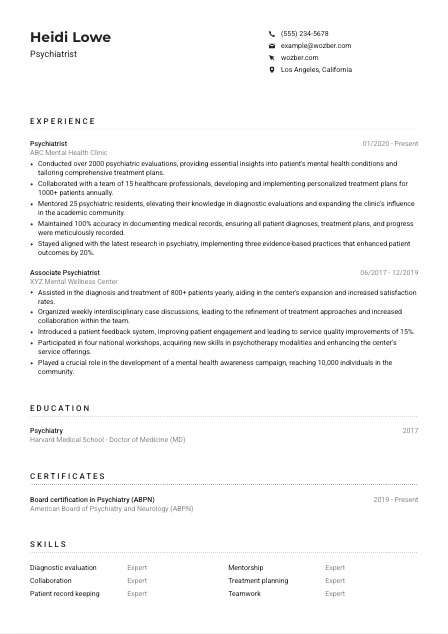
If the employer specifies a location requirement, include your city and state in the header. In the example, listing Los Angeles, California directly supports a posting that requires the psychiatrist to be located there. Treat that as role-specific tailoring rather than a rule for every application.
A LinkedIn profile, faculty page, or professional website can be useful when it supports your clinical background, publications, teaching, or speaking work. For psychiatrists in academic or leadership tracks, that extra link can reinforce supervision experience, research activity, or community mental health involvement.
This section should answer the practical questions first: who you are, what kind of physician you are, how to reach you, and whether any stated location requirement is already met. When those basics are clear, the rest of the CV can stay focused on patient care and clinical outcomes.




The experience section carries most of the hiring weight for psychiatrists. This is where a medical director, department chair, or recruiter looks for diagnostic range, medication management depth, interdisciplinary work, documentation discipline, and any teaching or supervision responsibilities tied to the role.
Read the job description for the work that will define the role, then echo that language through your strongest achievements. For this opening, psychiatric evaluations, medication management, individualized treatment planning, evidence-based care, and supervision all deserve space in your bullets because they map directly to the work being hired for.
Use reverse chronological order and include employer, title, and dates for each position. That structure helps reviewers understand your progression from associate or staff roles into broader psychiatric responsibility, and it makes periods of clinical practice easy to track during credential review.
Avoid generic lines like "responsible for patient care." Instead, describe the scope and result of your work. The sample bullet "Conducted over 2000 psychiatric evaluations" works because it shows patient volume, core clinical function, and direct relevance to diagnostic practice in one line.
Use numbers that fit psychiatric practice: evaluation volume, annual patient load, treatment adherence improvements, patient outcome gains, documentation accuracy, interdisciplinary case activity, or resident supervision counts. In the example, mentoring 25 residents and improving outcomes by 20% gives a far clearer picture than broad claims about being effective.
Prioritise work that shows diagnostic evaluation, psychopharmacology, treatment planning, medical record documentation, collaboration with therapists or primary care teams, and evidence-based updates to care. Community outreach or awareness work can stay if it supports your profile, but your main bullets should prove you can manage a caseload safely and competently.
By the end of this section, a hiring team should be able to picture the kind of psychiatrist you are: the patient populations you have treated, the volume you have handled, the teams you work with, and the outcomes you influence. That is the level of clarity that moves a physician CV forward.
Psychiatry is one of the clearest examples of a profession where education is a hard requirement, not background detail. Your degrees and training should confirm that you completed the medical path expected for independent psychiatric practice and make that path easy to verify at a glance.
When a posting calls for an MD or DO from an accredited medical school, list that degree exactly as earned. Put your medical degree first so there is no ambiguity about your qualification to practice. In this example, "Doctor of Medicine (MD)" aligns directly with the requirement.
Use a straightforward structure: degree, field, school, year. A line such as "Doctor of Medicine (MD), Psychiatry, Harvard Medical School, 2017" gives credentialing staff and hiring leaders the information they need without forcing them to search for it.
If the role requires completion of a four-year psychiatry residency, make sure your education or training history leaves no doubt that you completed it. If residency appears in a separate training section on your CV version, keep the wording specific and prominent. Do not assume reviewers will infer it from your job title alone.
For early-career psychiatrists, academic appointments, or research-oriented positions, honors, distinctions, thesis work, or relevant coursework can add value. For more experienced clinicians, these details are secondary unless they support the target role, such as teaching, neuroscience research, or academic psychiatry.
Psychiatric practice changes with new evidence, updated prescribing guidance, and evolving treatment models. If you have CME activity, formal psychotherapy training, or recent academic development that supports the role, include it where appropriate to show your knowledge is current rather than static.
Your education section should confirm medical qualification quickly and cleanly. When the degree, specialty, and training path are obvious, reviewers can move on to the more distinctive parts of your practice history.
For psychiatrists, certifications are not decorative credentials. Board status, state licensure, and related registrations often determine whether a candidate can move forward at all. Present them clearly so no reviewer has to hunt for eligibility or current standing.
Put the most decision-critical credentials first. For this role, that means ABPN board certification or eligibility in Psychiatry and a valid state medical license. If you also hold DEA registration and the role requires it, include that clearly so prescribing authority is not left uncertain.
List certifications and licenses that affect your ability to practice psychiatry, supervise trainees, prescribe medication, or meet institutional requirements. General courses or unrelated certificates should not crowd out core physician credentials.
Active date ranges help employers understand that your credentials are current. In the example, "2019 - Present" for board certification and "2017 - Present" for state licensure quickly communicates active status, which matters in physician screening.
Psychiatrists often add credentials over time, whether through subspecialty certification, advanced psychotherapy training, or additional state licensure. Review this section regularly so it reflects your present practice authority and professional development accurately.
This section should make one point unmistakable: you meet the credentialing standard to practice psychiatry in the setting you are targeting. When that is clear, the conversation can shift to your clinical judgment and patient care record.
A psychiatrist's skills section should read like a concise map of clinical capability. Focus on the abilities that shape assessment, treatment, collaboration, documentation, and patient communication, because those are the areas most closely tied to daily performance in psychiatric care.
Review the language of the job description and extract the competencies behind it. Here, diagnostic evaluation, medication management, treatment planning, collaboration, documentation, mentorship, and evidence-based practice all belong because they reflect the work itself rather than generic strengths.
Choose skills you actively use in practice, not every trait that could apply to a physician. A concise list with psychopharmacology, psychiatric assessment, interdisciplinary collaboration, medical record documentation, and resident supervision tells a far clearer story than a long catalogue of vague professional qualities.
Psychiatry requires both clinical judgment and therapeutic communication. Organise the section so core medical capabilities such as diagnostic evaluation and medication management are visible alongside skills like patient communication, teamwork, and mentorship. The example does this well by combining treatment planning and supervision with collaboration and communication.
This section works best when it supports your experience rather than repeating it mechanically. A focused skills list should confirm the kind of psychiatrist your work history already suggests: clinically capable, collaborative, and dependable in patient care.
Language ability matters in psychiatry because clinical work depends on accurate communication, rapport, and nuance. If a posting names a required language, address it directly. Any additional language should be included when it expands the populations you can serve or strengthens team communication.
When the employer specifies English proficiency, place English at the top of the section and mark it at the appropriate level. That immediately addresses a stated requirement and removes a preventable screening question.
After the required language, list additional languages in descending order of relevance and proficiency. In many psychiatric settings, a second language can be especially valuable when it supports patient interviews, family discussions, or culturally responsive care.
Stick to recognizable levels such as Native, Fluent, Intermediate, or Basic. These terms are easy for recruiters and hiring managers to interpret and are more useful than creative labels that say little about actual communication ability.
Additional languages can strengthen your candidacy when they help you serve a diverse patient population or reduce reliance on interpreters in certain encounters. For example, Spanish may be especially useful in some communities, but include it because it reflects your real practice capability, not as filler.
In psychiatry, language skill is not simply a nice addition. It can affect diagnostic interviewing, therapeutic alliance, medication counseling, and communication with families or caregivers. Present it as a practical clinical asset when it genuinely is one.
If language ability will help you evaluate, counsel, and support patients more effectively, make that visible here. In psychiatric practice, better communication can directly improve the quality of care and patient trust.
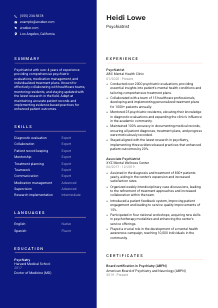
The summary is where you establish your practice profile in a few lines. For psychiatrists, that usually means years of experience, the core clinical work you handle, and one or two strengths that matter to the target setting, such as medication management, evidence-based care, or academic supervision.
Start with a direct statement of who you are and how long you have practiced. "Psychiatrist with over 4 years of experience" works because it immediately frames the reader's expectations around clinical maturity and scope.
Use the next line to highlight the responsibilities most central to the target role, such as psychiatric evaluations, medication management, treatment planning, collaborative care, or supervision of residents. The sample summary succeeds because it stays close to the actual work instead of drifting into broad personal traits.
Aim for three to five lines with tight wording and high-value details. This section should quickly orient a medical recruiter or department lead before they move into your experience, not repeat your entire career history.
Close with one detail that sharpens your profile, such as implementing evidence-based practices, improving patient outcomes, mentoring trainees, or working effectively in multidisciplinary settings. Choose a point that reflects your real practice and the demands of the role.
A well-built summary should tell a hiring team, in a few lines, what kind of psychiatrist they are about to read about. When it is specific, clinically grounded, and aligned with the posting, it frames the rest of the CV in the right way.
Your CV should now show the essentials of psychiatric hiring clearly: medical training, board or licensure status, evaluation and medication management experience, treatment planning, documentation habits, and any teaching or supervision work that fits the role.
Use Wozber's free CV builder to structure that experience in an ATS-compliant CV, and use its ATS CV scanner to align your wording with the posting's clinical requirements. The goal is a CV that makes your readiness for psychiatric practice easy to recognize, both in ATS screening and in physician review.




