



Use Wozber and land your dream job
Create CV
No registration required
Untangling disease mysteries, but your CV feels cryptic? Check out this Pathologist CV example, created with Wozber free CV builder. It shows how to present your diagnostic prowess to match job requirements, carving a career path as clear and accurate as your microslides!
Pathology CVs are read through the same lens the work itself demands: diagnostic accuracy, clinical judgment, and reliability under real reporting pressure. Hiring teams want to see whether you have handled case volume, interpreted findings clearly for treating physicians, worked within regulated laboratory settings, and contributed to the kind of medical decision-making that depends on timely, defensible results.
A tailored CV changes one crucial thing for a Pathologist. It quickly clarifies whether your background matches the practice they need, whether that means autopsy work, anatomic or clinical pathology, laboratory oversight, or academic contribution. Wozber's free CV builder helps you align that story in an ATS-friendly CV format, so board credentials, post-residency experience, and diagnostic scope are easy to recognize from the first scan.
For a Pathologist, the header should confirm professional identity and remove logistical uncertainty. Keep it clean, exact, and medically credible so the reviewer can move straight to your training, board status, and practice history.
Use your full name as the most visible element in the header. In medicine, name recognition matters, especially if your publications, conference presentations, or hospital credentials appear elsewhere in the hiring process. Keep the formatting simple and readable.
Place "Pathologist" directly under your name when that is the role you are targeting. This creates immediate alignment with the posting and helps separate your profile from adjacent physician roles, laboratory medicine positions, or subspecialty titles that may be less familiar to an initial reviewer.
List one reliable phone number and a professional email address. Check them carefully. In physician hiring, delays often happen because interview coordination, credentialing follow-up, and reference requests go to outdated contact information.
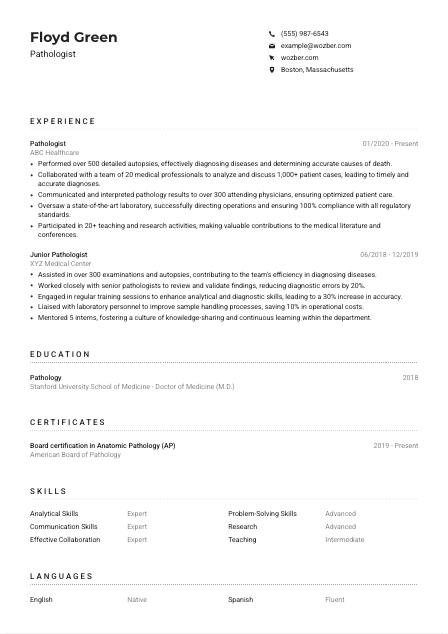
If the employer specifies a location requirement, include your city and state. Here, Boston, Massachusetts is relevant because it answers an operational question right away. If you are relocating, make that clear in a brief, practical way rather than leaving the employer to guess.
Include a LinkedIn profile or professional webpage only if it strengthens your candidacy. For a Pathologist, that might mean publications, teaching appointments, research activity, conference work, or institutional affiliations. Make sure it matches the dates, titles, and credentials on your CV.
Your personal details should establish that you are reachable, appropriately titled, and logistically aligned with the opening. Once that is clear, the reader can focus on your pathology practice, board certification, and clinical contribution.




The experience section carries most of the hiring weight for Pathologists. It should show how you practiced, what kinds of cases and responsibilities you handled, how you worked with clinicians and laboratories, and where you carried authority for interpretation, operations, teaching, or quality oversight.
Before rewriting your bullets, identify the actual practice needs in the job description. For this opening, the emphasis falls on tissue examination, autopsies, collaboration with medical staff, result communication, laboratory oversight, and research or teaching. Those priorities should shape which cases, responsibilities, and outcomes you elevate first.
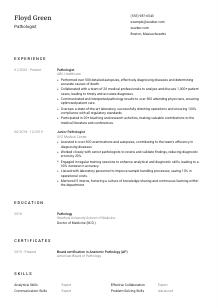
List positions in reverse chronological order and make the progression visible. A Pathologist CV should show growing diagnostic responsibility, broader case review, stronger collaboration with attending physicians, or increasing oversight of lab operations. The example CV does this well by moving from a junior role into full Pathologist practice with more authority and scope.
Use accomplishment bullets that combine core pathology work with measurable output. Good examples include autopsy volume, number of cases reviewed, physician groups served, diagnostic accuracy improvements, compliance performance, or teaching contributions. "Performed over 500 detailed autopsies" works because it names a core duty and quantifies sustained practice rather than making a vague claim about experience.
Numbers matter when they reflect real practice. Case counts, turnaround improvements, reduced diagnostic errors, regulatory compliance results, lab efficiency gains, publication or conference activity, and scope of clinician collaboration are all useful measures. In the sample, "100% compliance with all regulatory standards" and collaboration across 1,000+ patient cases give the reader a concrete sense of operating level.
Each position should help answer the same question: can this physician perform the work in this pathology setting? Prioritise bullets that show direct diagnostic work, interpretation of pathology findings, interdisciplinary communication, and laboratory responsibility. If you have unrelated early experience, trim it back so the section stays focused on pathology practice after residency.
By the end of your experience section, the reader should understand your practice scope, clinical judgment, and level of responsibility in the lab and with physicians. Make those points easy to see, and your CV will read like a practicing Pathologist's record rather than a general medical CV.
Education is a threshold section in physician hiring. For a Pathologist, it needs to confirm the degree, the medical training path, and any academic detail that adds context to your specialization without crowding out the more decisive sections on board certification and practice experience.
If the role asks for an M.D. or D.O. from an accredited medical school, write the degree in full and place it prominently. This is not the place for shorthand that leaves room for doubt. The example lists "Doctor of Medicine (M.D.)" clearly, which immediately confirms eligibility.
Present your education in reverse chronological order, starting with medical school. If you completed a pathology-focused academic track, thesis, or formal concentration that strengthens your profile, include it briefly. Keep the emphasis on the training most relevant to pathology practice.
Where appropriate, include a field or academic focus that connects directly to pathology. That detail helps when the employer is screening quickly across different physician backgrounds. In the provided CV, listing pathology with the medical degree helps reinforce the applicant's direct alignment with the specialty.
Relevant coursework, research, or capstone work can be useful if you are early in practice, moving into a teaching hospital environment, or applying to a research-active department. For more experienced Pathologists, keep this section concise unless the academic work directly supports the role's focus.
Honors, scholarships, pathology society involvement, or notable research affiliations belong here if they strengthen your profile. Keep them selective. A few high-value academic details can support your credibility, especially for roles that include teaching, publication, or conference participation.
This section should leave no doubt that you meet the medical degree requirement and have a training path that supports pathology practice. Keep it precise, easy to scan, and proportionate to your career stage.
For Pathologists, certifications are not decorative. They are core qualification markers. This section should make board status, relevance, and currency easy to identify, especially when AP, CP, or both are named in the job description.
Lead with the credentials the employer asked for, such as board certification in Anatomic Pathology, Clinical Pathology, or both. If the job description names AP and CP, do not bury them under unrelated courses or minor certificates. They are central to your eligibility.
After required board certifications, list other credentials that strengthen the specific application. For example, subspecialty certification, transfusion medicine, molecular pathology, laboratory management, or compliance-related training may matter depending on the practice setting. Keep the most job-relevant items at the top.
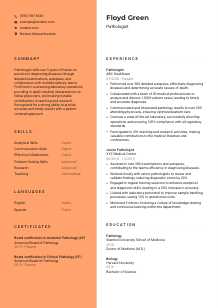
Show when each credential was earned and whether it is current. Active dates help the employer understand your professional standing and can support credentialing review. In the sample, the ongoing certification dates make current board status immediately visible.
Pathology changes with new testing methods, quality standards, and diagnostic techniques. If you have meaningful additional credentials or recent professional development that supports your current practice, include it selectively. Focus on items that strengthen your role in diagnosis, laboratory oversight, or academic medicine.
A reviewer should be able to confirm your required board credentials in seconds. When the role calls for AP, CP, or equivalent certification, make that the first thing this section communicates.
The skills section should reinforce how you practice, not repeat generic physician traits. Choose skills that connect to diagnostic interpretation, laboratory operations, interdisciplinary consultation, and the communication demands that come with issuing findings other clinicians act on.
Start with the wording in the posting, then translate it into a focused skill list. Here, analytical ability, diagnostic reasoning, problem-solving, communication, and collaboration are explicit. You can also include role-native skills such as histopathologic interpretation, autopsy examination, quality control, laboratory compliance, or case review if they reflect your actual work.
A Pathologist needs both diagnostic depth and the ability to explain findings to physicians, laboratory personnel, and sometimes broader care teams. Your skills should reflect that balance. The sample does this by pairing analytical and problem-solving skills with communication and effective collaboration, which matches the consultative nature of the role.
Do not turn this into a long keyword block. Prioritise the skills most relevant to the target opening and organise them so they scan quickly. If you use categories, separate technical pathology skills from communication, leadership, teaching, or research strengths. That structure helps both ATS parsing and human review.
This section should support the picture already established in your experience. When it is tailored well, the reader sees a Pathologist who can interpret findings accurately, communicate them clearly, and operate effectively in a regulated clinical environment.
Language skills matter in healthcare when they affect communication with physicians, staff, patients, trainees, or research collaborators. For Pathologists, this section is usually brief, but it should still reflect the communication demands of the job and state proficiency levels clearly.
If the posting requires fluent English, list English first and describe your level accurately as "Native" or "Fluent." This is a direct requirement, especially important in pathology where written reports and verbal interpretation must be precise.
Extra languages can strengthen your profile in hospital systems serving diverse populations or in academic environments with broad collaboration. They are usually secondary to your medical qualifications, but they can still support teamwork and communication across departments.
Use straightforward labels such as Basic, Intermediate, Advanced, Fluent, or Native. Avoid overstating ability. In medical settings, language proficiency carries practical implications for professional communication and should be represented honestly.
Pathologists are often less patient-facing than other physicians, but language ability can still matter in multidisciplinary meetings, resident teaching, research work, or cross-functional lab coordination. Include languages that genuinely support those settings rather than listing them as filler.
Additional languages can broaden your professional reach, especially in academic medicine or diverse health systems. Still, keep this section proportionate. It should complement your pathology qualifications, not distract from board certification, diagnostic experience, or laboratory leadership.
State required English fluency clearly, then add other languages only if they add credible professional value. For most Pathologist CVs, clarity matters more here than length.
The summary should give a hiring team a fast read on your pathology background, level of experience, and clinical contribution. In a few lines, it should connect your diagnostic work, laboratory responsibilities, and collaborative role with physicians to the practice needs of the opening.
Review the job description and identify the two or three points that matter most. For this role, that includes pathology practice after residency, accurate and timely diagnosis, communication with medical staff, lab oversight, and participation in teaching or research. Use those themes to shape the summary rather than writing a broad physician introduction.
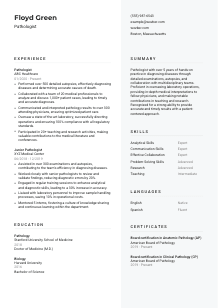
Start with a direct statement of who you are and how long you have practiced. The sample summary uses "Pathologist with over 5 years of hands-on practice," which works because it quickly establishes specialty and tenure without wasting space.
Use the next line or two to highlight the work that matches the position. That may include disease diagnosis through tissue examination, autopsy work, interpretation of pathology results, clinician communication, or laboratory leadership. Choose the capabilities that best reflect your own record and the employer's stated priorities.
A summary should not read like a full biography. Aim for a tight paragraph with concrete terms and no filler. If every phrase points to your pathology practice, reporting responsibility, and clinical collaboration, the reader will know exactly what to look for in the rest of the CV.
After reading the summary, a hiring team should understand your specialty, your level of experience, and the kind of pathology work you are prepared to handle. That clarity sets up the rest of the CV well.
Your Pathologist CV should make three things easy to confirm: you meet the medical and board requirements, you have practiced with real diagnostic responsibility, and you can support clinicians and laboratory operations with accurate, timely interpretation.
Use Wozber's free CV builder to shape that experience into an ATS-compliant CV, refine the wording with role-specific terminology, and check alignment with an ATS CV scanner. The final document should make your readiness for pathology practice visible within the first review.




