



Use Wozber and land your dream job
Create CV
No registration required
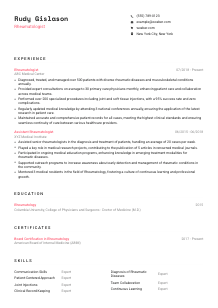
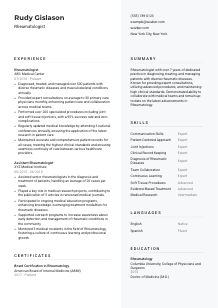
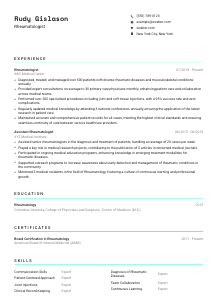
Cracking joints, but your CV feels stiff? Flex your skills with this Rheumatologist CV example, created with Wozber free CV builder. Learn how to align your expertise with job requirements, paving the way for your career to move as fluidly as the joints you treat!
Rheumatology hiring usually turns on clinical depth that is easy to recognize fast. A hiring team wants to see whether you can manage complex autoimmune and musculoskeletal cases, perform procedures confidently, collaborate with referring physicians, and document care with the level of detail that supports continuity, compliance, and patient safety. Your CV should make that clinical scope visible from the first screen.
When the CV is tailored well, it becomes much easier to distinguish a true rheumatology specialist from a general internal medicine profile with partial overlap. Using Wozber's free CV builder and an ATS-friendly CV format helps you align your wording with the posting's clinical language, board-status requirements, and procedure expectations so the reader can quickly understand your readiness for independent rheumatology practice.
This section does not need much space, but it does need precision. In physician hiring, small details such as specialty title, contact accuracy, and location can affect whether your application moves forward to credential review or a first conversation.
Place your name at the top in a clean, readable format. Keep it prominent and professional so it anchors the page immediately, especially in a CV that may be reviewed alongside board status, fellowship training, and procedural experience.
Under your name, list the title "Rheumatologist" exactly as it appears in the posting when that matches your current scope of practice. This helps both human reviewers and ATS tools connect your profile to a role focused on rheumatic disease management, consultations, and office-based procedures.
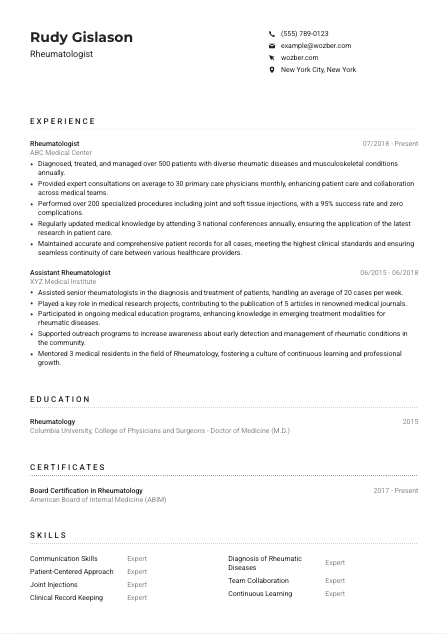
Use a professional email address, confirm your phone number is correct, and include your city and state when location is relevant. In the example, listing "New York City, New York" directly addresses a stated requirement. If relocation applies to you, make that easy to understand rather than leaving the recruiter to guess.
Include LinkedIn, a physician profile, or a professional website only if it strengthens your candidacy. For a Rheumatologist, that could mean a profile showing hospital affiliations, publications, research interests, or speaking activity. Keep the information consistent with your CV, especially around titles, dates, and credentials.
Do not include age, marital status, headshot, or other nonessential personal details unless a specific market requires them. Keep the focus on clinical qualifications, communication access, and job-relevant logistics.
Treat this section like the front desk of your application. It should confirm who you are, what specialty you practice, and whether you meet practical requirements before the reader turns to your clinical record.




For a Rheumatologist, experience is where clinical credibility is built. Hiring teams look for more than time in practice. They want to understand your patient volume, case mix, procedural scope, collaboration with referring providers, and the standards you maintain in follow-up care and documentation.
Before editing your bullets, mark the responsibilities and requirements that shape the role. In this case, the CV should clearly reflect diagnosis and management of rheumatic and musculoskeletal conditions, consultations with primary care physicians, specialised procedures, current clinical knowledge, and detailed patient records. Those terms belong in your experience section when they reflect your real work.
List your most recent physician role first and work backward. That format lets the reviewer quickly see your current scope of practice, how long you have worked post fellowship, and whether your responsibilities have grown from supporting care to leading consultations, treatment plans, and procedures.
Every bullet should show what you handled and what it led to. Instead of writing only that you treated rheumatic diseases, specify the scale, complexity, or outcome. The example does this well by showing annual patient volume, monthly consultation frequency, and procedure counts. Those details tell a much fuller story than a generic list of responsibilities.
Numbers work especially well here when they reflect real physician performance. Patient volume, consultation load, procedure totals, publication count, complication rates, continuity of care measures, or education activity all help. "Performed over 200 specialised procedures with a 95% success rate and zero complications" is strong because it shows procedural competence in language that feels native to clinical hiring.
Prioritise work that supports your rheumatology profile. Internal medicine training, rheumatology practice, research tied to autoimmune disease or musculoskeletal care, resident mentoring, and interdisciplinary consultation usually deserve space. Older or unrelated roles should only stay if they explain your path or add meaningful clinical context.
Your experience section should leave no doubt about the level at which you practice. A reviewer should be able to see your clinical volume, procedural confidence, team collaboration, and standard of documentation without having to infer them.
Physician education is not just background information here. For rheumatology roles, the hiring team needs to confirm a clear training path from medical degree through internal medicine training and rheumatology specialization, often before they spend much time on the rest of the CV.
Make your M.D. or D.O. unmistakable, then show the training that supports independent rheumatology practice. The job description asks for an accredited medical degree, internal medicine residency, and rheumatology fellowship. If your education section alone does not make that sequence clear, use the experience or certifications section to complete the picture.
List each institution, degree, field or training area, and completion year in a consistent format. Physician CVs are often reviewed quickly for credentialing basics, so clean structure matters. Start with the most advanced or most relevant entry, as the sample does.
Medical education wording should be precise. If you earned an M.D., say M.D. If you completed Internal Medicine training and a Rheumatology fellowship, name them directly rather than relying on broad specialty labels. Exact terminology helps with ATS matching and avoids confusion during credential review.
Most practicing Rheumatologists do not need coursework details. Include them only if you are early in your career or if a course of study directly supports a niche area such as immunology research, musculoskeletal ultrasound, or clinical investigation. Once your practice record is established, your training path and outcomes matter more.
Honors, research projects, leadership roles, or thesis work can strengthen this section when they point toward rheumatology, autoimmune disease, internal medicine excellence, or scholarly contribution. This is especially useful for newer attendings whose publication or fellowship record helps offset a shorter post-training work history.
This section should quickly answer the credential question. The reader should be able to trace your preparation for rheumatology practice without searching across multiple sections for missing pieces.
In a physician CV, certifications often carry screening weight early. For rheumatology openings, board certification or board eligibility is frequently a hard filter, and the way you present it can affect how quickly your application moves to interviews or credentialing review.
Place your most relevant certification first. For this role, that means board certification or board eligibility in Rheumatology through ABIM or AOBIM, depending on your path. If the certification is current, say so clearly. If you are board eligible, use that exact wording rather than leaving the reviewer uncertain.
Focus on certifications that support your ability to practice as a Rheumatologist. Internal Medicine board certification belongs here because it underpins your specialty training. Other entries should earn their place by strengthening your clinical scope, subspecialty expertise, or employability in the target setting.
Show the issue year and, when relevant, active date range. In the example, "2017 - Present" immediately communicates that board certification is active. That kind of detail helps both recruiters and medical administrators confirm status without follow-up.
If you maintain additional training in procedures, clinical research, or specialty updates, include it when it strengthens your current candidacy. Rheumatology values physicians who stay current with evolving biologics, treatment guidelines, and emerging evidence, so selective continuing education can reinforce that pattern.
Your certifications should answer the board-status question quickly and cleanly. When this section is handled well, the reader can move on from credential checks and focus on your clinical strengths.
A rheumatology skills section works best when it reads like a concise map of your clinical practice. Broad claims are less useful than a balanced mix of diagnostic judgment, procedures, collaboration, and patient communication that matches the way rheumatologists work day to day.
Review the job description for the skills that shape daily practice. Here, that includes diagnosis of rheumatic disease, management of musculoskeletal conditions, specialised procedures, communication, and a patient-centered approach. Those belong on the CV when they reflect your genuine strengths, not as copied keywords without support elsewhere.
Put the most role-relevant skills first. For a Rheumatologist, that may include joint injections, soft tissue procedures, autoimmune disease diagnosis, evidence-based treatment planning, clinical documentation, interdisciplinary consultation, and patient education. The sample list works because it combines technical and relational strengths instead of leaning on generic soft skills alone.
Keep the list focused and readable. Grouping skills by clinical practice, procedures, communication, or research can help if your format allows it. Whether you use ratings or not, make sure the section supports the rest of the CV and does not overstate abilities that are not visible in your experience bullets.
This section should reinforce what your experience already shows. If a hiring team scans your skills in five seconds, they should immediately recognize a physician who can manage patients, coordinate care, and perform the procedures the role requires.
Rheumatology depends on clear communication. Treatment plans often involve chronic disease management, medication counseling, symptom history, and shared decision-making over time, so language ability can matter well beyond a basic application detail.
If the posting specifies English fluency, include it directly and use an accurate proficiency label such as "Native" or "Fluent." This is especially important in patient-facing roles where consultation quality, charting accuracy, and multidisciplinary communication all rely on precise language use.
Additional languages can be an advantage in practices serving diverse communities. The example includes Spanish, which can be valuable in many urban care settings. Treat that as a tailoring opportunity, not a universal requirement. Include extra languages when they genuinely help you connect with your patient population or care team.
Use realistic levels. In medicine, overclaiming language ability can create practical problems in consent discussions, symptom assessment, and follow-up education. If you can hold clinical conversations, that is different from basic conversational comfort, and your CV should reflect the distinction.
Language skills matter most when they improve understanding. If bilingual ability has helped you explain long-term treatment plans, support adherence, or build rapport with patients and families, it strengthens your profile as a clinician who can deliver more accessible care.
Only list languages you can actually use. A short, truthful section carries more value than a longer list with weak proficiency. For a specialty built around ongoing patient relationships, credibility matters here as much as in your clinical claims.
When language skills are relevant, they should point back to patient understanding and team communication. That is what makes this section useful in a rheumatology CV, not the number of languages alone.
The summary sits at the top of the CV, so it should quickly establish the level of physician you are. For a Rheumatologist, that usually means years in practice, core clinical scope, procedural or consultation strengths, and the kind of care environment where you work best.
Start by identifying the few responsibilities that most define the opening. In this posting, that means diagnosing and managing rheumatic disease, performing procedures, collaborating with physicians, and maintaining high clinical standards. Use those themes to shape your opening lines rather than writing a generic physician profile.
Begin with a direct professional statement such as your title and years of practice. The sample summary opens with "Rheumatologist with over 7 years of dedicated practice," which works because it immediately establishes specialty and tenure. If you are earlier in your career, you can anchor the summary with fellowship completion, board eligibility, and patient population focus instead.
Choose the strengths most likely to matter for the target role. That may be high-volume outpatient management, referral consultations, office-based procedures, clinical research, or patient-centered communication. Mirror the posting's language where it is accurate, but keep the phrasing specific enough to sound like your actual practice.
Aim for three to five lines. That is enough space to show specialty, experience, and a few differentiators without repeating your experience bullets. Tight summaries read best when every phrase points to something concrete, such as case management, procedural competence, interdisciplinary care, or staying current with treatment advances.
A well-written summary should make the rest of the CV easier to read. By the time someone reaches your experience section, they should already understand your level, your specialty focus, and the kind of rheumatology work you do best.
A rheumatology CV works when it presents the full physician picture clearly: training, board status, independent clinical practice, procedures, consultations, documentation standards, and patient-centered communication. When those pieces are aligned with the posting, the hiring team can quickly see whether you are ready for the role.
Use Wozber's free CV builder and ATS CV scanner to tighten section wording, match relevant specialty terms, and produce an ATS-compliant CV that reads cleanly in an ATS-friendly CV template. The finished document should make one thing easy to judge: your ability to deliver high-standard rheumatology care from day one.




