



Use Wozber and land your dream job
Create CV
No registration required
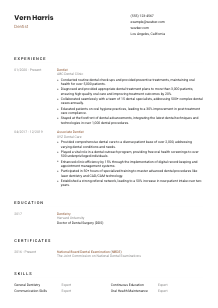
Filling cavities, but your CV's got a gap? Check out this Dentist CV example, created with Wozber free CV builder. Learn how to shape your oral health expertise to match job specs and keep your dental career as polished as those pearly whites!
Dentistry is hands-on clinical work built on trust. Hiring teams want to see more than a degree and a license. They look for clear signs that you can diagnose accurately, carry out routine and restorative procedures safely, explain treatment plans to patients, and keep care standards high across a full schedule of check-ups, fillings, extractions, and follow-up visits.
A tailored CV changes how quickly that clinical picture comes through. When your wording matches the posting's treatment scope, patient-care focus, and credential requirements, an ATS-compliant CV is far more likely to surface the right experience early. Wozber's free CV builder helps organise that language cleanly, support ATS optimisation, and make it easier for a practice to see your readiness for the chair, not just your job history.
Dental hiring starts with practical basics. A clinic needs to know you are reachable, professionally presented, and available for the setting they are hiring into. In a role with licensure, patient-facing care, and sometimes location-specific requirements, this section should be clean, exact, and easy to scan.
Use your full name at the top in a clear, readable format. Keep the styling professional rather than decorative. In healthcare hiring, clarity matters more than design flair, and your name should anchor the page the same way your credentials anchor your clinical profile.
Place the exact job title under your name when it reflects the role you are applying for, such as "Dentist." This helps immediately position you for general dentistry openings and supports ATS alignment by echoing the language used in the posting.
Add a reliable phone number and a professional email address that uses your name. Avoid informal handles. If a practice wants to move quickly from CV review to interview scheduling, your contact details should make that effortless.
If the posting calls for local availability or on-site work, list your city and state. Here, "Los Angeles, California" directly addresses the employer's stated location requirement. Use this kind of detail when it removes an obvious question about relocation or commute, not as filler.
Include a LinkedIn profile or professional website only if it reinforces your dental background with consistent dates, credentials, and career history. If you maintain a profile that mentions treatment focus, continuing education, or community outreach, make sure it matches the CV exactly.
Your personal details should read like the front desk version of good patient intake: accurate, complete, and easy to work with. When the basics are handled well, the hiring team can move straight to your clinical qualifications.




For dentists, experience is where practices look for day-to-day competence. They want to understand your patient volume, treatment range, clinical judgment, collaboration with specialists, and the outcomes you help produce. Job titles alone do not show that. Your bullets need to describe real care delivered.
Read the job description with a clinician's eye. Note the procedures, patient responsibilities, and workflow expectations it emphasizes, such as preventive care, treatment planning, extractions, fillings, root canals, patient education, and collaboration on complex cases. Those are the points your experience section should answer directly, using natural language rather than copied phrases.
List your most recent dental role first, followed by earlier positions. For each entry, include your title, the practice or clinic name, and dates of employment. This straightforward structure helps hiring teams quickly trace your progression from associate-level care to broader clinical responsibility, if applicable.
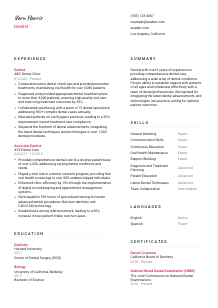
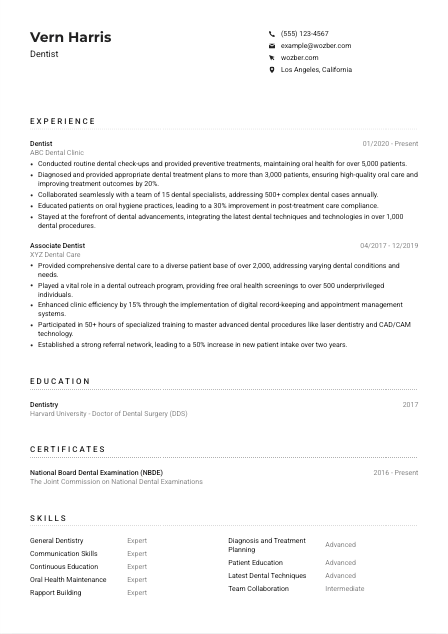
Focus each bullet on what you actually handled in practice. Strong dentist bullets often describe patient volume, diagnostic work, treatment planning, preventive care, restorative procedures, patient compliance, or referral coordination. The example CV does this well by pairing duties with outcomes, such as treatment planning for more than 3,000 patients and a 20% improvement in treatment results.
Metrics carry weight when they are native to the work. Useful figures include patients treated, procedures completed, complex cases supported, compliance improvement, efficiency gains, referral growth, or continuing education hours applied to new procedures. The sample's references to 5,000 patients, 500+ complex cases, and 30% better post-treatment compliance give hiring managers a clearer sense of scale than broad claims ever could.
Prioritise experience that strengthens your case as a practicing dentist. If you have older or unrelated work, keep it brief or remove it unless it adds something meaningful, such as patient communication, healthcare operations, or community oral health outreach. Every bullet should help a practice understand the kind of care environment you have worked in and the level of responsibility you can take on now.
A well-built experience section should leave little guesswork about your chairside ability. Show the procedures, patient populations, results, and collaboration points that define your practice, and your CV will read like a dentist's record of work, not a generic career summary.
Dental education is not background detail. It is a core qualification, and practices look for it quickly. Your CV should make your dental degree easy to spot, especially when the job specifically requires a DDS or DMD from an accredited institution.
Place your DDS or DMD prominently in the education section. For this opening, a Doctor of Dental Surgery or Doctor of Dental Medicine is essential, so it should never be buried under undergraduate study. The sample CV gets this right by leading with the DDS.
For each entry, include the school, degree, field of study, and graduation year. Keep the layout simple so both ATS systems and practice managers can find your qualifications immediately. This section does not need extra design if the academic information is already strong.
Use the formal name of your degree exactly as awarded. If the posting asks for a DDS or DMD, write "Doctor of Dental Surgery" or "Doctor of Dental Medicine" in full, and include the abbreviation if useful. Precision matters in regulated healthcare roles.
If you completed advanced coursework tied to procedures or technologies the employer values, mention it when appropriate. Examples could include endodontic training, digital dentistry, CAD/CAM exposure, or other clinical education that supports your current scope of practice. Keep the focus on training that strengthens your candidacy for the role at hand.
Academic honors, distinctions, or leadership roles can add value, especially for earlier-career dentists. For someone with several years of clinical work, though, degrees, licensure, and treatment experience usually matter more. Include honors when they add context, not when they distract from your professional practice.
This section should answer the first academic question immediately: are you formally trained and properly credentialed to practice dentistry? When your degree is easy to find and clearly presented, the hiring team can move on to your clinical experience with confidence.
In dentistry, certifications are not decorative. They confirm legal eligibility, exam completion, and ongoing professional standing. Employers should be able to see your licensure status and required board credentials without searching for them.
Start with the certifications and licenses named in the job description. For this role, that means the National Board Dental Examination and state dental licensure. Put these near the top of the section so the employer can confirm essential eligibility right away.
Keep the list focused on what supports your ability to work as a dentist now. State licensure, board examinations, and relevant procedural certifications carry more weight than unrelated courses. If you have several items, order them by hiring importance rather than date alone.
Add issue dates and renewal or active dates where relevant. In regulated healthcare roles, dates help show that your qualifications are current. The example CV handles this clearly by showing both NBDE status and California licensure as ongoing.
Dentistry changes with new materials, imaging tools, restorative methods, and compliance standards. If you have recent training in areas such as laser dentistry, digital workflows, or updated treatment techniques, include those credentials when they support the position. This helps show that your practice has stayed current, not static.
Your certifications section should quickly answer two practical questions: can you practice, and have you kept your clinical knowledge up to date? When those answers are clear, the rest of your CV carries more weight.
A dentist's skills section should sound like a clinic, not a generic professional profile. It needs to balance treatment capability with patient communication, because both affect outcomes. The most useful skills are the ones the employer can connect directly to chairside care, diagnosis, teamwork, and patient education.
Start with the competencies the role depends on. For a general dentist, that may include general dentistry, diagnosis and treatment planning, preventive care, restorative procedures, patient education, and collaboration with specialists. Use the posting to guide emphasis, especially when it names procedures such as fillings, extractions, and root canals.
A useful skills list should reflect both technical care and patient-facing work. In dentistry, rapport building, communication, and explaining post-treatment care are not secondary skills. They influence case acceptance, patient trust, and follow-through. The example CV pairs clinical capabilities with communication and oral health maintenance, which is a strong approach.
Choose concise, recognizable skill labels. Avoid vague entries that could belong to any healthcare role. "Diagnosis and Treatment Planning" says far more than "problem-solving," and "Patient Education" is stronger than "people skills." Make every item feel tied to work you actually perform in a dental setting.
This section should support what your experience already shows. When your skills reflect real procedures, patient communication, and clinical workflow, the hiring team gets a sharper picture of how you would operate in practice.
Dental visits depend on clear communication. Patients need to understand treatment recommendations, consent, oral hygiene guidance, and post-procedure instructions. If a posting specifies English fluency, your CV should confirm that directly, and any additional languages can strengthen your value in a diverse patient population.
If the employer asks for strong English fluency, list English clearly with an honest proficiency level. This role makes that requirement explicit, so do not leave it implied elsewhere in the CV.
Additional languages can matter in dental settings where trust, education, and follow-up instructions must be understood clearly. In some markets, Spanish or another widely spoken language can support stronger rapport and smoother patient communication. Include extra languages when they are genuinely usable in practice.
Stick with clear terms such as "Native," "Fluent," "Intermediate," or "Basic." That gives employers a realistic sense of how comfortably you can explain treatment plans, answer questions, or guide patients through aftercare.
Language skills become especially relevant when a practice serves families, multilingual communities, or patients who may need extra clarity around procedures and recovery instructions. Highlighting those abilities can strengthen your application when communication is a visible part of the clinical experience.
For dentists, language ability is not simply an extra line item. It affects comfort, understanding, and compliance. If you can communicate with patients in more than one language, that can improve the overall care experience and deserves a place on the CV.
Your language section should help a practice see how well you can explain care, build rapport, and support follow-through. In dentistry, those communication gains often show up in better patient experience and better compliance.
Your summary sits at the top of the CV, so it should establish your level of practice within a few lines. For dentists, that means combining years of experience with a clear picture of treatment scope, patient care style, and any strengths that match the role's immediate needs.
Open with your title and years of practice, for example, "Dentist with 6+ years of experience in general dentistry." That gives the reader immediate context and helps position you at the right seniority level.
Use the posting to decide what belongs in these lines. If the role emphasizes diagnosis, routine treatment, patient rapport, and teamwork with specialists, bring those themes into the summary using your own experience. This is the place to connect your background to the kind of care the practice delivers every day.
Choose details that reflect your working style and clinical value, such as treatment planning, preventive care, patient education, or adoption of newer dental techniques. The sample summary works because it combines broad care experience with rapport-building and collaboration, instead of listing every procedure performed.
Aim for 3 to 5 lines. That is enough space to establish your background, your clinical focus, and one or two differentiators. Avoid generic adjectives and let specifics do the work. A concise summary with concrete dental language will always read stronger than a long paragraph full of broad claims.
A strong summary gives the hiring team an immediate read on your experience, treatment focus, and patient-care approach. Get that right, and the rest of the CV has a clear clinical frame.
A dentist CV works best when it reads like a record of real clinical care. Degrees, licensure, patient volume, treatment scope, collaboration with specialists, and communication with patients should all be easy to find and easy to trust.
Use Wozber's free CV builder to structure that information in an ATS-friendly CV format, then refine the language with its ATS CV scanner and AI-powered tailoring tools so your experience matches the role's requirements naturally. The finished CV should make one thing clear fast: you are ready to deliver safe, effective dental care from day one.