



Use Wozber and land your dream job
Create CV
No registration required
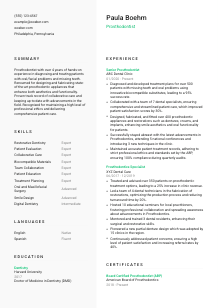
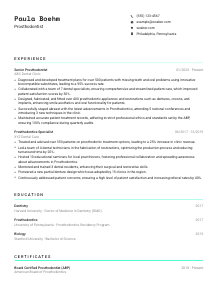
Crafting smiles, but your CV feels like it's missing a tooth? Check out this Prosthodontist CV example, created with Wozber free CV builder. Learn how to effortlessly connect your dental expertise with job requirements, ensuring your career shines as bright as a polished set of pearly whites!
Prosthodontics is one of the few dental specialties where treatment planning, technical execution, and patient communication carry equal weight. Hiring teams want to see that you can restore function and aesthetics with precision, manage complex cases involving dentures, crowns, and implants, and explain procedures in language patients can trust. Your CV needs to make that clinical judgment visible, not bury it under generic dental experience.
When a prosthodontist CV is tailored well, the reader can quickly connect your case volume, restorative scope, residency training, and board credentials to the role at hand. Wozber's free CV builder helps you shape that experience into an ATS-compliant CV that mirrors the employer's language naturally, so your background in treatment planning, prosthetic restoration, and interdisciplinary care is easier to recognize from the first scan.
In clinical hiring, the header is where basic logistics get cleared fast. For a prosthodontist, this section should confirm who you are, how to reach you, and whether you meet practical requirements such as location, without distracting from your clinical qualifications.
Place your full name at the top in a clean, readable format. Avoid decorative styling. In specialist hiring, your header should feel as polished and professional as the treatment plans you present to patients and referring providers.
List your title directly under your name as "Prosthodontist." If you hold a more specific variation such as "Board-Certified Prosthodontist," use it only when it is accurate and supported elsewhere in the CV. Matching the target title helps position you for both ATS screening and human review.
Include your phone number and a professional email address you check regularly. If you add a website, make sure it supports your candidacy with a professional profile, publications, speaking work, or practice information. Every link should reinforce credibility, not create extra cleanup for the reviewer.
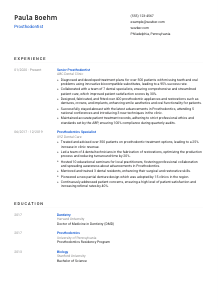
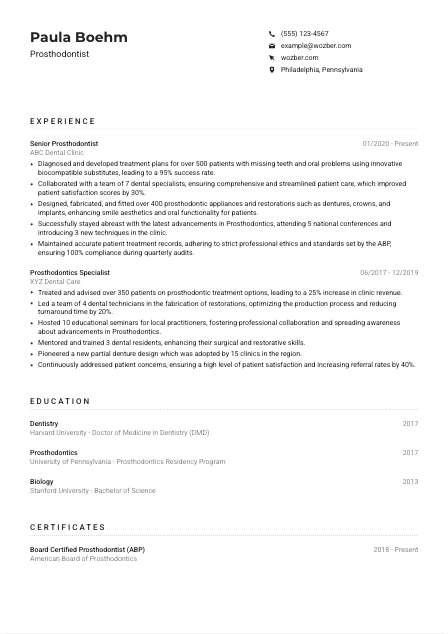
If a role specifies a city or relocation requirement, mention your city and state clearly. In the example, listing Philadelphia, Pennsylvania immediately answers a stated hiring condition. If you are relocating, note that directly rather than leaving the employer to guess.
A digital footprint can help when it shows relevant professional substance, such as case-focused presentations, research, faculty work, or an established practice profile. Skip personal social links. A prosthodontist CV benefits from signals of clinical authority, not general online activity.
Do not include age, marital status, photo, or other unrelated personal information unless local hiring norms explicitly require it. For this specialty, hiring decisions should stay centered on licensure, residency training, restorative scope, patient care standards, and communication ability.
Your personal details should remove practical questions in seconds. If the header is clean and complete, the hiring team can move straight to your board status, case history, and prosthodontic experience.




This is where your CV proves you can handle real prosthodontic work, not just list credentials. The strongest experience sections show the kinds of cases you managed, the restorations you delivered, the specialists you worked with, and the patient outcomes or operational results that followed.
Start from the clinical requirements in the posting and make sure your work history answers them directly. If the employer asks for 3+ years in prosthodontics, your dates and titles should make that easy to confirm. Highlight positions where you diagnosed oral or facial problems, developed treatment plans, restored missing teeth, or managed complex prosthetic cases.
List each role in reverse chronological order with job title, employer, and employment dates. For specialists, titles matter. "Senior Prosthodontist" and "Prosthodontics Specialist" immediately frame scope more clearly than a generic dental title would. This structure also helps the reviewer see progression in clinical responsibility.
Each bullet should show what you handled and what changed because of your work. Strong examples include patient volume, restoration volume, treatment success, turnaround time, audit compliance, referral growth, or patient satisfaction. The sample CV does this well by citing 500+ patients treated, 400+ restorations completed, and 100% compliance during quarterly audits.
Mirror the employer's wording where it reflects your actual background. If the role emphasizes treatment planning, prosthodontic appliances, biocompatible substitutes, interdisciplinary collaboration, and accurate records, use those ideas in your bullets naturally. That helps both ATS systems and dental decision-makers connect your experience to the position quickly.
Numbers are especially persuasive in a specialty built on precision and repeatable clinical results. Include metrics tied to real prosthodontic performance, such as number of cases restored, implant-supported prostheses delivered, patient satisfaction improvement, reduced lab turnaround, or referral retention. Use data that reflects your actual contribution to patient care or clinic performance, not filler statistics.
Your experience section should show a practicing prosthodontist who can diagnose, restore, collaborate, and document at a high standard. If your bullets make the reader picture the complexity and scale of your clinical work, this section is doing its job.
Education matters more in prosthodontics than in many other roles because the training path is highly specific. Your CV should make your dental degree and specialty residency easy to verify, with no ambiguity about whether you meet the core academic requirements.
List your DDS or DMD prominently, including the institution and graduation year. Since the role specifically requires a DDS or DMD from an accredited institution, this should never be buried. In the example, the DMD is placed clearly and immediately supports eligibility.
Use a consistent structure for each entry: degree, field, school, and graduation date. This makes it easier for hiring teams to confirm that you completed both general dental education and advanced specialty training without searching through extra wording.
Accuracy matters here. If your degree is "Doctor of Dental Surgery" or "Doctor of Medicine in Dentistry," write it in full so there is no doubt about equivalency. Precise degree naming helps avoid confusion during credential review, especially in specialist and hospital-affiliated settings.
Completion of an accredited prosthodontics residency is a central qualification, so give it a dedicated education entry rather than hiding it in a summary or certificate section. The sample CV handles this correctly by listing the residency separately, which immediately confirms specialty training.
Honors, research, teaching, or advanced coursework can be useful if they connect to prosthodontics, restorative dentistry, biomaterials, digital workflows, or oral rehabilitation. Keep the emphasis on training that supports your clinical practice rather than unrelated campus activities.
Your education section should remove any doubt about foundational dental training and specialty preparation. A hiring manager should be able to verify your DMD or DDS and your prosthodontics residency in one quick read.
In prosthodontics, certifications are not decorative extras. They often confirm legal eligibility, specialty standing, and ongoing professional development in a field where materials, digital workflows, and restorative protocols continue to evolve.
For this kind of role, board certification in Prosthodontics is a major credential and should appear first. If you hold American Board of Prosthodontics certification, state it clearly with the issuing body and active dates. That immediately answers one of the employer's most important qualification checks.
List certificates and licenses that support actual prosthodontic work, such as state dental licensure, implant training, digital dentistry coursework, maxillofacial prosthetics education, or advanced biomaterials training. Keep the section focused on credentials that deepen your clinical authority.
Dates matter because employers need to know whether a license or certification is current. Use clear ranges such as "2018 - Present" when the credential remains active. The example CV does this effectively for both board certification and Pennsylvania licensure.
If you regularly complete continuing education in implant systems, CAD/CAM workflows, esthetic rehabilitation, or complex restorative planning, include the strongest items. This is especially useful when the posting mentions keeping up with advancements in prosthodontics and related technologies.
Certifications should show that your specialist credentials are current and your clinical knowledge is active. In prosthodontic hiring, that combination carries real weight.
A prosthodontist skills section should read like a snapshot of how you practice. It needs to cover both the clinical abilities required to restore oral function and the communication strengths that help patients understand complex treatment options and move forward with care.
Review the posting for both explicit and implied capabilities. For this role, that includes treatment planning, prosthodontic restorations, patient communication, collaborative care, record accuracy, and familiarity with current techniques. Build your list from the work itself, not from a generic dental skills bank.
Balance specialist competencies such as restorative dentistry, smile design, biocompatible materials, implant prosthetics, and digital dentistry with interpersonal skills like patient education and team collaboration. The example CV does this well by pairing clinical depth with communication and coordination skills that matter in multidisciplinary practice.
Place the most role-specific capabilities first. A hiring team reviewing specialist CVs will care more about treatment planning, restorative expertise, collaborative case management, and prosthetic design than broad terms like "leadership." If you group skills, use categories that reflect actual practice, such as Clinical, Technical, and Patient Care.
Your skills section should make your clinical toolkit easy to scan. A reader should come away seeing a prosthodontist who can restore, explain, collaborate, and keep pace with modern specialty practice.
Language skills matter in prosthodontics because treatment acceptance often depends on trust, clarity, and patient understanding. When cases involve implants, full-mouth rehabilitation, or long treatment timelines, communication is part of the clinical work.
If the posting states that English fluency is essential, list English at the top with an honest proficiency level such as "Native" or "Fluent." This is especially important in a patient-facing specialty where explaining procedures, risks, aftercare, and expectations is part of daily practice.
Extra languages can strengthen your profile when they help you communicate with a broader patient base. In the example, Spanish adds practical value because it can improve consultation quality and patient comfort in many clinical settings. Treat added languages as a patient-care asset, not a decorative detail.
Choose straightforward levels such as Native, Fluent, Conversational, or Basic. Avoid inflated claims. In healthcare, accuracy matters, and overstating language ability can create real problems in patient communication.
Think about how your language ability supports consultations, informed consent, treatment plan discussions, and follow-up instructions. A second language is most persuasive on a CV when the employer can picture how it improves the patient experience.
This section does not need a long explanation. List languages that you can genuinely use in a professional setting and leave out marginal proficiency if it would not help in chairside communication or team collaboration.
For a prosthodontist, language ability can directly support treatment understanding and patient confidence. List what you can truly use in practice, and let that reinforce your ability to deliver clear care.
Your summary should sound like an experienced prosthodontist introducing the scope of their practice. In a few lines, it should establish your specialty training, years of experience, restorative focus, and the strengths that make you effective with both patients and clinical teams.
Before writing, identify the two or three priorities in the posting that matter most. Here, that includes prosthodontic clinical experience, advanced restorative care, and the ability to explain procedures clearly to patients. Those themes should shape the wording of your opening lines.
Start with your title and years of experience, then define your clinical focus. A line such as "Prosthodontist with 4+ years of experience in treatment planning and restorative care for patients with missing teeth and oral or facial conditions" works because it establishes specialty, tenure, and case relevance immediately.
Use the next sentence to highlight what sets your work apart. That might be high-volume restoration experience, strong interdisciplinary coordination, advanced knowledge of biocompatible materials, or adoption of new prosthodontic techniques. In the example, the summary gains strength by referencing appliance design, collaborative care, and current specialty knowledge.
Aim for three to five lines. Skip broad traits like "hardworking" or "passionate" unless they are tied to something real. The summary should quickly answer what you treat, how you practice, and why your background fits the position without repeating every bullet from the experience section.
A well-written summary gives the hiring team an immediate sense of your specialty scope and professional level. By the time they move into your experience, they should already understand that you are trained, clinically credible, and aligned with the kind of prosthodontic work the role requires.
A prosthodontist CV works best when it presents your credentials, residency training, restorative experience, and patient communication in the same precise way you approach clinical care. Every section should help the employer see that you can diagnose complex cases, deliver high-quality prosthetic treatment, and collaborate smoothly within a dental team.
Use Wozber's free CV builder to shape your content into an ATS-friendly CV format that reflects the language of the job description and keeps your specialist qualifications easy to scan. The final result should make one thing clear fast: you are ready to step into prosthodontic practice with proven clinical judgment and the right professional foundation.