



Use Wozber and land your dream job
Create CV
No registration required
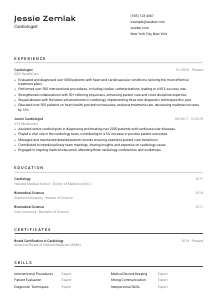
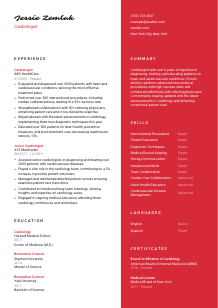
Mending hearts, but your CV skipping a beat? Sync it up with this Cardiologist CV example, created with Wozber free CV builder. Learn how to align your medical prowess with job requirements, setting your career pulse at a healthy pace!
Cardiology CVs are read through a clinical lens. Hiring teams want to see how you evaluate cardiovascular conditions, make treatment decisions, handle procedures when applicable, and work with referring physicians and care teams without losing sight of patient outcomes. If your CV stays at the level of broad physician duties, it misses the details that distinguish a practicing cardiologist from other internal medicine specialists.
A tailored CV changes the first read. When your experience, credentials, and terminology match the target role, reviewers can quickly separate general cardiac exposure from true cardiology practice, and ATS screening can pick up the right phrases as well. Wozber's free CV builder helps organise that alignment into an ATS-friendly CV format, so your application makes your clinical scope and cardiology background easier to recognize right away.
In medicine, small administrative details matter because they affect whether a candidate can move forward at all. Your personal details section should make it easy to confirm who you are, how to reach you, what role you practice in, and whether you meet practical requirements such as location or licensure alignment. For a cardiologist, keep this section clean, professional, and immediately relevant.
Place your full name at the top in a larger, easy-to-read font. In physician hiring, this section should feel as orderly as the rest of the CV. Avoid decorative styling. The goal is simple identification, especially when your application may be reviewed alongside credentialing documents, publication lists, or hospital system records.
List "Cardiologist" directly under your name when that is the role you are pursuing. This helps frame your experience from the first line and supports ATS matching when the posting uses that exact title. If your background is more specialised, such as interventional cardiology, only add that when it matches your actual training and the role you are targeting.
Include a reliable phone number and a professional email address. Physician hiring often moves through recruiters, practice administrators, and credentialing staff, so accuracy matters. A missed digit or outdated email can interrupt follow-up on interviews, hospital privileges, or licensing discussions.
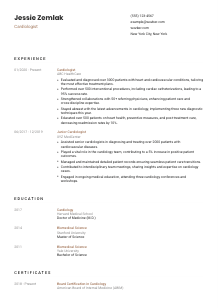
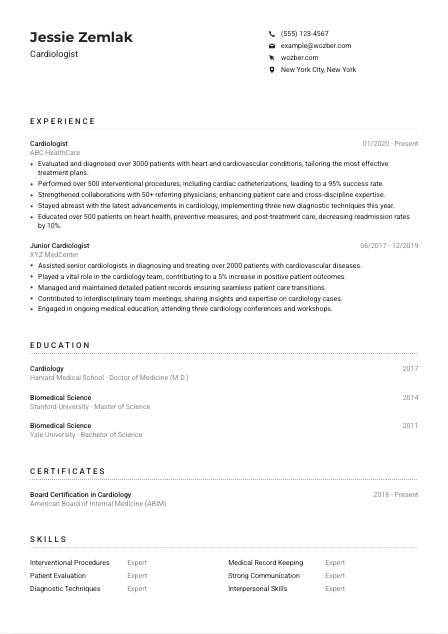
If a job requires you to be based in a specific city or state, show that clearly in this section. In the example, listing New York City, New York directly supports the employer's stated location requirement. Treat this as tailoring to the posting, not as a standard rule for every cardiology CV.
A LinkedIn profile, physician biography page, or professional website can be useful if it is current and consistent with your CV. For cardiologists, this may reinforce hospital affiliations, publications, speaking activity, or areas of clinical focus. Skip it if the profile is sparse or out of date.
This section should answer the practical basics without distraction. When your title, contact details, and any posting-specific location information are clear, reviewers can move straight to your clinical experience instead of pausing on administrative questions.




For a cardiologist, the experience section carries most of the hiring weight. This is where you show patient volume, diagnostic range, procedural work, collaboration with referring physicians, and outcomes tied to treatment decisions. The strongest entries sound like real practice, not generic physician summaries.
Before you edit bullets, identify the recurring priorities in the job description. In this example, those include evaluation and diagnosis of cardiovascular conditions, treatment planning, interventional procedures, collaboration with referring physicians, patient education, and staying current with advancing techniques. Those themes should shape which cases, outcomes, and responsibilities you emphasize.
Start with your current or most recent cardiology position and work backward. For each entry, include title, institution or practice name, and dates. This structure lets hiring teams quickly understand your clinical progression, whether you moved from fellowship into attending practice, from general cardiology into procedural work, or from junior roles into broader patient and referral responsibility.
Each bullet should show how you practiced cardiology, not just that you held the job. Focus on work such as evaluating cardiac patients, diagnosing complex conditions, managing treatment plans, performing procedures, coordinating with other physicians, or educating patients after intervention. The sample does this well by showing direct patient care, procedural volume, collaboration, and implementation of new diagnostic techniques.
Metrics help when they are native to the specialty. Good measures include patient volume, number of catheterizations or other procedures, success rates, readmission reduction, number of referring physicians supported, or improvement in outcomes. In the example, "evaluated and diagnosed over 3000 patients" and "performed over 500 interventional procedures" give a much clearer picture of scope than a general statement about providing care.
Keep the section centered on cardiology practice. If an older role adds little beyond broad medical duties, shorten it and preserve space for higher-value content such as procedural experience, cardiovascular disease management, interdisciplinary care, or quality improvement. Your experience section should leave no doubt about your level of clinical responsibility and the kind of cardiology work you can step into now.
By the end of this section, a reviewer should understand your practice scope, your procedural depth if relevant, and the patient outcomes tied to your work. That is what turns experience into a credible cardiology profile.
Education matters in physician hiring because certain credentials are baseline requirements, not optional differentiators. For a cardiologist, your degree path should make your medical training easy to confirm at a glance, while any additional academic work can add context without distracting from the essential qualifications.
If the posting asks for an M.D. or D.O. from an accredited medical school, that credential should be impossible to miss. List the degree clearly, with the school and graduation year. In this example, the Doctor of Medicine degree is the key item that directly answers the stated requirement.
Lead with your terminal medical degree, then any additional graduate education, followed by undergraduate study. This format reflects how physician credentials are typically reviewed and prevents less relevant earlier education from taking attention away from your medical qualification.
If your education entry includes a field or concentration tied to cardiology or biomedical science, include it when it adds clarity. Do not overstate academic labels, especially if your actual specialty training is shown elsewhere. The point is to support your medical foundation, not to replace fellowship or board information.
For early-career cardiologists, selected rotations, clinical concentrations, or research work can help bridge the gap between training and independent practice. For more established physicians, this level of detail usually matters less than board certification, clinical experience, and procedural history. Use space where it adds the most value for your stage.
A master's degree or other advanced study can support your candidacy when it connects to research, cardiovascular science, population health, or clinical innovation. In the example, a Master of Science in Biomedical Science adds academic depth, but it should remain secondary to the medical degree that qualifies you for practice.
This section should confirm that you meet the medical education requirement quickly and cleanly. Once that foundation is clear, the rest of the CV can do the deeper work of showing your cardiology practice.
In cardiology hiring, certification and licensure are often screening gates before anyone studies your clinical achievements in depth. This section should make your current standing easy to verify, with enough detail to show that you meet the role's formal requirements and maintain current professional credentials.
If the role requires board certification or board eligibility in Cardiology, put that credential first. Name the certifying body and include the active date range when relevant. In the example, ABIM board certification directly addresses one of the employer's main requirements.
Prioritise credentials that affect your ability to practice or reinforce specialty expertise. For most cardiologist CVs, that means board certification, state licensure, and possibly subspecialty credentials if they apply to the role. Avoid filling this section with unrelated training that does not affect hiring decisions.
Recency matters in medicine. Expiration windows, renewal cycles, and active status can influence both hiring and credentialing timelines. A clear date range such as "2018 - Present" tells the reviewer that the certification is current enough to take seriously at first glance.
Certifications should never lag behind the rest of the CV. When you renew a license, gain a new credential, or move states, update the section immediately. For physicians, stale credential data raises avoidable questions about readiness, compliance, and onboarding speed.
A well-built certifications section clears two major hurdles fast: whether you are licensed to practice and whether your cardiology credentials meet the posting. That lets the employer focus on the quality of your patient care and experience.
A cardiologist's skills section should reinforce the work already shown in experience, not repeat generic traits. Focus on clinical capabilities, procedural strengths, diagnostic judgment, care coordination, and communication skills that matter in cardiovascular practice. The best skill lists read like a summary of how you function in a real clinical setting.
Start with the language used in the job description. For this role, that includes patient evaluation, diagnosis, interventional procedures, communication, collaboration with interdisciplinary teams, and patient education. These are the terms most likely to matter in both ATS screening and human review.
List the skills you use regularly in clinic, hospital, or procedural settings. For a cardiologist, that may include interventional procedures, cardiovascular disease management, diagnostic techniques, treatment planning, cardiac care collaboration, and medical record documentation. The sample skill list works because it mirrors the practice areas described elsewhere in the CV.
Do not overload this section with every clinical concept you know. Choose a concise set that supports the target job and complements your experience bullets. If a skill is central to the role, keep the wording close to the employer's phrasing so it reads naturally for both ATS optimisation and hiring review.
When this section is tailored well, it reinforces your cardiology profile in a few seconds. Reviewers should see a physician who can diagnose, treat, collaborate, and communicate effectively in cardiovascular care.
Language ability matters in healthcare because it affects informed consent, patient education, discharge instructions, and communication with families and colleagues. For cardiologists, the language section should stay practical. Lead with the proficiency required for the role, then add other languages that genuinely expand your ability to care for a broader patient population.
If the posting calls for strong English speaking and listening skills, list English clearly with an honest proficiency level such as Native or Fluent. This is especially important in roles involving complex diagnosis discussions, procedure consent, follow-up instructions, and interdisciplinary communication.
Additional languages can strengthen your CV when they are useful in the population you serve. In a diverse city or large referral network, being able to explain symptoms, treatment plans, and preventive care in another language can improve patient understanding and trust. In the example, Spanish is a practical addition because it broadens communication capacity.
Be precise about how well you speak each language. Terms like Native, Fluent, Advanced, or Conversational are more useful than vague claims. In a medical setting, overstating language ability can create real care risks, so accuracy matters here as much as in your clinical credentials.
Not every cardiology role will place the same weight on additional languages, but some practices and hospital systems do. If the patient population is diverse, language skills can support patient education, adherence, and smoother handoffs with family members or support staff. Use them when they add genuine relevance.
This section should support how you practice, not just add another line to the page. When language skills help you explain post-procedure care, discuss preventive measures, or build rapport across cultures, they belong on the CV. If not, keep the section minimal and accurate.
For a cardiologist, language skills matter when they help patients understand their condition and treatment. Lead with required English proficiency, then add other languages only when they strengthen that care picture.
The summary is your opening clinical snapshot. It should tell the reader what kind of cardiologist you are, how much experience you bring, and which parts of your background matter most for the target role. Keep it compact, but make every line carry specialty-specific weight.
Start with the central demands of the role, then select the experience and strengths that answer them. In this case, diagnosis and treatment of cardiovascular conditions, interventional work, collaboration with physicians, and patient education all belong near the top if they reflect your background. This keeps the summary aligned from the first sentence.
State that you are a Cardiologist and give your approximate years in practice, such as 4+ years or 6+ years, when that supports the posting. This creates immediate context and helps the reader place your level of clinical maturity before they reach the detailed experience section.
Choose points that are both important to the role and supported by the rest of your CV. Good examples include procedural expertise, high patient volume, strong collaboration with referring physicians, or measurable outcomes in patient care. The sample summary works because it combines years of experience, interventional capability, and collaboration in language that matches the body of the CV.
Aim for a short paragraph that can be understood in seconds. Avoid generic claims about passion or excellence unless the sentence also shows how that plays out in cardiology practice. Specific references to cardiovascular diagnosis, treatment planning, procedures, or patient education will do far more work than broad enthusiasm.
A good summary gives the reviewer a clear starting point: your specialty, your level, and the kind of cardiology work you do best. Once that is established, the rest of the CV should deepen the same story with credentials, metrics, and clinical scope.
Your CV should now show the essentials that matter in cardiology hiring: the medical degree, board status, licensure, clinical experience, procedural or diagnostic scope, collaboration with physicians and care teams, and patient-facing communication. When those elements are tailored to the posting, the document reads less like a general physician profile and more like a candidate ready for the specific cardiology role.
Wozber's free CV builder can help you organise that content in an ATS-friendly CV template, while the ATS CV scanner helps you match the language of the job description more closely and spot missing requirements. The finished CV should make it easy to judge your readiness for real cardiovascular practice from the first page.