



Use Wozber and land your dream job
Create CV
No registration required
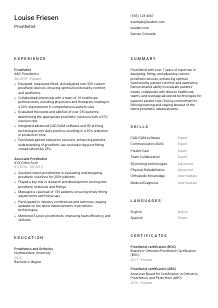
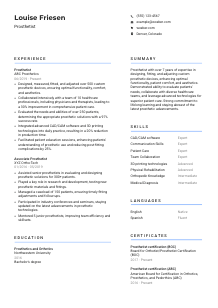
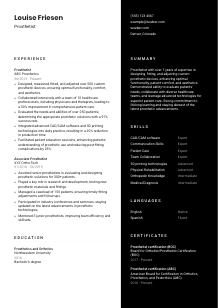
Molding limbs, but feeling detached from your CV? This Prosthetist CV example, created with Wozber free CV builder, shows how to match your limb-creating skill with job criteria, designing a career that fits as snugly as a custom-made prosthetic!
Prosthetists work where biomechanics, fabrication, and patient trust meet. Hiring teams want to see more than compassionate care or technical ability in isolation. They need a CV that shows how you evaluate limb presentation and functional goals, translate those findings into a custom device, and stay involved through fitting, adjustment, and follow-up.
A tailored CV changes how quickly that clinical scope becomes visible, especially when an ATS is screening for prosthetic design, fitting, certification, and CAD/CAM experience. Wozber's free CV builder helps organise that language into an ATS-compliant CV, so your application reads clearly as someone who can manage patient assessment, device fabrication decisions, and interdisciplinary care.
In prosthetics hiring, the header is straightforward, but it still sets the tone. It should present you as a licensed clinical professional who is easy to contact and immediately identifiable for the exact opening, without crowding the top of the page with extra detail.
Use your full name in the largest text on the page so it is easy to spot in a quick review. Keep the presentation clean and professional, similar to the clarity expected in clinical documentation and patient records.
Place "Prosthetist" directly under your name when that is the target role. If your current title is slightly different, such as "Associate Prosthetist," adjust it only when the change is accurate and supported by your experience. This helps both hiring teams and ATS filters connect your background to the position immediately.
Include a reliable phone number and a professional email address. Check them carefully. In a healthcare setting where patient scheduling, interdisciplinary coordination, and interview timing all move quickly, incorrect contact details can cost you the opportunity.
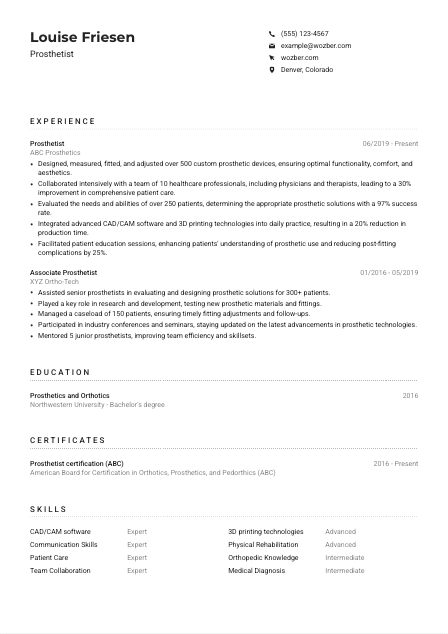
If the employer specifies a city or relocation requirement, include your location clearly. In the provided example, listing Denver, Colorado works because the posting asks for someone located there or willing to relocate. Use this kind of detail to remove a practical hiring question early, but only when the job posting makes it relevant.
A LinkedIn profile or professional website can help if it supports your clinical background, certifications, conference involvement, or technology experience. Make sure the information matches your CV, especially titles, dates, and credentials such as ABC or BOC certification.
Your personal details should do one job well: present you as a reachable, role-aligned prosthetist without distractions. Clean formatting and accurate basics help the rest of your clinical and technical experience land faster.




This section carries the most weight for prosthetists. Employers look for proof that you can evaluate patients, design and fit custom devices, work with physicians and therapists, and improve function over time, not simply assist in a lab or list standard duties.
Read the job description for the real work behind the title. For a prosthetist, that often includes patient evaluation, prosthetic design, measurement, fitting, adjustment, post-fitting monitoring, and collaboration with rehabilitation teams. Those priorities should shape which achievements you surface first in each role.
Start with your most recent position and include job title, employer, and dates. Clinical hiring managers want to understand your progression, whether you moved from an associate role into independent patient management, took on more complex fittings, or expanded into CAD/CAM and 3D printing workflows.
Replace generic lines like "responsible for fitting prosthetics" with outcomes that show scope and execution. The sample CV handles this well by stating "Designed, measured, fitted, and adjusted over 500 custom prosthetic devices," which immediately shows volume, technical ownership, and direct patient impact.
Numbers matter here because they show caseload, device volume, team coordination, production efficiency, and patient results. Useful metrics include number of patients assessed, quantity of custom devices delivered, reduction in production time, follow-up volume, complication reduction, or improvement in care coordination. In the example, a 20 percent reduction in production time through CAD/CAM and 3D printing is far more persuasive than simply saying you used those tools.
Prioritise work that supports the target role: lower-limb or upper-limb fittings, custom fabrication decisions, patient education, interdisciplinary planning, and technology use. If you include related work such as R&D or mentoring, connect it back to better fittings, smoother workflows, or stronger patient outcomes so the section stays anchored in prosthetic practice.
Your experience should make it easy to picture you in clinic, in consultation with therapists and physicians, and in the fitting process itself. When your bullets show patient volume, device complexity, and measurable outcomes, your background reads as practice-ready.
For prosthetists, education is not a formality. It tells employers you have the academic grounding in anatomy, biomechanics, gait, materials, and device design needed to make sound clinical decisions and build appropriate prosthetic solutions.
Start by checking the degree named in the posting. If the role asks for a Bachelor's degree in Prosthetics and Orthotics or a related field, use that exact wording where it applies. In the example, listing a Bachelor's degree in Prosthetics and Orthotics directly supports the requirement without extra interpretation.
Include degree, school, field of study, and graduation year. Keep the format easy to scan. Education sections in healthcare CVs do best when they are concise and complete, especially when the degree is a baseline qualification for clinical work.
If your program included a concentration or especially relevant training in prosthetic design, rehabilitation, or orthotics and prosthetics, name it clearly. This is especially useful early in your career or when your degree title could otherwise look broad.
If you completed coursework or formal training in CAD/CAM, digital modeling, materials science, or 3D printing, include it when those tools appear in the job description. Keep this selective. Add training that supports patient care and fabrication capability, not a long academic inventory.
Honors, research, or competition work can help when they point to prosthetic innovation, biomechanics research, rehabilitation outcomes, or clinical problem-solving. If they do not strengthen your candidacy for patient-facing prosthetist work, leave them out.
A clear education section reassures employers that your clinical decisions rest on the right technical and anatomical training. Once that foundation is obvious, the focus can move quickly to your fittings, outcomes, and patient care experience.
Certification is one of the first checkpoints in prosthetist hiring. It tells employers whether you meet the professional standard to practice, work with patients responsibly, and step into a regulated care environment with the right credentials already in place.
If the posting names ABC or BOC certification, list that credential prominently and use the full official name. This should be one of the easiest parts of your CV to find because it directly affects whether you qualify for the role.
Lead with certifications that support prosthetic care, patient evaluation, fitting, and clinical compliance. In the provided example, ABC and BOC certifications are the key entries because they align directly with the stated requirement. Do not crowd the section with unrelated certificates that dilute that message.
Show the issue date, renewal period, or active status when available. That helps employers confirm you are current, which matters in clinical settings where credential validity affects onboarding and scope of work.
Conferences, seminars, and specialised training can support your application when they reflect current prosthetic methods, digital fabrication, socket design, or rehabilitation advances. Use them to show that you stay current with the field, especially if the role values emerging prosthetic technologies.
Your certification section should quickly confirm that you meet the professional standard for the job. Once that is clear, the rest of the CV can focus on how well you deliver prosthetic care.
A prosthetist's skills section should balance clinical judgment, fabrication technology, and patient communication. Hiring managers expect to see the tools and interpersonal abilities that support safe fittings, functional outcomes, and coordinated care.
Start with the posting, then filter it through your actual experience. For prosthetist roles, that often means patient evaluation, prosthetic fitting, CAD/CAM, 3D printing, interdisciplinary collaboration, and education of patients and caregivers. Keep the list grounded in work you have done, not broad healthcare language.
Place the most role-relevant capabilities first. Technical skills such as CAD/CAM software, digital design workflows, and 3D printing belong near the top when the job emphasizes custom device production. Communication and team collaboration also matter because prosthetists routinely coordinate with physicians, therapists, and patients during evaluation and follow-up.
Choose skills that add hiring value rather than filling space. The sample CV works because it combines technical tools with clinical and interpersonal strengths like patient care and team collaboration. A shorter list of relevant skills is more convincing than a long catalogue of vague strengths.
When the right technical and clinical skills appear in the right order, employers can quickly see how you would function in their prosthetic workflow. Focus on the capabilities that support assessment, device design, fitting, and ongoing patient care.
Language proficiency matters in prosthetics because patient instruction, informed expectations, and interdisciplinary communication all depend on clear conversation. This section is especially important when a posting names a required language outright.
If the job requires English fluency, list English at the top with an accurate proficiency level. That answers a direct screening requirement and signals that you can handle patient education, care coordination, and clinical documentation in the working language of the role.
Lead with languages that help in patient consultations, follow-up appointments, and collaboration across care teams. Keep the order practical rather than alphabetical so the most job-relevant information appears first.
Extra languages can strengthen your application when they help you serve a broader patient population or work effectively in diverse clinical settings. In the example, Spanish is a useful secondary language because it may support communication with more patients, even though English is the stated requirement.
Use clear labels such as Native, Fluent, Advanced, or Conversational, and stay honest. In a healthcare context, overstating language ability can create real communication risks during patient education or device-use instruction.
If a language has been part of your patient care work, note that elsewhere in the CV when relevant, such as in experience bullets about patient education or follow-up support. That gives the language section more weight than a standalone label.
Be clear, accurate, and practical. Language skills carry the most value when they help an employer trust that you can explain prosthetic use, set expectations, and communicate well across the care team.
The summary is where you frame your value in a few lines before the reader reaches the details. For prosthetists, that means combining years of practice with the kind of patients, devices, technologies, and care coordination you handle best.
Before writing, identify the top requirements in the posting. In many prosthetist openings, that means direct fitting experience, custom device design, certification, digital fabrication tools, and collaboration with physicians and therapists. Your summary should reflect that hierarchy rather than trying to mention everything.
Lead with a concise statement such as your title and years of experience. The sample summary does this effectively by establishing more than 7 years in designing, fitting, and adjusting custom prosthetic devices. That immediately places the candidate at the right level for a role asking for at least 3 years of direct experience.
Choose the strengths that matter most for the target employer, such as patient assessment, CAD/CAM-based design, interdisciplinary rehabilitation work, or education on prosthetic use and limitations. Keep them tied to actual prosthetist practice rather than broad statements about being passionate or dedicated.
Aim for a short paragraph that can be read in seconds. Use concrete terms like custom prosthetic devices, patient evaluation, fitting adjustments, and prosthetic technologies. That gives the reader a quick, credible view of your scope without repeating every bullet from your experience section.
A well-written summary tells the reader what kind of prosthetist you are before they reach your employment history. It should quickly establish your level of practice, your technical range, and the patient care strengths that define your work.
A prosthetist CV should leave little doubt about three things: your clinical experience with patient assessment and fitting, your technical ability with custom device design and fabrication tools, and your credentials to practice. When those elements are easy to find, the hiring team can focus on your outcomes, not on filling in gaps.
Use Wozber's free CV builder to organise your content in an ATS-friendly CV format, then refine each section so the language matches the posting naturally and accurately. Done well, your CV will make it easy to judge whether you can step into the clinic, collaborate across the care team, and deliver prosthetic solutions that improve function and quality of life.




