



Use Wozber and land your dream job
Create CV
No registration required
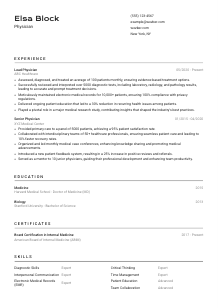
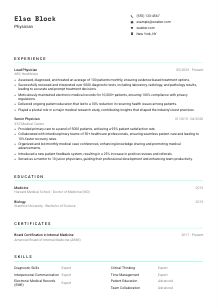
Healing patients, but your CV feels a bit under the weather? Check out this Physician CV example, created with Wozber free CV builder. It shows how to present your medical expertise to match job criteria, making sure your career stays in peak health!
Physician CVs are read through the lens of clinical responsibility. Hiring teams look for signs that you can manage patient care safely, interpret diagnostic data accurately, document to standard, and work effectively with nurses, specialists, and families. Generic claims about compassion or leadership do not carry much weight unless they are tied to a patient panel, treatment decisions, research activity, EMR use, or measurable care outcomes.
A tailored CV quickly brings your specialty training, licensure, board status, and patient-care scope to the surface, which matters in both ATS screening and physician hiring review. Wozber's free CV builder helps organise those details in an ATS-friendly CV format so the first read makes clear whether you meet core requirements and how your practice aligns with the position.
In physician hiring, the top of the CV needs to establish professional identity without delay. This section should confirm who you are, how to reach you, and whether you meet practical requirements such as location or licensure context when those matter for the opening.
Use your full name in a clean, prominent format at the top of the page. For a physician, this is not a branding exercise. It is a basic professional marker that should be immediately visible when a recruiter, practice administrator, or medical director scans the document.
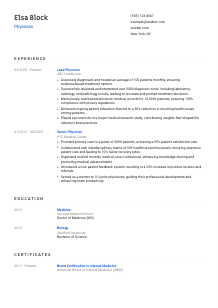
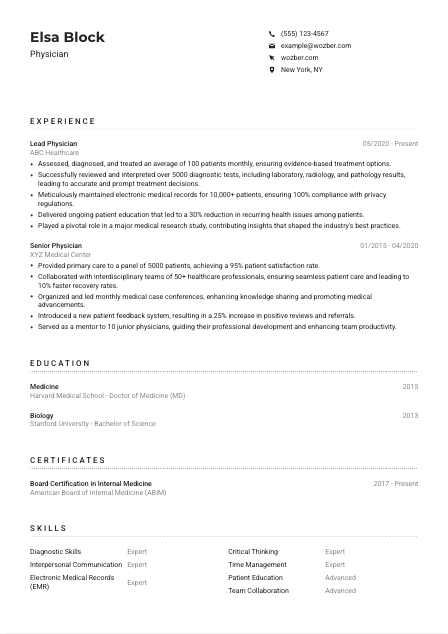
Place "Physician" directly under your name, or use your specialty title if it fits the target role more precisely, such as Internal Medicine Physician or Family Physician. Matching the job language helps position you correctly from the first line. In the provided example, the title stays simple as "Physician," which works because the posting is broad and centered on core clinical practice.
List one phone number and one professional email address that you monitor consistently. Avoid informal email handles. If you include a website or profile, make sure it supports your candidacy with publications, speaking, research, or professional credentials rather than unrelated content.
If the posting requires you to be in a certain state or willing to relocate, include your city and state. Here, listing New York, NY directly addresses a stated requirement and removes an early logistical question. Use this only when location is relevant to the role, not as filler.
A LinkedIn profile, faculty page, or personal site can strengthen your application when it includes publications, clinical interests, board certifications, or research work. For physicians involved in trials, teaching, or conference presentations, this can add useful depth. Keep titles, dates, and credentials aligned with the CV.
Your personal details should confirm basic eligibility and professional identity in seconds. When the top of the page is clear and complete, hiring teams can move straight to your training, patient-care scope, and clinical results.




For physicians, the experience section carries the most hiring weight because it shows how you practice medicine day to day. Titles alone are not enough. Employers want to see patient volume, diagnostic responsibilities, treatment decisions, care coordination, documentation standards, and any research or quality-improvement work that reflects the demands of the role.
Start by pulling out the responsibilities that define the job. In this case, that includes assessing and treating patients, interpreting lab, radiology, and pathology results, maintaining compliant records, educating patients, and contributing to research. Then shape your bullet points around those functions so your background reads as directly relevant clinical practice rather than a generic list of duties.
List positions in reverse chronological order with your title, organisation, and dates. For physician CVs, titles such as Lead Physician, Attending Physician, Hospitalist, or Senior Physician quickly establish level and setting. A clean structure helps readers compare your scope across roles, especially when they are tracking progression in responsibility, patient panel size, or leadership.
Each bullet should show what you handled and what changed because of your work. Useful physician metrics include number of patients seen, diagnostic accuracy, treatment turnaround, patient satisfaction, readmission reduction, documentation compliance, referral growth, or outcomes from preventive care efforts. The sample does this well by pairing routine clinical work with concrete results, such as reducing recurring health issues by 30 percent through patient education.
Quantified details make your clinical range easier to understand. An average of 100 patients monthly, a panel of 5,000 patients, or interpretation of 5,000 diagnostic tests gives employers a clearer view of workload and complexity than broad statements about extensive experience. Choose numbers that reflect the pace, scale, and accountability of your actual practice.
Keep the focus on work that supports diagnosis, treatment planning, interdisciplinary collaboration, documentation, preventive care, and research participation. If you have older or less relevant experience, condense it. The page should spend its space on the parts of your practice that match the role's clinical and regulatory demands.
After reading your experience section, a medical employer should understand your patient-care scope, decision-making level, and clinical results. That is what separates a physician CV with substance from one that only lists responsibilities.
Education matters in physician hiring because it confirms the formal path behind your clinical authority. This section should make your medical degree, foundational training, and any advanced preparation easy to identify without forcing the reader to search for essential qualifications.
When a role calls for an MD or DO and substantial post-graduate training, your education section should surface that immediately. List your medical degree clearly and avoid burying it beneath unrelated academic details. In this example, the MD is the first education entry, which is exactly where it belongs.
Present each entry with institution, degree, field, and graduation year. Physicians often have extensive training histories, so clarity matters more than decoration. If you also list residency or fellowship elsewhere, keep naming consistent across sections.
If the target role sits within a defined specialty, make sure your education and training language supports that path. The degree itself does not need embellishment, but specialty-relevant residency, fellowship, or academic focus should be easy to connect to your board certification and practice history.
Honors, research programs, or academic awards can help if they support the kind of physician role you want, especially in academic medicine, competitive hospital systems, or research-linked positions. If they are dated or unrelated to your current specialty, leave them out and use the space for stronger clinical evidence.
Continuing medical education, specialty updates, or training in new care protocols can show that your practice reflects current standards. This is especially helpful when the role mentions evidence-based treatment, research participation, or keeping up with best practices.
Your education section should make your medical foundation immediately credible. A hiring team should be able to confirm degree level, training path, and specialty direction without piecing the story together themselves.
For physicians, certifications are not an optional add-on. They confirm that you are authorized to practice, trained to specialty standard, and current with the professional requirements tied to patient safety and regulatory compliance.
Review the posting for required certifications and licensure, then place those credentials prominently. Here, that means board certification or eligibility and a valid state medical license without restrictions. If your state license is active in the hiring state, say so clearly.
List credentials that directly support the clinical scope of the job before adding supplemental training. In the example, Board Certification in Internal Medicine carries far more hiring value than unrelated coursework because it aligns with specialty credibility and common physician screening standards.
For medical licenses and board certification, dates matter. Employers need to know whether credentials are active and current. Use date ranges or issue and expiration details where appropriate so there is no ambiguity about standing.
If you hold additional certifications in areas such as ACLS, BLS, clinical research, quality improvement, or subspecialty procedures, include the ones that strengthen your candidacy for the target role. Keep the list relevant. The section should reinforce your practice profile, not become a full transcript of every course taken.
Licensure and certification often determine whether a physician application moves forward at all. Make your current status, specialty standing, and regulatory eligibility easy to confirm from one quick review.
A physician skills section works best when it reflects the actual work of diagnosis, treatment, documentation, communication, and coordination. The goal is not to sound well-rounded in the abstract. It is to show the clinical and operational abilities that support safe, effective care in the setting you are targeting.
Start with the terms the employer already uses. Here, diagnostic skills, evidence-based treatment, interpersonal communication, collaboration, and medical record accuracy are central. Mirroring that language helps your CV align with both ATS screening and human review, provided the skills reflect your real practice.
Prioritise skills such as diagnostic evaluation, treatment planning, EMR documentation, patient education, interdisciplinary collaboration, preventive care, clinical research, and specialty-specific procedures when relevant. The sample skill list works because it includes both core clinical judgment and practical systems knowledge such as EMR use.
Do not crowd this section with every soft skill you have ever used. A focused skills list is more useful when it reflects how physicians are actually evaluated. If a skill does not help explain your patient care, documentation quality, team coordination, or specialty contribution, it probably does not belong here.
This section should echo the clinical strengths already demonstrated in your experience. When the skills are relevant and specific, they help confirm how you practice medicine, not just how you describe yourself.
Language ability can directly affect patient communication, care planning, and trust, especially in diverse communities and large metropolitan health systems. For physicians, this section is most useful when it clarifies your ability to communicate accurately with patients, families, and care teams.
If the job requires English, list it clearly with an accurate proficiency level. In this posting, English is essential, so that requirement should be addressed without ambiguity. This is a simple but necessary eligibility point.
After English, list any additional languages that genuinely support patient care in your practice setting. Fluency in a second language can help with history-taking, patient education, follow-up, and rapport, especially when interpreters are not the only communication channel.
In many physician roles, multilingual ability strengthens access and continuity of care. The example includes Spanish, which can be especially valuable in many U.S. communities. Use extra languages to show broader communication range, but only when your proficiency is strong enough to represent honestly.
Use clear labels such as Native, Fluent, Professional Working, or Conversational. Avoid overstating your level. In clinical environments, language accuracy matters, and inflated claims can raise concerns about judgment as much as communication.
A language section becomes more relevant when it matches the demographics of the community or institution. For a role based in New York, multilingual ability may support patient access across a wide range of populations, but it is still a secondary advantage after core clinical qualifications.
List languages when they strengthen patient communication or team collaboration. Kept accurate and relevant, this section adds real clinical context rather than extra decoration.
A physician summary should quickly establish specialty level, years of practice, core clinical strengths, and the kind of medical environment you work in. This short section is most effective when it reflects the role's clinical priorities rather than repeating broad claims that could sit on any healthcare CV.
Read the posting closely and identify the themes that should appear in your opening lines. In this case, those themes include diagnosis, evidence-based treatment, interpretation of diagnostic tests, patient education, documentation, and collaboration. Your summary should bring those elements together in a compact snapshot.
Lead with a clear statement of who you are and how long you have practiced, such as a physician with 10+ years in internal medicine, hospital care, or multispecialty practice depending on your background. The example does this effectively by anchoring the summary in years of medical care experience before moving into specific strengths.
Choose two to four high-value strengths that reflect the job, such as diagnostic accuracy, evidence-based treatment planning, EMR documentation, patient education, interdisciplinary collaboration, or research contribution. This is where you connect your background to the employer's priorities without rewriting the full experience section.
Aim for three to five lines. That is enough space to show scope, specialty relevance, and a few defining strengths. Skip generic traits and use the room for practice-based detail that tells the reader what kind of physician you are and what you handle well.
A strong summary gives the reader an immediate sense of your medical scope and specialty value before they reach the detailed sections. By the end of it, they should already understand the level of care, judgment, and collaboration you bring to the role.
Once each section is tailored, your CV should show more than credentials. It should present a physician who can diagnose, treat, document, communicate, and contribute within a real care environment.
Use Wozber to tighten language, improve ATS optimisation, and organise your content into an ATS-compliant CV that keeps licensure, board status, patient-care scope, and outcomes easy to review.
That gives hiring teams a clearer view of whether you are ready to step into the clinical demands of the role from day one.