



Use Wozber and land your dream job
Create CV
No registration required
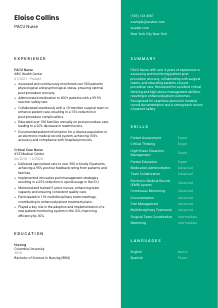
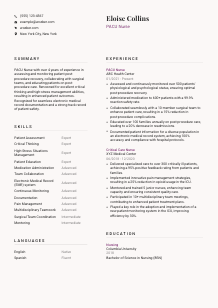
Soothing post-anesthetic transitions, but your CV feels groggy? Prep for recovery with this PACU Nurse CV example, created with Wozber free CV builder. Learn how to match your critical nursing skills to the job, setting your career on a steady course to patient rejuvenation!
Post-anesthesia care moves quickly, and the nursing judgment behind it has to be calm, accurate, and immediate. A PACU Nurse CV needs to show more than bedside experience. It should make your recovery monitoring, medication administration, patient safety work, and communication with surgical teams visible from the first scan.
When that information is tailored to the opening, your background reads less like general acute care and more like direct PACU capability. Wozber's free CV builder helps shape an ATS-compliant CV around the language employers use, so key details like post-procedure monitoring, EMR documentation, and specialty certification surface early and clearly.
This section is brief, but it still affects how smoothly your application moves forward. For PACU nursing roles, hiring teams want immediate clarity on who you are, how to contact you, and whether you meet practical requirements such as location and professional title.
Place your name at the top in a clean, readable format. Avoid decorative styling. In hospital hiring workflows, your CV may be reviewed quickly alongside many RN applicants, so legibility matters more than design flair.
Add "PACU Nurse" directly under your name when that is the role you are pursuing. This helps distinguish you from broader RN, ICU, or med-surg applicants and reinforces alignment with the posting's language for both ATS screening and human review.
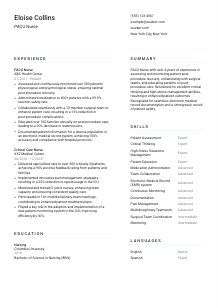
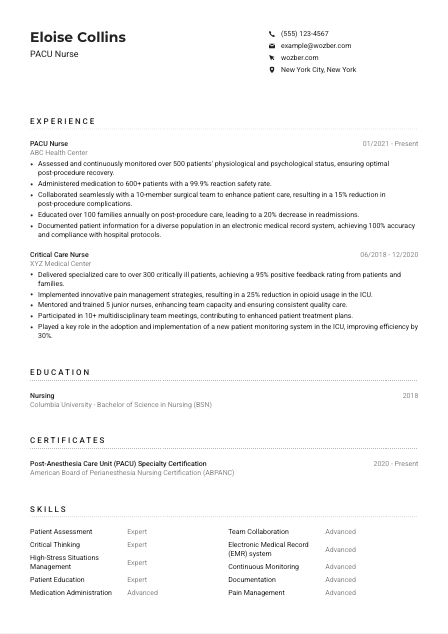
List a current phone number and a professional email address you check often. If the employer requires a local candidate, include your city and state. In the example, "New York City, New York" immediately answers a stated requirement and removes questions about relocation.
For clinical roles with on-site scheduling, location can affect interview priority. If the posting specifies a city, include it plainly in your personal details rather than burying it elsewhere. Keep it simple, with no full street address needed.
If you share a LinkedIn profile or professional website, make sure the information matches your CV, including job titles, dates, and credentials. For a PACU Nurse, consistency around RN licensure, specialty certification, and recent hospital experience matters more than adding extra links for the sake of it.
Your personal details should remove basic questions before they are asked. Clear title, accurate contact information, and any sample-specific location requirement give the hiring team a clean start.




This is the section most likely to decide whether your CV stays in consideration. PACU hiring teams look for recovery-room judgment, rapid assessment, medication safety, collaboration with anesthesia and surgery, and clear documentation under pressure.
Read the job description and mark the actions that define the role. For PACU jobs, that often includes monitoring physiological and psychological status, administering medications, educating families, documenting in the EMR, and coordinating with anesthesiologists and the surgical team. Those themes should appear in your bullets when they reflect your real work.
Use reverse chronological order and include your title, employer, and dates for each position. Distinct titles such as "PACU Nurse" and "Critical Care Nurse" help hiring managers quickly understand your progression and confirm that you meet requirements like 2+ years in PACU or critical care.
Lead each bullet with a concrete responsibility or intervention, then show the result. In the example, "Assessed and continuously monitored over 500 patients" works well because it connects core PACU work to a clear scope. Similar bullets can cover airway monitoring, pain control, discharge readiness, adverse reaction response, or family education when those were meaningful parts of your role.
Use metrics that make sense for nursing practice, such as patient volume, accuracy rates, reduction in complications, readmissions, medication safety, or process improvements. "99.9% reaction safety rate" and a "15% reduction in post-procedure complications" are effective because they quantify safety and recovery outcomes rather than adding generic numbers.
Even if you have broad RN experience, prioritise bullets that support post-anesthesia or critical care readiness. A strong ICU bullet about pain management, patient monitoring systems, or multidisciplinary care can absolutely support a PACU application. Less relevant duties should move down or come off the page so the most applicable clinical work stands out first.
Your experience should show that you can manage post-procedure recovery with sound clinical judgment and dependable documentation. If a reader can quickly see patient volume, care setting, team coordination, and outcomes, the section is doing its job.
For nursing roles, education is often a formal screening point before experience is reviewed in depth. PACU openings may specify a BSN, so your education section should make that credential easy to locate and easy to confirm.
If the posting asks for a Bachelor of Science in Nursing, write it that way. Use the full degree name instead of only an abbreviation if space allows. In the example, "Bachelor of Science in Nursing (BSN)" aligns neatly with the stated requirement.
List your degree, field, school, and graduation year in a clean order. This makes the section easy to scan in hospital systems and by nurse recruiters who may be reviewing many applications in one sitting.
Your nursing degree should be the lead item, especially when it is a requirement. If you hold multiple degrees, place the most relevant and most recent nursing credential where it supports your PACU candidacy best.
Honors, relevant academic distinctions, or nursing associations can be useful if they support your clinical profile. Keep them brief and role-relevant. For an experienced PACU Nurse, these details should never overshadow your direct patient care background and certification.
Once you have solid nursing experience, you usually do not need to list extensive coursework or student activities unless they are unusually relevant. Keep the section focused on the academic credential the employer needs to see.
This section should confirm that you meet the nursing education requirement without making the reader search for it. Clear degree wording and a simple structure are usually enough.
Certifications carry real weight in perianesthesia nursing because they show specialised knowledge and current professional standing. If a posting asks for PACU specialty certification and active RN licensure, make those credentials easy to verify.
Start with the credential most relevant to PACU work. Here, that means the PACU specialty certification should appear prominently. If the employer specifically requests it, do not make the reader hunt through unrelated credentials to find it.
Include certifications that strengthen your case for recovery-room care, perioperative support, critical care crossover, or current clinical competence. A short list of directly relevant credentials reads better than a long list of marginal ones.
If a certification is current, display the active date range or renewal status. In nursing, outdated credentials create uncertainty, especially in areas tied to patient monitoring, sedation recovery, and specialty standards.
PACU nursing depends on current practice standards, so recent renewals and continuing specialty credentials matter. If you are maintaining certification through an organisation such as ABPANC, present that cleanly to show continued engagement with the field.
For a PACU Nurse, certifications help confirm specialty preparation, not just general nursing eligibility. Put the credentials that support post-anesthesia care front and centre, with current dates that are easy to read.
A PACU skills section works best when it reflects how recovery care is actually delivered. That means emphasizing assessment, monitoring, medication safety, patient education, documentation, and teamwork across perioperative settings, not padding the list with broad nursing terms.
Use the job description to identify the exact capabilities being requested. In this case, assessment, communication, critical thinking, teamwork, and handling high-stress situations are central. Mirror that language where it truthfully reflects your practice so the connection is immediate for ATS screening and nurse recruiters.
Lead with the abilities most relevant to the unit. Strong examples include patient assessment, continuous monitoring, medication administration, pain management, EMR documentation, patient education, and surgical team coordination. The example CV does this well by grouping both bedside and workflow-based strengths that matter in PACU.
Choose skills that support your target role rather than trying to cover every strength you've developed in nursing. A focused list helps the reader quickly connect your capabilities to core PACU responsibilities like monitoring recovery, identifying complications early, and documenting accurately under pressure.
Your skills list should sound like someone ready to work a PACU shift, not a generic RN profile. If the top entries point clearly to recovery care, medication safety, communication, and calm decision-making, you are on the right track.
PACU nursing depends on clear communication at moments when patients and families may be anxious, groggy, or trying to absorb discharge instructions quickly. Language skills can strengthen your CV when they improve patient understanding, family communication, or team coordination.
If the posting requires oral and written English, list English clearly with an honest proficiency level. For a clinical role involving patient education, charting, and coordination with anesthesiologists and surgeons, this should never be implied.
Additional languages can be valuable when they help you explain post-procedure care, answer family questions, or reduce communication barriers on a diverse unit. In the example, Spanish is a meaningful addition because it may support patient interactions in a large urban care setting.
Terms like "Native," "Fluent," "Intermediate," and "Basic" are enough. Avoid vague descriptions. Hiring teams need a realistic sense of whether you can chart, educate, or hold a clinical conversation in that language.
Do not overstate fluency. In patient care, language claims carry real consequences. Only list a language if you could use it appropriately in the clinical situations your proficiency level suggests.
Additional languages can strengthen a PACU application, especially in diverse communities, but they do not replace core nursing qualifications. Keep the emphasis on safe care, clear teaching, and accurate communication rather than listing languages as a separate achievement category.
Language skills matter when they help you communicate care instructions clearly and support a broader patient population. Keep this section accurate, relevant, and tied to real clinical communication.
Your summary should give a quick, credible picture of the kind of PACU Nurse you are. In a few lines, it should connect your years of experience with the clinical strengths that matter most in recovery care, such as monitoring, medication administration, team coordination, and patient education.
Review the posting and pull out the themes that define success in the role. For a PACU summary, that usually means post-procedure recovery, assessment, collaboration with anesthesia and surgical teams, patient teaching, and documentation. Use those ideas to shape the content instead of writing a generic nursing introduction.
Start with a direct line such as "PACU Nurse with over 4 years of experience" if that statement is accurate for you. This quickly establishes your specialty and seniority. The example summary handles this well by identifying both the role and the depth of experience up front.
Choose strengths that reflect actual PACU work, such as critical thinking during recovery, high-stress decision-making, medication safety, or strong EMR documentation. Keep them tied to patient care and team function rather than relying on broad personality terms.
Aim for a compact summary that can be read in seconds. Three to five lines is usually enough. Every phrase should help the reader understand your recovery-room background, your nursing judgment, and the kind of outcomes or consistency you bring to the unit.
A well-written summary should immediately place you in the PACU setting and highlight the clinical value you bring there. If it reads like a focused snapshot of your recovery-care experience, it is ready to lead the CV.
A PACU Nurse CV works best when it makes your post-anesthesia experience easy to recognize section by section. Education should confirm the BSN requirement. Certifications should show current specialty preparation. Experience should highlight monitoring, medication safety, team coordination, family education, and EMR accuracy in ways that reflect real patient care.
Wozber's free CV builder can help you organise that information into an ATS-friendly CV format, while its ATS CV scanner and AI CV builder features help align your wording with the posting's clinical priorities. The finished CV should make one thing clear right away: you can step into a PACU environment and support safe recovery with sound nursing judgment.