



Use Wozber and land your dream job
Create CV
No registration required
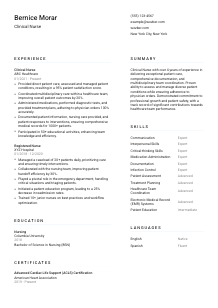
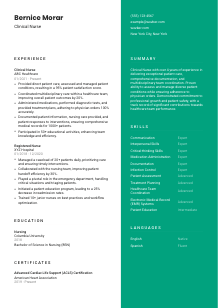
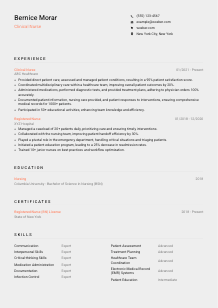
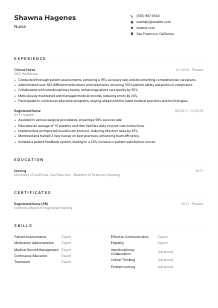
Working in health, but your CV feels under the weather? Navigate the anatomy of a standout application with this Clinical Nurse CV example, created with Wozber free CV builder. Learn how to align your care-centric skills with job prerequisites, charting a career course as precise as an IV drip!
Clinical nursing work is reviewed through the quality of care you deliver under pressure. Hiring teams want to see how you assess changing patient conditions, administer treatment safely, document clearly in the medical record, and coordinate with physicians and other clinicians without missing critical details.
A tailored CV helps those priorities surface fast, especially when the role is screened through ATS criteria before it reaches a nurse manager. Wozber's free CV builder supports that process by helping you align your wording with the posting, keep an ATS-friendly CV format, and make your patient care scope, licensure, and clinical judgment easy to recognize.
In nursing, the header is less about personality and more about removing friction. This section should confirm who you are, how to reach you, and whether you meet any immediate logistics the employer listed, without making the reader search for basics.
Use your full name in the most visible text on the page so the CV is easy to identify in a hiring system or printed review stack. Keep the presentation clean and professional, the same way you would approach charting or handoff communication.
Place the job title directly under your name when it matches the position you are pursuing. If the opening is for a "Clinical Nurse," use that wording so your CV immediately lines up with the role being filled and avoids any ambiguity with adjacent titles.
List a reliable phone number and a professional email address. In healthcare hiring, delays happen when contact details look outdated or inconsistent, so make sure the information is current and easy to scan.
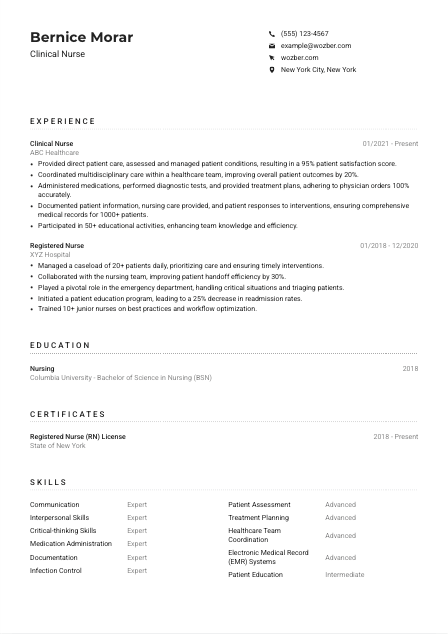
If an employer specifies a location requirement, add your city and state in the header. In the example, "New York City, New York" directly addresses a stated requirement and helps remove relocation questions early. Only do this when it reflects your actual situation.
A LinkedIn profile, nursing portfolio, or professional webpage can be useful if it reinforces your clinical background, certifications, or leadership activity. Keep it only if the information is current and consistent with your CV, especially around titles, dates, and credentials.
Your personal details should function like a clean patient intake summary. Accurate, direct, and aligned with the posting so the employer can move quickly to your clinical qualifications.




The experience section carries most of the weight on a Clinical Nurse CV. Employers are looking for day-to-day care delivery, sound judgment, safe medication administration, documentation habits, and the way you work inside a multidisciplinary care team.
Read the job description closely and mark the responsibilities that define the unit's expectations. For this role, the clear priorities are direct patient care, condition assessment, medication administration, treatment execution under physician orders, documentation, team coordination, and safety protocols. Those are the themes your bullets should reflect.
List your most recent nursing role first, then work backward. For each position, include your title, employer, and dates so the reader can quickly follow your clinical progression from staff RN work into broader Clinical Nurse responsibilities or higher-acuity assignments.
Each bullet should show what you handled, how you worked, and what changed because of your contribution. The sample does this well by tying direct patient care to a 95% patient satisfaction score and multidisciplinary coordination to a 20% improvement in outcomes. Use your own metrics where they are credible, whether that is readmission reduction, faster handoff efficiency, lower documentation error rates, or patient volume managed per shift.
Numbers matter in nursing CVs because they clarify workload and reliability. Patient caseload, number of records maintained, percentage accuracy in medication administration, training volume, or improvement initiative results all help the employer understand your operating level. The example's "1000+ patients" and "20+ patients daily" give useful scale.
Prioritise experience that reflects bedside care, assessment, documentation, patient education, infection control, and collaboration with clinicians. If you include achievements from a different setting, translate them into nursing-relevant value. A bullet about workflow improvement is stronger when it shows safer handoffs, better triage flow, or reduced readmissions rather than general efficiency alone.
A hiring manager should be able to see your unit-level contribution from this section alone. When your bullets show patient care scope, clinical judgment, and measurable outcomes, your experience reads like practice, not just employment history.
Education is straightforward on a Clinical Nurse CV, but it still carries screening value. Nursing employers often check degree requirements early, especially when a BSN is specifically requested for patient care roles or hospital systems with formal hiring standards.
If the posting calls for a Bachelor of Science in Nursing, make sure that wording appears clearly in your education section. For this opening, a BSN from an accredited institution is a stated requirement, so it should be easy to find and written exactly, not implied.
List the degree, field, school, and graduation year in a simple order. Nursing CVs do not benefit from decorative formatting here. Clear structure helps both ATS parsing and quick credential review by HR or a clinical hiring coordinator.
Use the formal degree name when possible. In the example, "Bachelor of Science in Nursing (BSN)" instantly confirms alignment with the requirement and removes guesswork about educational eligibility.
Most practicing nurses do not need to list coursework unless they are early in their career or targeting a specialised area where training is relevant, such as critical care, community health, pharmacology, or leadership in nursing practice. Keep it selective and role-related.
Honors, clinical excellence awards, leadership in nursing organizations, or capstone work related to patient care can add value if they are relevant and concise. For experienced nurses, these details should stay secondary to your bedside and team-based experience.
Education should confirm that you meet the formal entry requirement for the role. Once the BSN is clear, the rest of the CV should shift the reader's attention to your clinical performance.
For Clinical Nurse roles, certifications are not decorative extras. Active licensure and current life support credentials often determine whether your application can move forward, so this section should be precise, current, and easy to verify.
Lead with the credentials the employer named. Here, that means the Registered Nurse license first, followed by BLS and ACLS where applicable. Ordering matters because these items often function as screening checkpoints before experience is reviewed in depth.
Include licenses and certifications that support bedside practice, clinical readiness, or the specific patient population you serve. A focused list is more useful than a long inventory. The example keeps attention on the RN license and life support certifications tied directly to the role.
Employers need to know whether credentials are current. Include issue dates, renewal ranges, or "Present" when appropriate, especially for time-sensitive credentials such as BLS, ACLS, and state licensure.
If you have additional current certifications or recent continuing education relevant to your unit, add them when they support the target role. This can include specialty credentials, quality improvement training, or patient safety education that shows you stay current with clinical standards.
Your licensure and certifications should answer the employer's compliance questions at a glance. When this section is current and well ordered, the hiring team can focus on your practice instead of chasing documentation.
A Clinical Nurse skills section should read like the work you actually perform on shift. That means balancing clinical capabilities, documentation habits, safety awareness, and communication skills that matter in patient care settings.
Start with the obvious requirements, such as communication, interpersonal skill, and critical thinking. Then add the practical nursing skills embedded in the responsibilities, including patient assessment, medication administration, documentation, infection control, and multidisciplinary coordination.
Select the skills you use in practice and order them by relevance to the role. In the example, core nursing functions like medication administration, documentation, infection control, treatment planning, and EMR use support the broader soft skills the employer requested. That combination feels grounded in daily clinical work.
Avoid turning this section into a catch-all. A shorter list of role-relevant skills is more effective than stuffing in every capability you have picked up. Aim for the mix that best reflects your patient care environment, unit demands, and coordination responsibilities.
This section should confirm the kind of nurse you are in practice. When the skills match the posting and your experience bullets back them up, the CV feels consistent and credible.
Language ability matters in nursing because communication affects safety, patient education, consent, and trust. If a posting specifies English proficiency, treat that as a practical requirement rather than a minor detail.
When the employer asks for strong English, list English at the top with an honest proficiency level. This directly answers the requirement and supports your ability to document accurately, explain care plans, and collaborate with the healthcare team.
Additional languages can strengthen your CV when they are relevant to the patient population or care setting. In the example, Spanish adds value because multilingual communication can support patient comfort, education, and more effective care coordination.
Terms like "Native," "Fluent," "Advanced," or "Intermediate" give a practical picture of your communication level. Keep the wording consistent and avoid overstating ability, especially in a clinical environment where precision matters.
Language skills carry more weight in settings with diverse patient populations, high patient education needs, or frequent family communication. If that describes the roles you target, keeping this section visible can help distinguish your profile.
For a nurse, language proficiency supports clearer patient instructions, stronger rapport, and more culturally responsive care. Present it as a care delivery asset, not just a personal extra.
Language skills are worth listing when they improve patient understanding and team communication. In clinical work, that can directly affect safety, satisfaction, and continuity of care.
The summary sits near the top of the CV, so it should give a fast, accurate picture of your nursing background. Focus on years of experience, care setting relevance, core clinical strengths, and the kind of contribution you make to patient outcomes and team operations.
Start by identifying the few responsibilities and qualifications that define the role. For this Clinical Nurse opening, that means direct patient care, assessment, medication administration, documentation, coordination with the healthcare team, and active credentials. Your summary should echo that level of practice in natural language.
State your title and years of experience clearly. The example begins with "Clinical Nurse with over 4 years of experience," which immediately establishes professional level and role relevance before moving into specific strengths.
Use the next lines to show the clinical capabilities that matter most for the target role. Good examples include managing diverse patient conditions, following physician orders accurately, maintaining comprehensive documentation, coordinating multidisciplinary care, or supporting patient safety initiatives.
Aim for a short paragraph, not a biography. Four to six focused lines are usually enough to cover your experience level, care strengths, and a notable contribution area without repeating bullets from the experience section.
A well-written summary should make your clinical focus and level of practice immediately clear. If the reader can quickly place you as a capable nurse who can step into patient care, documentation, and team coordination, the section is doing its job.
Your Clinical Nurse CV should now show the essentials employers screen for first: active credentials, relevant education, direct patient care experience, clear documentation habits, and the ability to work effectively within a healthcare team.
Use Wozber's free CV builder to shape that content into an ATS-compliant CV with clean structure, targeted language, and stronger ATS optimisation. The result should make it easy for a hiring team to see that you can deliver safe, organised, patient-centered care from day one.




