



Use Wozber and land your dream job
Create CV
No registration required
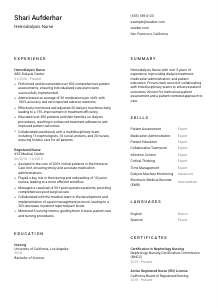
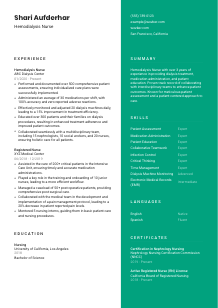
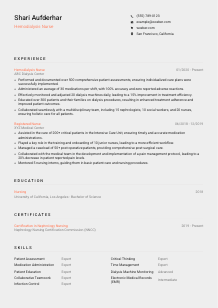
Pumping patients, but your CV feels clogged? Flush away concerns with this Hemodialysis Nurse CV example, created with Wozber free CV builder. Learn how to blend your bedside manner with renal requirements, ensuring your nursing career stays as clean and clear as your patients' bloodstreams!
Hemodialysis nursing work is built on close monitoring, fast clinical judgment, and steady patient support over repeated treatments. Hiring teams want to see that you can assess changes before and during dialysis, manage fluid removal and medication safely, document accurately, and help patients follow care plans that affect outcomes well beyond a single shift.
A tailored CV makes that clinical focus visible early, especially when an employer is screening for dialysis-specific experience, nephrology credentials, and patient education work. Wozber's free CV builder helps you shape an ATS-compliant CV around the language of the posting so your background reads clearly as hemodialysis care, not general RN experience. That distinction matters when a team is filling a role centered on renal treatment rather than broader bedside nursing.
In hemodialysis hiring, the top of the CV should confirm basic eligibility fast. Recruiters and nurse managers often check title, license alignment, and contact details before they spend time on treatment experience or nephrology certification.
Use your full name in a clean, readable format so it is easy to scan on a nursing CV and in an ATS. Keep it slightly more prominent than the rest of the header. The section should feel clinical and orderly, much like the documentation standards expected in dialysis care.
Place "Hemodialysis Nurse" directly under your name when that is the role you are pursuing. This helps separate your CV from broader RN profiles and immediately frames your experience around dialysis treatment, renal patient monitoring, and nephrology care rather than general floor nursing.
Include one reliable phone number and a professional email address. In healthcare hiring, fast follow-up matters, especially when interview scheduling moves quickly around staffing needs, shift coverage, and licensing checks. Keep the format simple and error-free.
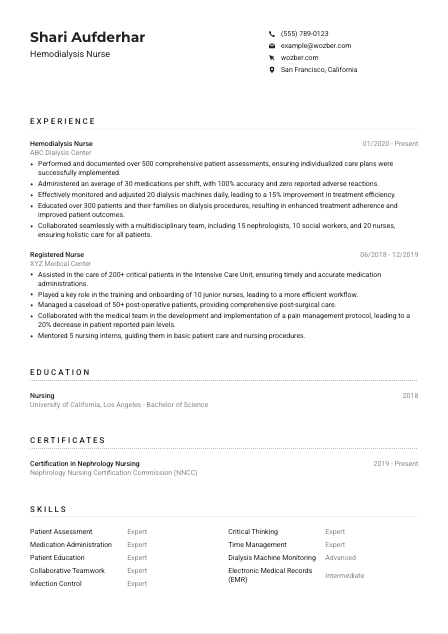
If a role requires you to be in a specific area or willing to relocate, reflect that clearly in your header. Here, listing San Francisco, California supports the location requirement in the posting and removes doubt about availability. Treat this as tailoring to the employer's stated need, not a universal rule for every hemodialysis opening.
A LinkedIn profile or professional webpage can support your application if it reinforces your nursing background, certifications, and clinical setting. Only include it when the content is current and consistent with your CV, especially around dialysis experience, licensure, and specialty credentials.
Keep this section straightforward and complete. For a Hemodialysis Nurse, the header should quickly confirm who you are, where you can work, and that your application belongs in a dialysis hiring pipeline.




This is where dialysis employers look for real clinical depth. They want to see direct treatment experience, patient volume, monitoring responsibilities, medication administration, documentation habits, and collaboration with nephrologists and other care team members.
Start with the core work named in the posting, then map your past experience to it. For a Hemodialysis Nurse, that usually means pre-treatment assessments, intra-treatment monitoring, individualized care plans, medication administration, patient education, and interdisciplinary coordination. If you have done those tasks, use the employer's terminology where it truthfully matches your work.
List roles in reverse chronological order with job title, employer, and dates. Put dialysis and nephrology experience first when you have it. If part of your background comes from ICU, med-surg, or another high-acuity setting, keep those roles, but emphasize the duties that transfer well, such as medication safety, patient monitoring, rapid response, and detailed charting.
Your bullets should describe what you handled and what changed because of your care. The sample does this well by naming 500+ patient assessments, 30 medications per shift with zero reported adverse reactions, and daily machine monitoring tied to a 15% treatment-efficiency improvement. Those details show workload, accuracy, and operational impact in a dialysis environment.
Quantify the parts of the job that naturally carry volume or performance measures. Strong examples include patient caseload, treatments per shift, assessment count, medication accuracy, adherence gains, infection control performance, machine oversight, or documentation timeliness. Numbers work best when they reflect actual dialysis practice rather than sounding inflated.
Every line does not need to come from a dialysis unit, but every line should support your case for this role. Prioritise hemodialysis treatment, nephrology exposure, patient teaching, care-plan implementation, and team-based care. If an older bullet does not help explain your readiness to manage dialysis patients safely, replace it with one that does.
By the end of this section, a nephrology unit or dialysis centre should be able to picture you managing treatments, documenting accurately, educating patients, and working smoothly with the wider care team. Wozber's ATS-friendly CV format helps keep that experience easy to scan and easy to match to the posting.
For this role, education is not a formality. A BSN requirement tells employers they want a registered nurse with the academic preparation expected for clinical judgment, patient education, and coordinated care in a specialised treatment setting.
If the posting calls for a Bachelor of Science in Nursing, make sure that wording appears plainly in your education section. Do not hide it behind abbreviations alone. In the example, the degree is listed as Bachelor of Science in Nursing, which directly matches the employer's stated requirement.
List your degree, school, and graduation year or date in a consistent format. This helps both recruiters and ATS systems identify the credential quickly. In healthcare roles with licensing and certification requirements, clear formatting matters because your education is often reviewed alongside those credentials.
When you hold multiple degrees, place the nursing degree that supports RN practice first. For hemodialysis roles, the key point is that your education supports safe clinical care, patient assessment, and specialised treatment responsibilities in a regulated setting.
Relevant honors, academic awards, or nephrology-related coursework can help, especially if you are earlier in your career. Keep them selective. A line about renal pathophysiology, acute care clinical rotations, or nursing leadership can add context, but the main priority remains the qualifying BSN.
If you completed post-graduate nephrology courses, CE programs, or dialysis-related training, add them when they sharpen your profile for this type of unit. Ongoing education is especially useful when you want to show current knowledge of renal care protocols, patient teaching, or treatment safety standards.
Your education section should answer the degree requirement cleanly and support the rest of your clinical profile. Wozber's free CV builder helps keep this part structured so the BSN is easy to find and easy to match during screening.
Hemodialysis roles often move quickly to credential checks because employers cannot place nurses into treatment workflows without the right license and specialty qualification. This section needs to be precise, current, and easy to verify.
Start with your active RN license and your nephrology nursing certification when the posting asks for both. In this case, the role names an active RN license and certification through organizations such as ANNA or NNCC, so those should appear before less relevant certificates.
Prioritise credentials that support renal care, medication administration, patient safety, and direct treatment work. For many candidates, that means RN licensure first, nephrology certification next, and then other certifications only if they strengthen your fit for a clinical dialysis setting.
Add the issuing body and the current date range so the employer can see the credential is valid. The example does this by naming the California Board of Registered Nursing and the Nephrology Nursing Certification Commission, then showing ongoing status. That level of specificity is useful in credential-heavy healthcare hiring.
Renewed certifications and recent specialty training signal that you stay current with renal-care protocols and professional expectations. In dialysis nursing, that matters because treatment procedures, safety guidelines, and patient-management standards require ongoing attention.
A hiring manager should be able to confirm, at a glance, that you are licensed to practice and qualified for a nephrology-focused nursing role. Present the credentials cleanly and in the order that supports dialysis hiring decisions.
A Hemodialysis Nurse skills section should read like the toolkit of someone who can run a safe treatment day. That means balancing technical tasks such as machine monitoring and medication administration with patient-facing work such as education, observation, and teamwork.
Start with the skills that appear in the job description and the dialysis workflow itself. Patient assessment, medication administration, dialysis machine monitoring, individualized care planning, patient education, EMR documentation, infection control, and interdisciplinary collaboration are all relevant because they map to everyday treatment responsibilities.
Lead with the capabilities most tied to hemodialysis care, then include broader nursing skills that support the role. For example, "Patient Assessment," "Medication Administration," and "Dialysis Machine Monitoring" speak directly to the unit, while "Critical Thinking" and "Time Management" support fast, accurate decision-making during treatment.
Do not turn this into a long inventory of every nursing skill you have used. Choose the skills that best support safe dialysis treatment, patient monitoring, and care-team coordination. The example works because it combines dialysis-specific abilities with relevant support skills such as EMR use and collaborative teamwork, without drifting into unrelated specialties.
The skills list should back up your experience, not repeat it loosely. When a dialysis employer scans this section, they should see the clinical abilities needed to manage treatment, communicate with patients, and work effectively inside a nephrology team.
Communication matters in dialysis because patients return for treatment repeatedly, education needs to be clear, and changes in condition must be discussed accurately with both patients and colleagues. This section is usually short, but it still needs to support the role.
If the posting requires English communication, list English clearly and rate it honestly. In a hemodialysis setting, that supports patient instruction, charting, medication communication, and coordination with nephrologists, social workers, and other nurses.
Place English at the top when it is required for the role. A clear rating such as "Native" or "Fluent" helps the reviewer quickly confirm that you meet the communication expectation stated in the posting.
Additional languages can be valuable in dialysis clinics that serve diverse communities, especially when patient education and family communication are part of the job. In the example, Spanish adds practical value because it may help with treatment explanations, dietary guidance, and self-care discussions.
Stick to common ratings such as "Native," "Fluent," "Intermediate," or "Basic." Avoid vague terms. Healthcare communication carries clinical consequences, so your language levels should be easy to interpret and accurate.
Language skills matter most when they improve understanding, adherence, and trust. If you speak another language well enough to help with patient instruction or family support, include it. If not, keep the section simple and avoid overstating proficiency.
Handled well, this section strengthens your profile as a nurse who can communicate clearly in treatment settings and support a broader patient population. Keep it honest, concise, and tied to real care interactions.
Your summary should quickly place you in the right clinical lane. For hemodialysis roles, that means leading with renal-care experience, treatment-related strengths, and the kind of patient and team work that defines the specialty.
Before writing the summary, identify the two or three requirements that most shape the role. Here, those are dialysis or nephrology experience, patient assessment and treatment monitoring, and collaboration with an interdisciplinary team. Build your opening around those points rather than broad nursing language.
State that you are a Hemodialysis Nurse, then add your years of relevant experience. This immediately tells the reader whether you come from a dialysis setting or from a more general RN background. The example does this well by naming more than 3 years of experience in dialysis treatment, medication administration, and patient education.
Use one or two specific strengths that match the role, such as individualized patient assessments, safe medication delivery, treatment monitoring, care-plan execution, or patient education that improves adherence. Keep the language grounded in actual practice, not generic statements about being dedicated or compassionate.
Aim for three to five lines with no wasted space. A strong summary should read like a compact clinical profile, not a mission statement. Wozber's AI CV builder can help tighten phrasing and align the wording with the posting so your summary lands clearly in ATS screening and human review.
When your summary is doing its job, the employer immediately understands that you are qualified for dialysis care, not simply licensed as an RN. It should make your renal-care experience, treatment judgment, and patient-facing strengths clear from the first few lines.
A Hemodialysis Nurse CV works best when every section supports the same clinical story: you can assess patients thoroughly, deliver treatment safely, document accurately, educate consistently, and collaborate across the nephrology care team. That is the combination employers need to see before they trust a candidate in a dialysis chairside role.
Use Wozber's free CV builder to organise that story in an ATS-friendly CV template, then refine the language with the ATS CV scanner so your experience, credentials, and dialysis-specific terminology align with the posting. The final result should make it easy for a hiring team to recognize your readiness for real hemodialysis practice.




