



Use Wozber and land your dream job
Create CV
No registration required
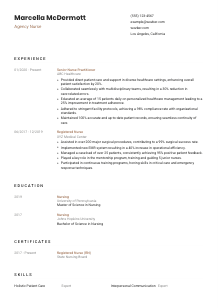
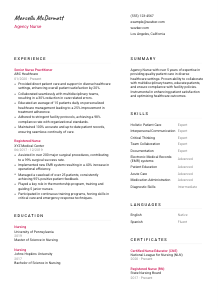
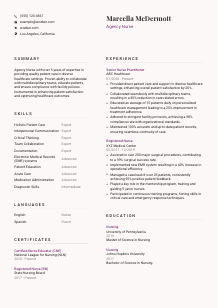
Navigating wards, but your CV feels bedridden? Check out this Agency Nurse CV example, created with Wozber free CV builder. Learn how to present your diverse nursing experience to match agency demands, nursing your career back to optimal vitality!
Agency nursing calls for fast clinical judgment, steady documentation, and the ability to step into a new unit without slowing patient care. Your CV needs to show that you can deliver safe, consistent nursing support across changing environments, whether that means acute care coverage, patient education, or working smoothly with physicians, case managers, and other bedside staff.
When an Agency Nurse CV is tailored well, the first read quickly answers a practical question: can this nurse walk into a facility, use its workflow, chart accurately, and contribute from day one? Wozber's free CV builder helps you align your background with the posting in an ATS-friendly CV format, so hiring teams can immediately see your license status, acute care history, EMR experience, and communication strengths.
Healthcare staffing teams move quickly, especially when they are filling agency shifts across hospitals and care facilities. Your personal details should make it easy to confirm who you are, how to reach you, and whether you already meet practical requirements such as location.
Use your full name in a clear, readable format at the top of the page. In nursing, presentation should feel professional and direct, much like clinical documentation. Skip nicknames and decorative formatting so the focus stays on your credentials and experience.
Place "Agency Nurse" directly under your name when that is the role you are pursuing. This immediately positions your CV for the assignment type and helps distinguish you from candidates applying for staff RN, charge nurse, or advanced practice roles.
Your contact information should be accurate and simple to scan, since staffing coordinators often review CVs quickly before moving to license checks, availability, and unit fit.
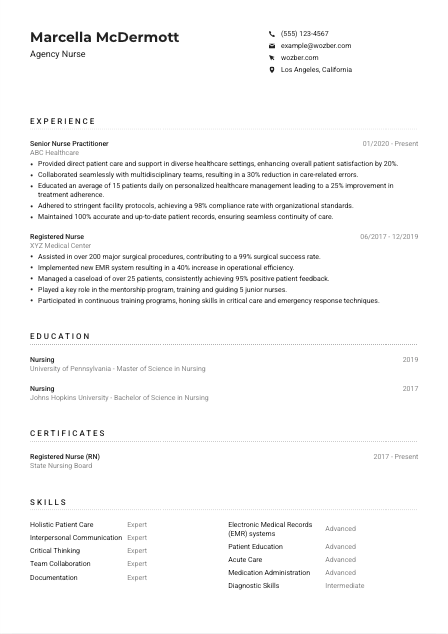
If a posting requires local availability, list your city and state clearly. Here, "Los Angeles, California" helps confirm that you already meet the location requirement and can be considered without relocation questions. Keep this practical rather than promotional.
A current LinkedIn profile can reinforce your work history, licenses, specialties, and education. If you include one, make sure job titles, dates, and credentials match your CV exactly, especially for regulated roles like nursing where inconsistencies raise unnecessary questions.
This section should remove friction, not create it. Clear contact details and the right location cue let the reviewer move straight to what matters next: your clinical experience, license, and ability to work effectively in agency settings.




For an Agency Nurse, experience is where hiring teams look for proof that you can deliver safe care, adapt to different facilities, and document accurately under pressure. Focus less on generic duties and more on patient volume, care setting, teamwork, compliance, and measurable outcomes tied to bedside practice.
Read the job description with a nurse manager's eye and mark the recurring care demands. In this case, direct patient care, multidisciplinary collaboration, patient education, protocol adherence, and EMR documentation are the core themes. Those priorities should shape which roles, bullets, and metrics you lead with.
List positions in reverse chronological order and include the employer, title, and dates. For nursing CVs, titles matter because they signal scope. If your past title is broader or more senior than the target role, keep it accurate but make sure the bullets underneath clearly connect to bedside care, acute care support, or float-style adaptability that an agency employer wants to see.
Your bullet points should show what changed because of your work. The example CV does this well by tying patient care to outcomes like a 20% increase in patient satisfaction and team collaboration to a 30% reduction in care-related errors. Metrics like compliance rate, patient load, treatment adherence, or EMR efficiency make nursing contributions easier to understand quickly.
Good nursing metrics are concrete and native to the work: patients educated per day, caseload managed, charting accuracy, compliance rates, response times, or support provided during procedures. The sample's mention of assisting in 200+ major surgical procedures and improving operational efficiency through EMR implementation gives the reviewer a clearer picture than broad claims about being hardworking or compassionate.
Agency employers need nurses who can enter a facility, follow protocol, communicate well, and maintain continuity of care. Trim accomplishments that do not support that picture. Prioritise bullets about acute care exposure, patient education, interdisciplinary coordination, documentation accuracy, and policy compliance, since those are the experiences most likely to transfer across assignments.
Your experience section should make your clinical value easy to recognize within seconds. If it shows where you practiced, what kind of care you handled, how you worked with teams, and what outcomes improved, it is doing the job an Agency Nurse CV needs to do.
Education matters in nursing because it confirms formal clinical preparation and helps establish whether you meet the posted baseline quickly. Keep this section straightforward, with degrees that support licensure and any advanced study that strengthens your profile for broader care coordination or patient education responsibilities.
For most Agency Nurse positions, the Bachelor of Science in Nursing should be visible immediately because it aligns with common RN qualification requirements. If you also hold a master's degree in nursing or a healthcare-related field, include it as added depth rather than assuming every posting requires it. In the example, both degrees support the candidate's profile without replacing the need to show recent clinical work.
List each degree with the school name, degree title, field of study, and graduation year. This section should be easy to scan, much like a credential file. Fancy formatting adds little value here compared with accuracy and clean structure.
Use the formal degree name as it appears on your diploma where possible, especially for nursing credentials. If the posting asks for a bachelor's degree in nursing, "Bachelor of Science in Nursing" makes that connection immediate and avoids ambiguity during screening.
Most experienced nurses do not need course lists, but early-career candidates can include selected training in acute care, pharmacology, critical care, or community health if it reinforces the type of assignments they are targeting. Keep it brief and relevant to patient care, documentation, or care coordination.
Honors, leadership roles, or nursing-related academic activities can be useful if they add something meaningful, such as teaching experience, clinical excellence, or research exposure. For seasoned nurses, these should stay secondary to licensure and hands-on care experience.
Your education section should confirm that you meet the role's academic baseline and, if applicable, show added preparation beyond it. In nursing, clear credentials support trust, but they work best when paired with strong clinical results elsewhere in the CV.
In nursing, certifications are not decorative. They show whether you can legally practice, whether your credentials are current, and whether you bring added capability in areas such as education, specialty care, or advanced clinical knowledge. Keep this section focused on what staffing teams and clinical leaders need to verify fast.
A valid Registered Nurse license belongs at the top because it is essential for the role. Do not bury it beneath optional certifications. The example gets this right by listing the RN credential prominently, making the candidate's eligibility clear right away.
After licensure, list credentials that strengthen the kind of care environments you want to work in. For example, a teaching-focused certification like CNE can support patient and family education responsibilities, while other candidates may feature BLS, ACLS, PALS, or specialty certifications depending on their clinical background.
Include issue dates or validity ranges so employers can see that your credentials are active. In regulated healthcare settings, date accuracy is part of professional credibility and often part of compliance review before placement.
Recent certifications can signal that you stay current with evolving care standards, technology, and clinical expectations. This is especially useful in agency work, where facilities may expect nurses to adapt quickly to different patient populations, documentation systems, and unit protocols.
This section should answer two questions immediately: are you licensed to practice, and do your added credentials support the assignments you want? When that is clear, the reviewer can focus on your care experience rather than chase missing compliance details.
The skills section should read like the toolkit of a nurse who can step into a facility and contribute safely. Keep it grounded in patient care, documentation, teamwork, and the clinical judgment needed in fast-moving care settings rather than filling space with vague personality traits.
Start with the language the employer already uses. Here, EMR proficiency, communication, interpersonal skills, and critical thinking are explicit requirements. Those terms should appear naturally in your skills section if they reflect your actual practice.
Agency Nurse CVs should show both system competence and bedside effectiveness. Pair hard skills such as EMR systems, acute care, medication administration, and documentation with role-critical soft skills like patient education, team collaboration, and clinical judgment. The sample skills list works because it covers both the technical and interpersonal sides of nursing care.
Put the most assignment-relevant skills first. If the role emphasizes acute care and EMR use, those should appear before less central abilities. A shorter, better-ranked list usually works harder than a long skills dump, especially when staffing teams are matching CVs to immediate care needs.
Your skills section should support the story told in your experience, not repeat generic CV language. When the skills line up with the actual care environment, documentation demands, and team expectations of agency work, the match feels credible.
Language ability matters in nursing because patient teaching, chart clarification, handoffs, and interdisciplinary communication all depend on clear understanding. Use this section to show required fluency first, then add other languages that may strengthen care delivery in diverse populations.
If the employer specifies language ability, mirror that requirement clearly. Here, fluent English in speaking and writing is mandatory, so English should be listed prominently and with an accurate proficiency level.
Lead with English when the role depends on precise charting, patient education, and care coordination in English-speaking clinical settings. This helps the reviewer confirm a basic operational requirement without hunting for it elsewhere on the CV.
Additional languages can strengthen your profile, particularly in communities where patient populations are multilingual. In the example, Spanish is a useful addition because it may support clearer bedside communication and education, though it is an advantage here rather than a universal requirement for all Agency Nurse roles.
Describe your level with terms such as "Native," "Fluent," "Intermediate," or "Basic." In healthcare, overstating language ability can create patient safety issues, so accuracy matters more than sounding impressive.
If you speak more than one language, think about where it helps in practice: patient intake, discharge teaching, family conversations, or reducing miscommunication during care transitions. That practical value is what makes language skills relevant on a nursing CV.
List language skills in a way that supports safe communication. For an Agency Nurse, that means making required English fluency obvious and treating any additional language as a real care asset, not just a CV extra.
The summary is your opening clinical snapshot. It should tell the reader, in a few lines, what kind of nurse you are, what environments you know, and which strengths you bring into patient care, documentation, and team-based practice.
Before writing the summary, identify the two or three priorities the employer cares about most. For this posting, that includes direct patient care, acute care experience, collaboration, patient education, and accurate documentation. Your summary should reflect that mix instead of sounding like a generic nursing bio.
Your first line should quickly establish who you are and how much relevant experience you bring. The example summary does this well with "Agency Nurse with over 5 years of expertise in providing quality patient care in diverse healthcare settings," which immediately frames clinical range and tenure.
Use the next sentence or two to highlight the strengths that travel well across assignments: EMR proficiency, multidisciplinary teamwork, patient and family education, protocol compliance, or acute care exposure. Pull from the strongest parts of your work history rather than trying to summarise every skill you have.
Aim for three to five lines. Focus on care setting, experience level, and one or two outcomes or specialties that help the reader picture you in the role. A concise summary with real nursing substance will land better than a longer paragraph full of broad claims about passion or dedication.
A well-written summary should make a reviewer expect strong clinical bullets below. If those opening lines already point to patient care quality, adaptable nursing experience, and reliable documentation, your CV starts on the right clinical note.
An effective Agency Nurse CV makes a few things easy to confirm fast: active licensure, relevant acute care experience, comfort with EMR documentation, and the ability to support patients and care teams across changing settings. That is the standard your final draft should meet.
Use Wozber to tighten the language, improve ATS optimisation, and organise your experience in an ATS-compliant CV that reflects how nursing work is actually evaluated. When the CV is tailored well, hiring teams can quickly see that you are prepared to deliver safe, dependable care from the first shift.




