



Use Wozber and land your dream job
Create CV
No registration required
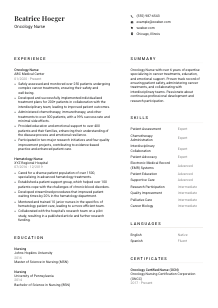
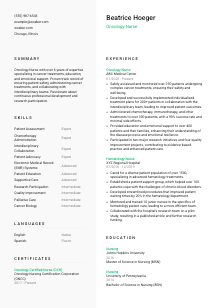
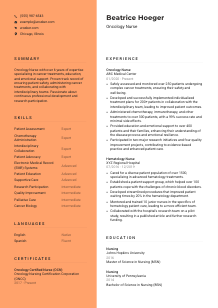
Fighting cancer, but your CV feels weak? Check out this Oncology Nurse CV example, created with Wozber free CV builder. It shows how to blend your care expertise with job specifics, shaping a career path as resilient as the patients you champion!
Oncology nursing CVs are strongest when they make clinical judgment visible. Hiring teams want to see how you assess patients during treatment, respond to side effects, administer high-risk therapies safely, and support families through difficult decisions. Generic nursing language misses the point. This role sits at the intersection of technical treatment knowledge and sustained patient support, and your CV needs to show both in concrete terms.
CV tailoring changes how quickly your background reads as true oncology experience rather than general bedside care. When your wording reflects treatment administration, symptom monitoring, interdisciplinary planning, EMR documentation, and patient education, an ATS-compliant CV gives a clearer picture of your day-to-day scope. Wozber's free CV builder helps organise those details in an ATS-friendly CV format so the hiring team can immediately see your readiness for oncology practice.
This section is brief, but it still does useful work. In healthcare hiring, clear personal details reduce friction, especially when licensure, location, and professional identity matter early in the review. Keep the information clean, accurate, and aligned with the oncology nurse position you are targeting.
Use your full name at the top in a slightly larger font than the rest of the page. It should be easy to find on a printed CV, in a PDF, or after ATS parsing. Keep the presentation simple and professional so the focus stays on your clinical background.
Place "Oncology Nurse" directly under your name if that is the role you are applying for. This helps frame the rest of the CV around infusion care, treatment monitoring, patient education, and oncology-specific collaboration instead of broader RN experience. It also reinforces alignment with the job title used in the posting.
List a current phone number and a professional email address, ideally a variation of your name. In a hospital or cancer centre hiring process, interview scheduling can move quickly, so accuracy matters. If you include a LinkedIn profile or professional site, make sure the roles, dates, and credentials match your CV exactly.
If the employer specifies a city or relocation requirement, include your city and state or note that you are willing to relocate. In the example here, Chicago, Illinois is part of the stated requirement, so showing that detail removes an obvious question early in the review process.
Include a LinkedIn profile when it strengthens your application with consistent work history, certifications, or professional affiliations. You do not need extra links unless they support your candidacy. For oncology nursing, the essentials are usually enough unless you have research publications, conference presentations, or committee work worth surfacing online.
This section should confirm who you are, where you are based, and what role you are pursuing without creating avoidable questions. A clear header lets the reader move straight into your oncology experience, credentials, and treatment-related responsibilities.




The experience section carries the most weight for this role. Employers need to understand your patient population, treatment environment, medication administration responsibilities, collaboration with physicians and advanced practice providers, and the outcomes you influenced. Make each entry show how you worked, not just where you worked.
Before rewriting your bullets, mark the responsibilities that define the role. For an oncology nurse, that usually includes treatment assessment, chemotherapy or immunotherapy administration, symptom monitoring, care coordination, family education, EMR documentation, and participation in quality or research efforts. Those priorities should guide which accomplishments you feature first.
List positions in reverse chronological order with job title, employer, and dates. That format helps reviewers quickly trace your oncology and hematology progression, and it supports ATS optimisation. If you have both general nursing and specialty experience, make the oncology-relevant roles the most detailed.
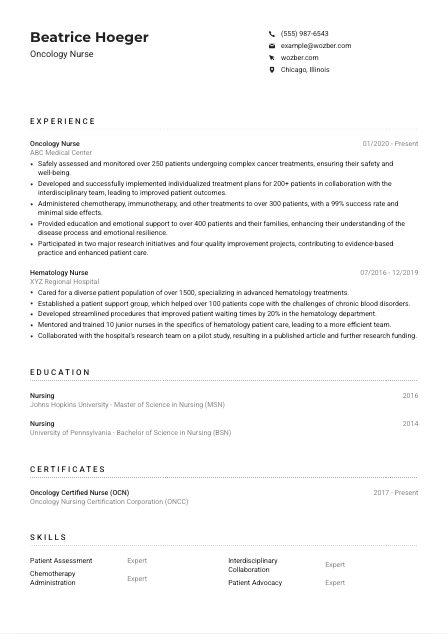
Each bullet should connect an oncology task to a result. Instead of saying you "provided patient care," show what that looked like: assessed patients during active treatment, administered chemotherapy, monitored for infusion reactions, educated families on symptom management, or coordinated treatment plans with the interdisciplinary team. The example CV does this well by pairing treatment work with measurable patient volume and outcome quality.
Quantify what you can without overstating it. Patient counts, treatment volume, wait time reduction, quality improvement participation, training contributions, and published research are all relevant in oncology settings. For instance, "administered chemotherapy and immunotherapy to over 300 patients" is stronger than a generic statement about medication administration because it shows both scope and specialty context.
Cut or compress experience that does not strengthen your case for this role. If you have hematology experience, infusion work, palliative care exposure, or research participation, give that more space than unrelated units. The sample CV uses a hematology nurse role effectively because it still supports the employer's request for oncology or hematology patient care experience.
A hiring team should be able to tell, within a few bullets, whether you can manage treatment-related risk, support patients through complex care, and contribute to an oncology unit from day one. Keep the section grounded in real responsibilities, patient volume, and treatment outcomes.
Education matters here because oncology nursing combines general RN preparation with specialty knowledge that affects treatment safety, patient teaching, and evidence-based care. Present your degrees clearly, then use this section to reinforce the academic path behind your oncology practice.
If the posting requires a BSN and prefers an MSN, list those credentials clearly and in descending order. Match the degree names accurately, especially when the employer uses formal wording such as "Bachelor of Science in Nursing" or "Master of Science in Nursing." That makes it easier for both ATS systems and human reviewers to confirm you meet the baseline requirement.
For each degree, include the school, degree, field, and graduation year. Avoid extra detail unless it strengthens your candidacy. In nursing hiring, clean formatting matters because this section is usually reviewed quickly for qualification confirmation rather than narrative depth.
If your MSN includes an oncology specialization, clinical concentration, thesis, or capstone tied to cancer care, include that detail. It helps distinguish specialty preparation from general graduate nursing education. If your degree is broader, do not force specificity, but do surface any directly relevant academic focus you genuinely completed.
Honors, leadership roles, or research projects are worth listing when they connect to oncology, hematology, patient education, or evidence-based nursing practice. A research-based project in symptom management or treatment adherence, for example, adds more value here than unrelated campus activities.
Continuing education is highly relevant in oncology nursing because treatment protocols, supportive care standards, and medication practices continue to evolve. If you have recent workshops, oncology-specific coursework, or advanced training that does not fit better under certifications, you can note it briefly to reinforce your commitment to current practice.
This section should quickly show that you meet the nursing education requirement and, where applicable, that your studies moved toward oncology care. Clear degree information supports the rest of your CV without distracting from your clinical experience.
For an oncology nurse, certifications are not decorative. They tell employers whether you hold the legal credential to practice and whether you have pursued recognized specialty validation in cancer care. Keep this section precise, current, and relevant to the work you will be doing.
Start with active RN licensure, then list oncology-specific credentials such as OCN or RN-BC when you hold them. In the provided job description, oncology certification is preferred rather than mandatory, but including it immediately strengthens alignment with the role and highlights specialty commitment.
Prioritise certifications that support chemotherapy administration, oncology practice, palliative care, infusion care, or related nursing responsibilities. General certificates can be included if they are current and relevant, but the most valuable entries are the ones that reinforce safe cancer treatment and specialty knowledge.
List the year earned and renewal status or active dates when appropriate. For licensure and specialty certifications, employers need to know they are current. The example CV handles this well by showing both RN and OCN credentials with active date ranges.
Oncology care changes with new protocols, targeted therapies, immunotherapy practices, and supportive care guidelines. Recent specialty certifications or renewals show that you are keeping pace with current standards rather than relying only on older training.
A clear, current credentials section helps employers quickly confirm licensure and recognize specialty preparation. When it is well ordered, it reinforces that you can step into a treatment environment with the required clinical foundation already in place.
The best oncology nurse skills sections combine technical competence with patient-facing strengths. Hiring teams expect to see treatment administration, assessment, EMR use, and collaboration, but they also look for communication skills that matter in serious illness care. Keep the list focused on skills you can support elsewhere in the CV.
Read the job description closely and separate hard skills from care-delivery skills. In this case, EMR proficiency, patient assessment, and medication administration sit alongside communication, empathy, and emotional support. Your CV should reflect both because oncology nursing depends on technical accuracy and sustained patient interaction.
Choose skills that mirror the treatments, workflows, and care environment you know. Examples include chemotherapy administration, immunotherapy monitoring, symptom management, interdisciplinary collaboration, patient education, supportive care, and EMR systems. The sample CV balances these well by mixing treatment skills with advocacy and education.
Do not overload this section with every nursing ability you have developed. A tighter list gives more weight to the skills that matter most in oncology practice. Include only strengths that are supported by your experience, certifications, or daily clinical work so the section reads as credible, not inflated.
A focused skills section should reinforce the picture already created by your experience. When the right clinical, documentation, and patient-support skills appear together, the reader gets a much clearer sense of your day-to-day effectiveness in an oncology setting.
Language ability can matter more in oncology than candidates sometimes realize. Treatment education, side-effect reporting, symptom escalation, and family conversations all depend on clear communication. Even when English is the only stated requirement, additional languages may strengthen your ability to support a diverse patient population.
If English competency is required, list English prominently and state your proficiency level directly. This is a simple but necessary way to show that you meet a basic communication requirement for patient care, charting, and interdisciplinary coordination.
Include additional languages when they are genuinely usable in clinical conversations. In many oncology settings, another language can support patient education, consent discussions, and family communication. The example CV includes Spanish, which may be valuable depending on the patient population served.
Use clear levels such as "Native," "Fluent," "Intermediate," or "Basic." Avoid vague labels. In healthcare, overclaiming language ability can create real patient communication risks, so accuracy matters more here than it might in other professions.
If space is limited, highlight languages that are most useful in the communities you serve or plan to serve. That choice can quietly reinforce your ability to support education, rapport, and culturally responsive care without overexplaining the point.
If you are currently improving a second language and have reached a usable level, you can note that. Keep it realistic. Employers will value honesty and practical communication ability more than an aspirational claim with no clinical application.
List languages when they improve your ability to educate patients, communicate with families, or work effectively in your care setting. Done well, this section adds another practical layer to your patient-centered profile.
Your summary should sound like an oncology nurse introducing their practice, not like a generic nursing profile. In a few lines, show your specialty experience, treatment environment, and the kind of patient care responsibility you have already handled. This is where you set the clinical tone for the rest of the CV.
Open with your title, your years in oncology or hematology care, and the core area of practice you want to emphasize. For example, the sample summary leads with more than 6 years of oncology-focused experience, which immediately positions the candidate inside the right clinical lane.
Select two or three qualifications that match the employer's priorities, such as cancer treatment administration, patient assessment, interdisciplinary planning, family education, or EMR proficiency. This is the place to echo the role's emphasis without copying the posting word for word.
A summary is short, but it should still include substance. Reference a meaningful accomplishment or area of contribution, such as safe administration of complex therapies, research participation, quality improvement work, or high patient volume in oncology settings. That gives the summary more authority than a list of traits ever will.
Aim for 3 to 5 sentences. Every line should add something useful about your oncology background, treatment experience, or patient support work. Avoid broad statements about being dedicated or passionate unless the surrounding language already proves that through specifics.
After reading this section, an employer should already understand your level of oncology experience, the kind of treatment environment you have worked in, and the patient care strengths you bring. That clarity sets up the rest of the CV to land with more force.
A well-tailored oncology nurse CV should show safe treatment administration, informed patient assessment, clear family education, interdisciplinary coordination, and up-to-date clinical credentials. When those elements are organised clearly, your experience reads as specialty practice rather than general nursing background.
Wozber's free CV builder can help you shape that content into an ATS-compliant CV, refine role-specific wording, and check alignment with an ATS CV scanner. The final result should make one thing easy to judge: you are ready to support patients through cancer treatment with both technical skill and steady clinical presence.




