



Use Wozber and land your dream job
Create CV
No registration required
Leading a medical team, but your CV needs life support? Check out this Nurse Manager CV example, created with Wozber free CV builder. Learn how to bring together your clinical expertise and management acumen, keeping your career trajectory as steady as a patient's heartbeat!
Nurse Manager CVs are reviewed through an operations lens. Hiring teams want to see how you run a unit, support safe patient care, guide nurses through policy and staffing demands, and keep standards steady when patient volume, staffing pressure, and compliance expectations are all moving at once. Your CV should make that management scope visible, not read like a staff nurse document with a leadership title added on top.
A tailored CV also helps separate bedside experience from true management ownership. When language from the posting shows up naturally in your work history, education, and licensure, Wozber's free CV builder helps you organise it into an ATS-compliant CV that clearly reflects clinical operations, staff supervision, EHR fluency, and resource oversight. That gives the hiring team a faster read on whether you can lead the department, not just work within it.
Healthcare employers move quickly once they identify a qualified Nurse Manager, so your header needs to answer the practical questions first. Keep this section clean, professional, and aligned with the role's stated requirements.
Use your full name in a larger, readable font so it stands out immediately in both digital and printed review. In nursing leadership hiring, clarity matters. A straightforward header supports the professional tone you want before the reader reaches your unit leadership experience.
Place "Nurse Manager" directly under your name when that is the role you are applying for. Matching the posted title helps frame your experience correctly, especially if your recent role was Assistant Nurse Manager, Clinical Supervisor, or another leadership variation.
Include a current phone number and a professional email address you check regularly. If you add a LinkedIn profile or professional site, make sure it reflects the same titles, dates, and leadership responsibilities shown on your CV. In healthcare hiring, inconsistencies around licensure, employment dates, or role progression create unnecessary friction.
If the employer specifies a location requirement, include your city and state in this section. For the Boston opening here, listing "Boston, Massachusetts" immediately answers a screening question and avoids confusion about relocation or local eligibility.
A LinkedIn profile can help if it reinforces your leadership path, committee work, quality improvement projects, or advanced nursing education. Skip any link that is outdated or thin. For a Nurse Manager, relevance matters more than having every possible platform listed.
This section should confirm that you are reachable, professionally presented, and already aligned with the basic logistics of the opening. Then the rest of the CV can focus on your clinical leadership.




For Nurse Manager hiring, experience is where your application earns credibility. This section needs to show operational control, staff leadership, patient care accountability, and the kind of measurable improvement that comes from managing people, workflows, and resources in a clinical setting.
Before revising bullets, mark the responsibilities that define the job. In this description, those include overseeing daily clinical operations, coordinating treatment plans across teams, evaluating and mentoring staff, shaping nursing standards, and handling budgets and supplies. Those themes should guide what rises to the top of your experience section.
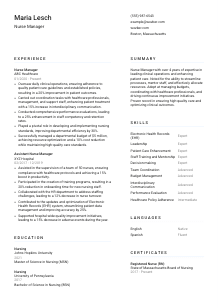
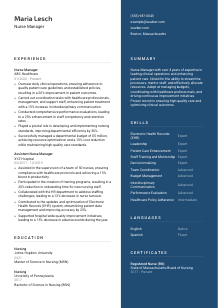
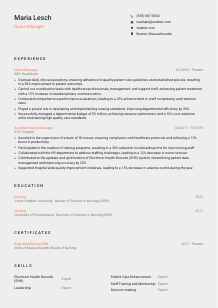
List positions in reverse chronological order with your title, employer, and dates. For nursing leadership roles, progression matters. A path from Assistant Nurse Manager to Nurse Manager, like the sample CV shows, quickly communicates increasing responsibility for staff oversight, unit performance, and departmental decision-making.
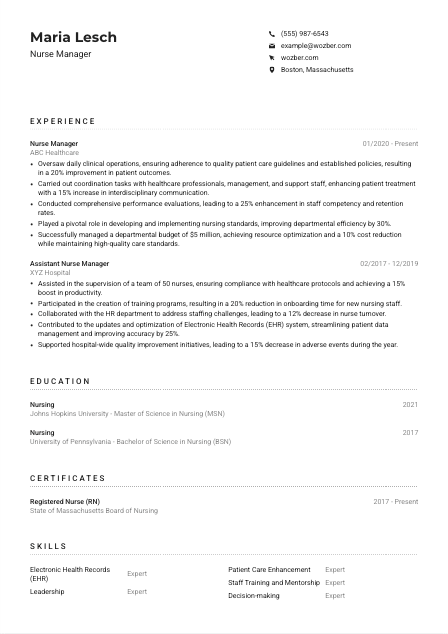
Focus on results tied to patient care quality, staff performance, workflow improvement, compliance, and interdisciplinary coordination. The sample does this well by connecting actions to outcomes such as a 20% improvement in patient outcomes and a 25% increase in staff competency and retention. That kind of bullet tells the reader what you led and what changed because of your leadership.
Quantified impact carries weight here because Nurse Managers are often accountable for staffing efficiency, quality indicators, retention, adverse events, budget control, and patient care outcomes. Metrics like reducing costs by 10%, improving departmental efficiency by 30%, or lowering adverse events are far more persuasive than broad claims about being results-driven.
Keep the emphasis on supervision, policy implementation, resource allocation, performance evaluation, mentoring, EHR-related process improvement, and collaboration with physicians, support staff, and hospital leadership. If a bullet could belong on a staff nurse CV without any change, revise it until the management dimension is clear.
A Nurse Manager CV should leave no doubt that you have led teams, improved care delivery, and handled the operational side of nursing. When that is clear, your experience section does the heavy lifting for the application.
Education matters in Nurse Manager hiring because it confirms both licensure foundation and readiness for broader leadership responsibility. Keep this section straightforward, and make the required nursing degrees easy to find.
When a posting asks for a BSN and notes an MSN as preferred, list those credentials clearly and exactly. That direct match matters in screening. In the example, the BSN satisfies the stated requirement and the MSN strengthens the candidacy for a management-level nursing role.
For Nurse Manager roles, lead with your most advanced nursing degree if you have one, then include the rest in reverse chronological order. Show the degree, field, institution, and graduation year so reviewers can confirm your academic background without digging.
Write out credentials such as "Bachelor of Science in Nursing (BSN)" and "Master of Science in Nursing (MSN)" rather than abbreviating too loosely. This mirrors the language employers often use in postings and helps with ATS matching while keeping your qualifications unmistakable.
Most experienced Nurse Managers do not need course lists. Include them only if they directly support the opening, such as healthcare administration, nursing leadership, informatics, quality improvement, or budgeting, and only when your work history is still developing.
Honors, leadership activities, or relevant capstone work can help if they show early management potential or specialised knowledge. Once you have several years of supervisory experience, though, these details should stay brief so the focus remains on your clinical and operational record.
This section should make it easy to confirm that you meet the nursing degree requirements and, where applicable, bring added leadership preparation. Then the reader can move straight to how you have applied that training on the floor and across the department.
For a Nurse Manager, licensure is essential, and any additional certification should reinforce authority, compliance, or leadership capability. Keep this section precise so there is no ambiguity around your current eligibility to practice and lead.
If the posting requires an active Registered Nurse license in the state of practice, make that your first entry. Include the full credential name, issuing body, and active date range. In this case, a Massachusetts RN license directly supports the stated requirement for practice in that state.
Prioritise credentials tied to nursing leadership, specialty oversight, patient safety, compliance, or staff development. Relevant examples may include nurse executive certifications, specialty clinical credentials, or leadership training with clear operational value. Leave out certificates that do not contribute to the management picture.
Dates matter because employers need to know whether a license or certification is current. If a credential is active, renewable, or recently completed, make that visible. Clear dates reduce follow-up questions and help the review process move faster.
Nurse Managers are often expected to keep pace with changes in care standards, documentation systems, quality initiatives, and regulatory expectations. Updated certifications can reinforce that you are staying current in both clinical practice and leadership responsibilities.
Your certifications section should confirm that you are licensed, current, and prepared for the level of accountability the role carries. For Nurse Manager hiring, that clarity matters immediately.
A Nurse Manager skills section should read like a leadership toolkit for running care delivery, supporting staff, and maintaining standards. Choose skills that match the actual work of the role, not a generic nursing list.
Look beyond the obvious keywords and identify the operational skills behind the posting. Here, that includes leadership, communication, decision-making, EHR proficiency, staff evaluation, policy adherence, resource management, and interdisciplinary coordination. Those are the terms most worth reflecting if they match your experience.
List the skills you can support through your work history. If you claim budget management, there should be a bullet showing budget responsibility. If you list Electronic Health Records, your experience should show documentation oversight, system optimisation, reporting accuracy, or workflow improvements connected to EHR use.
Replace vague entries with capabilities that mean something in nursing leadership. "Performance Evaluation," "Staff Training and Mentorship," "Healthcare Policy Adherence," and "Patient Care Enhancement" give a clearer picture than generic words like "hardworking" or "team player." The sample CV uses that approach well.
The best skills lists echo the realities of the unit you can manage. When each skill is supported elsewhere on the CV, this section becomes a fast, credible snapshot of your leadership range.
Nurse Managers communicate across patient care, staff supervision, and cross-functional coordination, so language ability can matter beyond basic conversation. Present this section in a way that reflects actual workplace use and the requirements of the posting.
If the role requires English, list it first with an accurate proficiency level. That immediately addresses a stated requirement and confirms you can manage documentation, staff communication, and clinical coordination in the language used by the organisation.
Additional languages can be valuable in hospitals and community health environments where patient populations and support staff are diverse. In the sample, Spanish adds practical value because it suggests broader communication reach with patients, families, and team members.
List a language when you can use it meaningfully in patient interaction, staff communication, or care coordination. This section should support credibility, so avoid overstating conversational ability if you could not use it in a clinical or supervisory setting.
Stick to plain categories such as "Native," "Fluent," "Intermediate," or "Basic." That gives hiring teams a quick and useful sense of what level of communication they can expect in documentation, conversation, or patient-facing contexts.
Extra languages are not mandatory for every Nurse Manager role, but they can support patient experience, de-escalation, family communication, and team coordination in multilingual environments. Include them when they add genuine value to the kind of unit or population you serve.
When this section is accurate and relevant, it adds another useful layer to your leadership profile. It can also help explain how you support communication across a busy care environment.
The summary should quickly establish the level of nursing leadership you bring and the kinds of outcomes you have managed. In a few lines, connect your supervisory background, clinical operations experience, and major strengths to the opening in front of you.
Start by identifying the core management themes in the job description, then reflect the ones that genuinely match your background. For this opening, that means clinical operations, staff supervision, patient care standards, EHR familiarity, and resource management. A summary that mirrors those themes will feel immediately relevant.
Open with your professional identity and years of relevant leadership experience. A line like the sample's "Nurse Manager with over 4 years of expertise in leading clinical operations and enhancing patient care" works because it establishes seniority and operational scope right away.
Choose strengths that are meaningful for Nurse Manager hiring, such as mentoring staff, improving care processes, managing budgets, coordinating interdisciplinary care, or advancing quality initiatives. Refer back to proof from your experience section so the summary feels grounded rather than promotional.
Aim for three to five lines with no filler. Focus on the parts of your background that tell a hospital or healthcare employer you can lead nurses, maintain standards, and improve unit performance. Save fine detail for the experience section.
When this section is tailored well, the reader understands your leadership level before reaching the first bullet point. That makes the rest of the CV easier to read through the right lens.
A Nurse Manager CV works when every section supports the same message: you can lead nursing staff, maintain care quality, manage operations, and keep the unit functioning under real clinical pressure. That means matching the posting closely, using measurable outcomes, and keeping licensure, education, and EHR-related experience easy to find.
Wozber's free CV builder, ATS-friendly CV template, and ATS CV scanner can help you shape that information into a CV that is tailored, readable, and aligned with ATS optimisation. The final result should make one thing clear without effort. You are prepared to run the nursing operation the employer needs.




