



Use Wozber and land your dream job
Create CV
No registration required
Administering care, but your CV feels under the weather? Scroll through this Licensed Practical Nurse CV example, created with Wozber free CV builder. Learn how to align your nursing expertise with job specifications, keeping your career as healthy as your patients!

Licensed Practical Nurse CVs are read through the realities of bedside care. Hiring teams want to see whether you can carry out physician or RN-directed treatments accurately, notice changes in patient condition early, document clearly in the chart, and communicate well with patients, families, and the rest of the care team. If your CV stays vague, it can blur the clinical judgment, consistency, and follow-through that matter in day-to-day nursing work.
A tailored CV makes your nursing scope easier to recognize fast, especially when an ATS is screening for terms such as LPN license, BLS, EHR use, medication administration, and patient monitoring. Wozber's free CV builder helps organise those details in an ATS-friendly CV format so your application surfaces the right clinical experience first and shows where you can step into patient care with confidence.
In healthcare hiring, the header does one practical job. It tells the employer who you are, how to reach you, and whether basic logistics line up before they spend time on your clinical background. Keep it clean, accurate, and consistent with the role you are targeting.
Use your full name in a slightly larger font than the rest of the page so it anchors the CV immediately. For nursing roles, this is especially important when hiring teams are reviewing many candidates across shifts, units, or outpatient settings and need a fast, clear read.
Place "Licensed Practical Nurse" directly under your name if that is the role you are applying for. This helps both recruiters and ATS tools sort your CV correctly. If your current role is adjacent, such as Nursing Assistant, your target title should still reflect the opening while the experience section explains your progression.
Include a reliable phone number and a professional email address. Double-check both. In healthcare, missed calls often mean missed interview slots or credentialing follow-up, so accuracy matters more than style here.
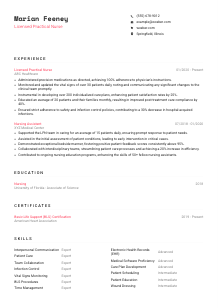
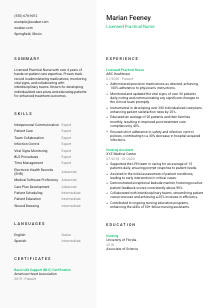
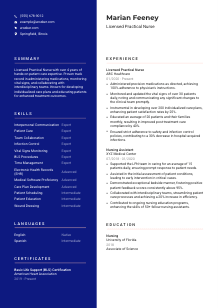
If the employer specifies a city or relocation requirement, show that clearly in your header. In the example, listing Springfield, Illinois immediately supports a posting that asks candidates to be local or willing to relocate. Use location as a tailoring detail, not as filler.
A LinkedIn profile or professional site can be useful if it supports your nursing background with consistent job dates, certifications, or additional context. Skip links that do not add anything relevant to patient care, clinical training, or healthcare employment.
Your contact section should remove friction. When the header is accurate and aligned with the posting, the employer can move straight to your license, experience, and patient care background.




The experience section carries the most weight for an LPN because it shows how you work in live clinical settings. Hiring teams look for day-to-day responsibilities, patient volume, documentation habits, safety awareness, and how closely your background matches the care environment they need to staff.
Before writing bullets, mark the core duties in the job description. For an LPN role, that often includes medication administration, vital signs monitoring, chart updates, care plan support, patient education, infection control, and coordination with physicians or RNs. Those priorities should shape which accomplishments you choose and how you phrase them.
List roles in reverse chronological order and give each one a clear structure: job title, employer, and dates. Put your LPN roles first, then supporting clinical positions if they help show continuity in patient care. A Nursing Assistant role can still add value when it demonstrates bedside support, teamwork, or early clinical exposure.
Each bullet should show what you did, who or what you supported, and what changed as a result. In this field, useful verbs include administered, monitored, documented, educated, coordinated, and escalated. The sample CV does this well with bullets on administering medications, updating vital signs, and helping develop individualized care plans rather than relying on generic statements about being compassionate or hardworking.
Quantify your work with measures that make sense in patient care. That can include patients seen per shift, medication accuracy, care plans completed, patient education volume, compliance improvement, satisfaction scores, or infection reduction. In the example, monitoring more than 30 patients daily and contributing to a 30% decrease in hospital-acquired infections gives employers a clearer picture of pace, scope, and quality.
Every bullet should support your case for safe, effective nursing care. Remove older or unrelated details that do not connect to treatment delivery, charting, teamwork, or patient outcomes. Keep the focus on the work most relevant to the opening, especially if the employer is looking for at least 2 years of healthcare experience.
For LPN hiring, experience needs to show dependable clinical execution. When your bullets reflect treatments, monitoring, documentation, education, and patient outcomes, the employer can picture you on the floor instead of guessing from job titles alone.
Education matters in nursing because it confirms the training behind your clinical work. Even when experience carries the most weight, employers still need to see that you completed the practical nursing education required for licensure and entry into patient care.
Read the posting closely and make sure your education section reflects the baseline credential it asks for. If the employer requires graduation from an accredited practical nursing program, your CV should make that easy to identify. When your degree title differs slightly from the posting, use the exact official wording from your school and let your license reinforce your nursing qualification.
List your degree, field of study, school, and graduation year in a straightforward order. This supports ATS parsing and helps recruiters confirm your academic background without digging through extra text. Nursing CVs benefit from clean structure because licensure and credentials often get checked early.
If your nursing education is your qualifying academic credential, place it first and make it easy to spot. In the example, an Associate of Science in Nursing clearly supports the LPN path. If you also have later coursework or unrelated education, do not let it overshadow the training that matters to bedside practice.
Early-career candidates can include relevant clinical coursework, rotations, or lab training if professional experience is still limited. Focus on topics that connect to the job, such as patient assessment basics, pharmacology, geriatric care, or medical-surgical nursing, rather than listing classes broadly.
Honors, leadership roles, or nursing projects are worth adding only if they reinforce your readiness for patient care. For example, a clinical practicum, simulation leadership, or patient education project can help. General campus activities matter less once you have solid healthcare experience.
Your education section does not need to be long. It needs to show that your nursing training is legitimate, relevant, and easy to verify alongside your license and clinical experience.
In nursing, certifications are practical credentials, not decorative add-ons. They show that you meet care standards, maintain required training, and can respond appropriately in clinical situations where timing and protocol matter.
Check the posting for certifications that are mandatory or strongly preferred, then list those at the top. For this kind of LPN opening, BLS belongs near the top because it directly supports patient safety and emergency readiness. Your active LPN license should also be impossible to miss.
Lead with certifications that affect your ability to work in the setting, follow care standards, or meet compliance requirements. A shorter list of high-value credentials is stronger than a long list of marginal ones. In many LPN roles, BLS, state licensure, and setting-specific training matter more than unrelated continuing education.
Include issue and renewal dates when relevant so employers can see that your credentials are active. In healthcare hiring, expired certifications create immediate friction, especially during compliance review and onboarding.
If you have recent training in areas such as wound care, IV therapy where permitted, infection prevention, or chronic disease management, include it when it fits the role. This shows that your skills are current and that you keep pace with care standards beyond the minimum license requirement.
For an LPN, certifications should reinforce readiness for safe patient care. Keep them current, relevant, and easy to scan so the employer can confirm your clinical eligibility quickly.
A nursing skills section works best when it reflects the actual mix of clinical tasks, documentation tools, and communication demands of the job. Employers are looking for skills they can connect to patient care delivery, not a broad personality list.
Read for more than obvious hard skills. An LPN posting may ask for medication administration, vital signs monitoring, infection control, EHR use, scheduling software, patient education, and collaboration with interdisciplinary teams. That combination tells you the employer needs someone who can handle both direct care and accurate documentation.
Use the same language the employer uses when it matches your real experience. If the posting mentions EHR systems, patient scheduling applications, or strong verbal communication, include those exact terms if you have worked with them. The sample CV handles this well by combining direct care skills such as Patient Care and Infection Control with system-based skills such as Electronic Health Records and Medical Software Proficiency.
Choose skills that support the care environment you are targeting instead of trying to inventory everything you know. Clinical strengths, charting tools, team coordination, and patient-facing communication usually matter more than general traits. A concise list makes it easier for both ATS tools and hiring teams to identify your strongest match points.
The best LPN skills sections read like a real clinical toolkit. When your list connects directly to treatments, charting, coordination, and patient interaction, it reinforces the experience section instead of repeating generic strengths.
Language ability can shape patient understanding, comfort, and follow-through, especially in community clinics, long-term care, and high-contact care environments. Even when English is the only stated requirement, additional languages can strengthen your ability to support patient communication.
If the posting asks for strong verbal and written English, list English clearly with an honest proficiency level. In nursing roles, this matters because charting, handoffs, discharge instructions, and patient education all depend on accurate communication.
After English, list any additional languages that could help in patient interaction or family communication. Order them by relevance and fluency. If you speak Spanish, Polish, or another language common in your care setting, that can be a practical advantage in bedside conversations and follow-up education.
Additional languages can support rapport, reduce communication barriers, and improve patient understanding of instructions. In the example, Spanish adds useful context because it suggests wider reach in patient-facing care, even though English remains the required language.
Choose levels such as Native, Fluent, Advanced, Intermediate, or Basic and be prepared to work at that level. Overstating language ability can become a problem quickly in patient education, symptom reporting, or interdisciplinary communication.
Only emphasize multilingual ability when it adds real value to the work you are targeting. In some settings it may be a clear advantage, while in others it is simply an added strength. Either way, it should support patient care rather than distract from your core nursing qualifications.
Language skills are worth listing when they help patients understand care, instructions, and next steps. Keep the section honest and practical, with English proficiency clearly established first.
The summary is where you frame your nursing background in a few lines before the reader reaches the detail. For LPN roles, it should quickly establish your experience level, your clinical strengths, and the kind of patient care work you have handled most often.
Pull the main themes from the posting before you write. If the role centers on medication administration, monitoring vital signs, updating records, supporting care plans, and educating patients, those are the themes your summary should reflect. Avoid generic openings that could belong to any healthcare worker.
Start with who you are professionally and how much relevant experience you bring. A line such as "Licensed Practical Nurse with 4+ years of hands-on patient care experience" works because it sets scope immediately and matches how nursing CVs are screened.
Choose details that connect directly to the role, such as medication administration accuracy, patient monitoring, EHR documentation, interdisciplinary teamwork, or patient education. The example summary works because it stays close to actual LPN responsibilities instead of using broad claims about passion or dedication.
Aim for three to five lines. That is enough space to show experience, clinical focus, and one or two outcomes without turning the summary into a paragraph of repeated CV bullets. In nursing hiring, fast clarity beats wordy introduction.
A sharp LPN summary tells the reader what kind of nurse you are before they review your full history. When it highlights clinical scope, patient care strengths, and relevant experience, the rest of the CV lands faster.
A Licensed Practical Nurse CV should make your day-to-day practice easy to understand. That means clear proof of licensure, recent clinical experience, patient care responsibilities, charting tools, certifications, and the outcomes you supported in real care settings.
Wozber can help you turn that information into an ATS-compliant CV with an ATS-friendly CV template, stronger ATS optimisation, and an ATS CV scanner that highlights missing requirements and role-specific keywords. Once your CV is tailored, hiring teams should be able to see quickly that you can step into medication administration, monitoring, documentation, patient education, and safe team-based care.