



Use Wozber and land your dream job
Create CV
No registration required
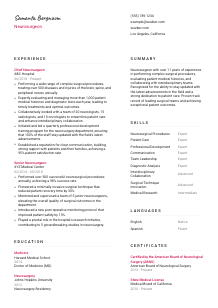
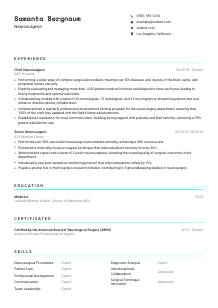
Delicately slicing through neurons, but your CV feels disconnected? Explore this Neurosurgeon CV example, created with Wozber free CV builder. Learn how to blend your brain surgery brilliance with job specifics, shaping a career graph as intricate as your finest operations!
Neurosurgery CVs are read with unusually high stakes because the work sits at the intersection of technical judgment, operative dexterity, and patient risk. Hiring teams want to see where you have practiced, what level of case complexity you have handled, and how you contribute before, during, and after surgery. Your CV should make that clinical scope visible quickly, from operative volume and outcomes to multidisciplinary coordination and patient communication.
In neurosurgery, small wording choices can change how your background is classified, especially when a hospital is sorting for board status, residency training, licensure, and procedure-related experience through an ATS. Wozber's free CV builder helps you align those credentials in a clean ATS-friendly CV format, so the hiring team can immediately understand your surgical background and whether your experience matches the service line's needs.
This section does not need flair. It needs to confirm that you are easy to contact, professionally presented, and positioned to meet any non-negotiable screening requirements tied to the opening.
Use your full name in the largest text on the page, and present it as a physician's professional identity rather than a design element. If your credentials are commonly used in practice, keep them accurate and consistent with the rest of the CV.
Place "Neurosurgeon" directly beneath your name so the CV is classified correctly from the first line. If your current title is more senior, such as Chief Neurosurgeon, you can still headline yourself as a neurosurgeon when targeting a practicing surgical role.
Include a reliable phone number and a professional email address. Hospitals and physician recruiters often move quickly once they identify a candidate with the right surgical background, so this information should be simple to find and free of distractions.
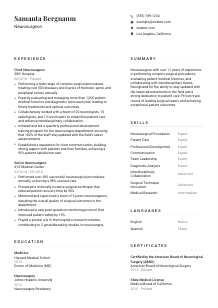
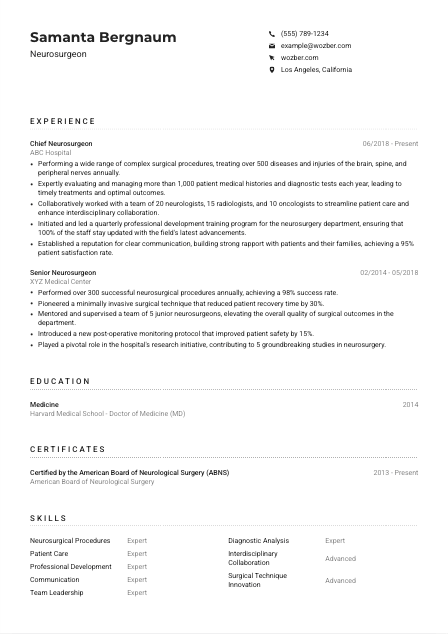
If an employer requires local presence or relocation, reflect that here. In the example, listing Los Angeles, California directly supports the posting's location requirement. If you are relocating, make that willingness clear rather than leaving the issue ambiguous.
A LinkedIn profile, faculty page, research profile, or hospital biography can strengthen this section if it is current and consistent with your CV. For neurosurgeons, links are most useful when they reinforce board certification, publications, leadership roles, or academic and clinical appointments.
Keep this section lean and exact. It should confirm who you are, what role you practice, and whether any basic screening requirements like location can be checked off immediately.




For a neurosurgeon, experience is where credibility is established. Titles matter, but hiring teams look deeper at procedure mix, case volume, outcomes, leadership in the OR, postoperative care, and how you work with neurology, radiology, oncology, and other specialties around complex cases.
If the opening asks for at least 5 years of post-residency neurosurgical practice, make that timeline obvious through your dates and progression. Your recent positions should immediately show sustained work in neurosurgical procedures and patient care rather than leaving the reviewer to calculate whether you meet the threshold.
List each role from most recent to earliest with the hospital or medical centre, your exact title, and dates of employment. This is especially important in medicine, where academic centers, trauma hospitals, private systems, and leadership appointments all shape how your scope of practice is understood.
Describe what you actually handled: cranial, spinal, peripheral nerve, minimally invasive, tumor-related, trauma, or other relevant surgical work. Pair responsibilities with results. The example does this well by tying complex procedures to annual case numbers, treatment timeliness, and patient satisfaction instead of listing duties in general terms.
Use measures that belong naturally in a surgical CV, such as annual procedure volume, success rates, complication reduction, recovery time improvement, patient load, protocol adoption, or satisfaction scores. Metrics like "over 300 procedures annually" or a "30% reduction in recovery time" are stronger than broad claims of excellence because they show scale and clinical effect.
Prioritise experience that supports the target role's core work: surgical treatment of brain, spine, or peripheral nerve conditions, diagnostic review, treatment planning, team-based care, and communication with patients and families. Research, mentoring, and departmental leadership are valuable additions when they reinforce your standing as a practicing neurosurgeon rather than pulling focus from operative competence.
Your experience section should leave a clear picture of what you operate on, how much responsibility you carry, and what outcomes follow your work. If a hospital can quickly understand your case scope and clinical judgment, this section is doing its job.
In neurosurgery, education is not a background detail. It confirms the formal path into practice, from medical school through the residency training that defines your specialty foundation.
The posting asks for an MD or DO from an accredited medical school, so list that degree clearly and exactly. Your medical degree should appear before any undergraduate education, and the wording should match the credential you actually earned.
Keep each entry easy to scan: degree, field, institution, and completion year. Straight formatting helps both human reviewers and ATS parsing, especially when a recruiter or credentialing team needs to confirm your training path quickly.
Residency is central to your qualification, so do not treat it like a minor detail. Name the program clearly as neurosurgery residency training. In the example, that entry reinforces direct alignment with the requirement for completed residency and helps connect the candidate's later surgical experience to formal specialty preparation.
Honors, research distinctions, or prestigious institutions can add value, especially in academic medicine or competitive hospital systems. Keep them secondary to the essentials. A hiring team first needs to confirm medical degree and specialty training before they weigh academic prestige.
Neurosurgery changes with new techniques, devices, imaging approaches, and treatment protocols. If you have fellowships, advanced courses, or CME-heavy development that matters to the role, include them where they fit best, while keeping this section focused on your core training path.
This section should confirm that your route into neurosurgery is solid, complete, and easy to follow. Medical degree first, specialty training clearly named, and no gaps in the qualification story.
For physicians, certificates are often less about decoration and more about eligibility. In a neurosurgeon CV, this section should quickly confirm board standing, licensure, and any current credentials that matter to safe practice and hospital compliance.
If the role asks for certification by the American Board of Neurological Surgery or eligibility for it, place that credential first. It is one of the clearest indicators that you meet specialty standards and are ready for clinical consideration.
List licenses and certifications that directly support your ability to work as a neurosurgeon. A state medical license belongs here. So do specialty credentials with direct clinical relevance. Leave out lower-value items that do not affect hiring, privileging, or specialty credibility.
Medical employers pay attention to whether a license or board credential is active. Add issuance or active date ranges when relevant. The example's "Present" formatting works because it quickly shows that the credentials are current.
Courses or certificates in neurosurgical technology, advanced techniques, or related continuing education can strengthen the section when they support the target role. Use them to show active engagement with the field, not to crowd out the core credentials every neurosurgical employer expects to see.
When this section is well organised, a reviewer should be able to confirm board standing and licensure in seconds. That removes friction early and keeps attention on your surgical experience.
A neurosurgeon's skills section should read like a clinical capability snapshot, not a generic checklist. It needs to balance operative ability, diagnostic judgment, interdisciplinary work, and patient-facing communication in language that matches the target position.
Start with the job description and extract the capabilities it emphasizes, including neurosurgical procedures, patient evaluation, treatment recommendations, multidisciplinary collaboration, communication with families, and dexterity-related demands. This helps your skills section reflect how the role is practiced rather than relying on broad medical buzzwords.
Lead with the capabilities most central to day-to-day neurosurgical work, such as neurosurgical procedures, patient care, diagnostic analysis, perioperative decision-making, and team leadership if the role carries senior responsibility. The example gets this mostly right by placing procedural and patient-care strengths ahead of broader supporting abilities.
Group or order skills in a way that makes sense to a medical reviewer. Technical and clinical skills can come first, followed by collaboration, leadership, research, or communication. This structure also supports ATS optimisation because it keeps role-specific terminology easy to identify without sounding stuffed with keywords.
Every skill listed should support the picture built by your experience section. If a hospital reviews this list and immediately sees operative competence, treatment judgment, and team-based care, you are on the right track.
Language ability matters in medicine because informed consent, family conversations, discharge planning, and interdisciplinary coordination all depend on clear communication. For neurosurgeons, this section is especially relevant when a posting names English fluency or when patient populations are linguistically diverse.
If the job states that duties must be performed in English, list English clearly and assign an honest proficiency level. This is a basic requirement, so do not bury it beneath additional languages.
Additional languages can strengthen your profile when they support patient rapport, family discussions, or care coordination across diverse communities. In the example, Spanish is a useful addition because it suggests broader patient communication capability without distracting from the primary English requirement.
List extra languages if you can use them meaningfully in patient care or professional settings. Do not add languages you can only handle casually if the role may involve high-stakes conversations around neurological risk, procedures, and recovery.
Use clear labels such as Native, Fluent, Advanced, or Conversational only if they accurately describe your ability. In a surgical specialty, overstating language proficiency can create real communication risk, especially during consent discussions and family counseling.
If the hospital serves a multilingual population, an additional language may carry more weight. For a Los Angeles opening, a language such as Spanish may be worth including near the top of the list, but only if you can use it confidently in a clinical setting.
Use this section to support the patient-facing side of your practice. Accurate language listings can strengthen your candidacy, especially in settings where family communication and community access matter.
Your summary should work like a clinical snapshot at the top of the page. In a few lines, it should establish your years in practice, the kind of neurosurgical work you handle, and the strengths that define your contribution to patient care and surgical teams.
Read the posting closely and reflect its emphasis in your opening lines. If the employer is focused on complex procedures, diagnostic review, multidisciplinary collaboration, and patient communication, your summary should touch those areas in natural language rather than using a generic physician profile.
Start with your title and years of experience, then move into the kind of work you do. A line like the example's "Neurosurgeon with over 11 years of experience" works because it immediately establishes specialty and tenure before expanding into procedures and patient care.
Choose details that fit the target role, such as complex cranial or spinal procedures, strong diagnostic judgment, leadership in interdisciplinary care, patient outcomes, or innovation in technique. Keep the claims grounded in the rest of the CV so the summary feels credible, not inflated.
Aim for 3 to 5 sentences. That is enough space to communicate your surgical background and differentiators without repeating the full experience section. A focused summary helps the reviewer understand your profile before they move into your case volume, outcomes, and credentials.
A well-written summary tells the reader, within seconds, what kind of neurosurgeon you are and what level of responsibility you have carried. That context makes the rest of the CV easier to trust and easier to review.
A neurosurgeon CV should make the essentials unmistakable: medical training, residency, board or board-eligible status, active licensure, operative experience, and the outcomes and collaboration patterns that define your practice. When those details are organised clearly, hiring teams can move quickly from screening to serious consideration.
Use Wozber's AI CV builder and ATS CV scanner to align your language with the posting, strengthen section-level ATS optimisation, and present your background in an ATS-compliant CV that reads cleanly to both systems and physician recruiters. The finished CV should make one thing easy to judge: whether your surgical experience matches the complexity of the role.