




Use Wozber and land your dream job
Create CV
No registration required
Carving paths to dental advancement, but your CV feels hidden in wisdom teeth? Check out this Oral and Maxillofacial Surgeon CV example, created with Wozber free CV builder. Learn how to extract your surgical skills and expertise, grafting them onto a career roadmap that aligns with job requirements!
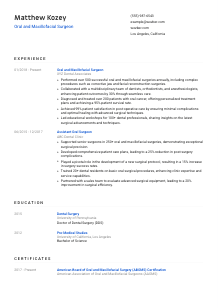
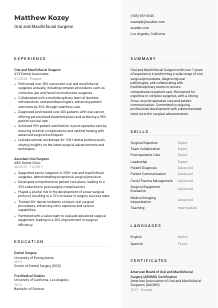
Oral and maxillofacial surgery sits at the intersection of surgical precision, diagnostic judgment, and patient trust. A hiring team wants to see more than a list of procedures. Your CV needs to show the level of case complexity you handle, the outcomes you deliver, and how you work across referrals, treatment planning, and post-operative care.
CV tailoring changes how quickly those clinical strengths come through, especially when an employer is sorting candidates with similar surgical training. Using Wozber's free CV builder to shape an ATS-compliant CV helps you match the language of the posting without flattening the details that matter, such as board status, sedation credentials, reconstructive scope, and multidisciplinary collaboration. That makes it easier to recognize where your practice already aligns with the role.
For a surgeon, the personal details section should read cleanly and professionally from the first line. It is not the place for personality copy or extra explanation. It should confirm who you are, how to reach you, and any logistical detail that removes friction for a practice or hospital reviewing your application.
Use your full name in the most prominent text on the page. Keep the styling polished and readable, the same way you would present yourself in a clinical setting. This section should feel precise and controlled from the start.
Place "Oral and Maxillofacial Surgeon" beneath your name so the target specialty is obvious at a glance. This helps separate you from general dentistry, oral surgery support roles, or broader surgical profiles and immediately anchors the CV in the right clinical lane.
List a direct phone number and a professional email address you check regularly. Accuracy matters here. A missed call for an interview or credentialing follow-up because of a typo is an avoidable problem.
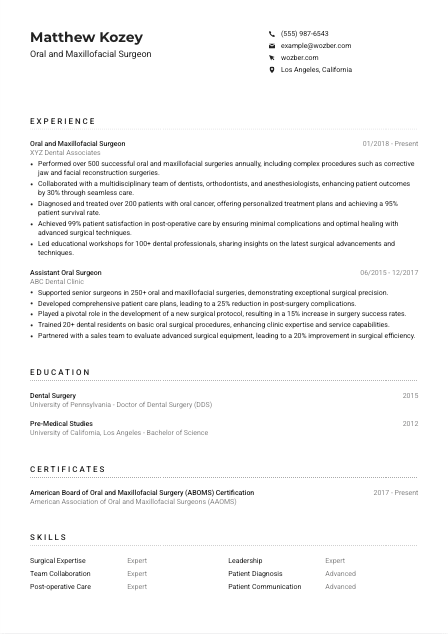
If a posting requires local presence, reflect that clearly in this section. Here, Los Angeles, California matters because the employer states it outright. When location is part of the screen, showing it up front prevents unnecessary doubt about availability or relocation timing.
Include LinkedIn, a faculty profile, or a practice bio only when it strengthens the clinical picture already on your CV. If you link out, make sure the profile matches your board status, affiliations, publications, procedural focus, and employment dates.
Your header should remove questions, not create them. When name, title, contact details, and location are handled cleanly, the reader can move straight to your surgical experience and credentials.




Experience is where oral and maxillofacial surgery CVs are won or lost. Hiring teams look for proof of procedural range, case volume, outcomes, and the kind of clinical environment you have worked in. Your bullets should show what you operated on, who you worked with, and how your care held up after the procedure.
Before rewriting your bullets, identify the medical and surgical priorities in the job description. In this case, that includes post-residency experience, corrective jaw surgery, facial trauma, facial reconstruction, oral pathology, post-operative care, and collaboration with dentists and orthodontists. Those priorities should shape what rises to the top of your experience section.
List your most recent surgical position first, then work backward. For each role, include employer, title, and dates so reviewers can quickly understand your progression from residency-adjacent work into independent surgical practice and increasing case responsibility.
Focus each bullet on a meaningful piece of practice. Strong examples include annual surgical volume, treatment results, complication reduction, patient satisfaction, or success in managing complex pathology. The sample CV does this well with details like 500+ surgeries annually and a 99% patient satisfaction rate in post-operative care.
Not every past responsibility belongs in the final version. Lead with bullets that reflect the type of surgery and care model the employer needs, whether that is facial trauma, orthognathic work, reconstruction, dentoalveolar surgery, or interdisciplinary treatment planning. If a posting emphasizes oral cancer diagnosis and treatment planning, make sure that appears before less relevant achievements.
Metrics carry weight when they are native to the work. Case volume, reduced post-op complications, survival outcomes, referral growth, patient satisfaction, or efficiency gains from protocol changes all help translate your practice into concrete results. Figures such as a 30% improvement in outcomes through team-based care are much more useful than vague claims about excellence.
This section should show the scope of surgeon you are now. When case mix, outcomes, and clinical collaboration are easy to read, the employer can quickly judge whether your background matches the complexity of their patient population.
In oral and maxillofacial surgery, education is a credentialing checkpoint as much as a background section. Degrees and training pathways need to be clear enough for a reviewer to confirm that you meet the baseline requirements for surgical practice before they move deeper into your application.
For this specialty, your MD or DDS and completion of an accredited Oral and Maxillofacial Surgery residency program belong at the centre of the section. If the role requires one of these credentials, do not assume the reviewer will infer it from other parts of the CV. State it plainly.
List institution, degree, field, and graduation year in a clean format. A straightforward structure helps credentialing staff and hiring managers review your academic history quickly, especially in settings where licensing and board eligibility are being checked alongside experience.
Your education section should mirror the level of training named in the posting. If the position calls for a DDS or MD plus residency, make sure both are easy to locate. The example CV lists the DDS clearly, though a completed OMFS residency should also appear explicitly if that training is part of your path.
Most experienced surgeons do not need to list coursework. An exception would be highly relevant training tied to craniofacial surgery, oncology, anesthesia, or trauma if you are earlier in your career or applying to an academic or highly specialised setting. Otherwise, keep the section focused on degrees and formal training.
Include distinctions that strengthen your surgical profile, such as honors in dental surgery, research recognition, chief resident status, or notable academic appointments. Skip achievements that do not add anything to your readiness for independent oral and maxillofacial practice.
A reviewer should be able to scan this section and confirm that your academic foundation supports the scope of surgery in the role. Clear education entries make the rest of your CV easier to trust.
Licensure, board status, and sedation authority matter immediately in this specialty. Certifications are not decorative here. They help determine whether you can step into the surgical, anesthesia, and regulatory demands of the role with minimal delay.
Start with the certifications and licenses the posting specifically calls for. Here, ABOMS board certification or eligibility, an active state medical license, and sedation permits or related certifications should appear first because they directly affect hiring viability.
Select certificates that support your ability to practice as an oral and maxillofacial surgeon. Board credentials, state licensure, sedation permits, anesthesia training, trauma certifications, and specialty fellowships belong here. General certificates with weak relevance can distract from the essentials.
Show when a certificate was issued and whether it is current. In regulated clinical environments, active status matters. The sample CV handles this well by showing ongoing California licensure, ABOMS certification, and sedation permit validity.
This field evolves through advances in reconstructive techniques, imaging, anesthesia protocols, and oncologic care. If you maintain specialty training or continuing education that strengthens your current practice, include it when it supports the position you are targeting.
When board status, licensure, and sedation authority are easy to find, your CV clears one of the most practical screens in surgical hiring. List the credentials that let an employer picture you operating safely and compliantly from day one.
The skills section should read like a focused snapshot of how you practice. For oral and maxillofacial surgery, that means balancing technical capability with patient communication, interdisciplinary coordination, and perioperative judgment. Keep it specific enough to support the rest of the CV rather than repeating generic strengths.
Read the posting for both stated and implied requirements. Here that includes surgical expertise, treatment planning, collaboration with dentists and orthodontists, post-operative care, patient communication, and experience with complex facial cases. Those are stronger anchors than broad labels like "hardworking" or "detail-oriented."
Use skill terms that reflect the employer's language when they match your actual background. Wozber's ATS CV scanner can help surface the phrases the posting emphasizes so your skills section supports ATS optimisation while still sounding like a real clinical profile.
A compact list usually works better than an exhaustive inventory. Combine procedural strengths such as facial trauma management or medical imaging interpretation with practice-critical soft skills like patient communication and team collaboration. The sample CV does this effectively by pairing surgical expertise with post-operative care and interdisciplinary work.
Your skills should reinforce the kind of surgeon your experience already describes. When the list is specific, relevant, and aligned with the posting, it adds clarity instead of noise.
Language skills matter in surgical practice when they affect patient consent, education, follow-up, and team communication. This section is usually brief, but it can still help if the posting names a required language or if your patient population makes multilingual communication especially useful.
If the posting names a language requirement, list it first with an honest proficiency level. In this case, English is mandatory, so it should appear clearly near the top of the section.
Lead with the languages you can use confidently in patient-facing settings. Proficiency matters in surgery because pre-op discussions, informed consent, discharge instructions, and post-op follow-up all depend on clear communication.
Extra languages can strengthen your profile when they are relevant to the population you serve. For example, Spanish can be a practical asset in many California practices because it may improve patient comfort and reduce communication barriers during treatment planning and recovery.
Use accurate levels such as Native, Fluent, Advanced, or Conversational. Overstating fluency can create real clinical risk in patient interactions, so this section needs the same honesty as your credentials and case history.
If multilingual communication has supported patient education, better adherence to post-operative instructions, or smoother coordination with families, it is worth showing. Keep the point grounded in patient care rather than treating languages as a decorative extra.
A concise language section can strengthen your application when it reflects the communication demands of the practice. Keep it accurate and clinically relevant.
The summary should tell a reviewer what kind of oral and maxillofacial surgeon you are before they read the rest of the page. In a few lines, it should establish your years in practice, procedural focus, and the clinical strengths that match the opening. Specificity matters more than polish here.
Start with the position's core needs, then choose the parts of your background that answer them best. If the employer emphasizes corrective jaw surgery, facial trauma, reconstruction, oral pathology, and multidisciplinary care, those ideas should guide the summary instead of a generic overview.
State your title and years of relevant experience early, such as "Oral and Maxillofacial Surgeon with 7+ years of experience." This immediately places you at the right level of practice and helps the reader understand your candidacy before they reach the detailed bullets.
Use the middle of the summary to name the areas where your practice stands out, such as high-volume oral surgery, facial reconstruction, oral cancer diagnosis, or strong post-operative outcomes. The example summary works because it stays close to actual experience rather than broad claims.
Aim for a short paragraph that can be read in seconds. Avoid vague adjectives and focus on what you do, the environments you work in, and the outcomes you are known for. A concise summary with real surgical substance will carry more weight than a longer statement full of general ambition.
A well-written summary gives the reader an immediate sense of your scope, experience, and practice style. By the time they enter the experience section, they should already know why your background fits the opening.
Your CV should now present the essentials of oral and maxillofacial practice clearly: training, licensure, board status, surgical scope, outcomes, and patient care strengths. Review each section against the job description so the employer can quickly see where your background matches their case mix and clinical needs.
Wozber's free CV builder can help you turn that information into an ATS-friendly CV template, and its ATS CV scanner can sharpen the wording around required credentials, procedures, and collaboration points. The finished CV should make one thing easy to judge: whether you are ready to step into this oral and maxillofacial surgeon role with the right experience and credentials.




