



Use Wozber and land your dream job
Create CV
No registration required
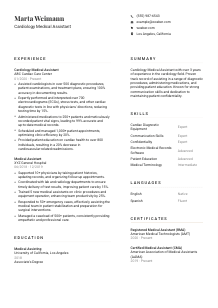
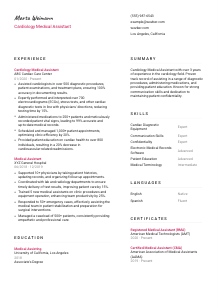
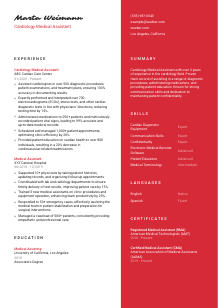
Bridging hearts, but your CV feels arrhythmic? Tune into this Cardiology Medical Assistant CV example, created with Wozber free CV builder. Learn how to bring your healthcare expertise in line with job needs, designing a career that's perfectly in rhythm and sync!
Cardiology clinics move quickly, but the work leaves very little room for loose documentation or vague clinical experience. A hiring team wants to see that you can support patient exams, handle ECGs or stress testing, record vitals accurately, manage follow-up flow, and speak with patients in a calm, confidential way. Your CV should make that clinical reliability visible from the first few lines.
When the CV is tailored to the posting, the difference is immediate. Cardiology-specific terms, accurate certification wording, and clear mention of EMR work or diagnostic testing help an ATS-compliant CV surface for the right reasons. Wozber's free CV builder helps organise that language cleanly so both the ATS and the cardiology team can quickly understand where you've worked, what tests you've performed, and how you support patient care.
In a medical support role, small details matter because they reflect how you handle larger ones. The header section should present your identity and contact information with the same accuracy you would bring to patient records or appointment scheduling.
Use your full name as the most prominent text on the page. Keep it easy to read and professional. In healthcare hiring, a clean header sets the tone quickly, especially for roles that involve constant documentation and patient-facing communication.
Place the job title directly below your name and match it to the role you are pursuing when it is accurate for your background. Using "Cardiology Medical Assistant" signals immediate relevance and helps align your CV with both the posting and ATS keyword matching.
Include a reliable phone number and a professional email address. Check formatting carefully. A typo in your contact details can suggest the same kind of carelessness that employers do not want in medication logs, test documentation, or patient chart updates.
If the employer asks for a specific location or local availability, include your city and state. For the Los Angeles example here, listing Los Angeles, California helps remove a practical hiring question right away. If you are relocating, make that clear instead of leaving the employer to guess.
Include LinkedIn or a professional profile only when it reinforces your clinical experience, certifications, or healthcare background. If you link out, make sure the dates, titles, and credentials match your CV exactly. Inconsistencies can create unnecessary doubt.
Do not include age, marital status, gender, photo, or other personal identifiers unless required by local law or specific application rules. For a Cardiology Medical Assistant CV, the focus should stay on certification, clinical experience, patient care, and administrative accuracy.
This section should read like a clean patient intake form. Accurate, relevant, and easy to scan.




For a Cardiology Medical Assistant, experience carries the most weight when it shows both clinical support and operational discipline. Employers look for evidence that you can assist physicians, handle testing, document care correctly, and keep patient flow moving without losing accuracy.
Read the job description line by line and mark the work that needs to appear in your bullets. In cardiology, that often includes ECGs, stress tests, vital signs, medication administration, EMR documentation, appointment scheduling, and patient education. If a duty appears in the posting, your CV should reflect where and how you handled it.
List roles in reverse chronological order so the hiring team sees your latest patient-care setting first. For a specialty clinic role, recent cardiology experience matters because it shows current familiarity with workflows, physician support, and diagnostic equipment.
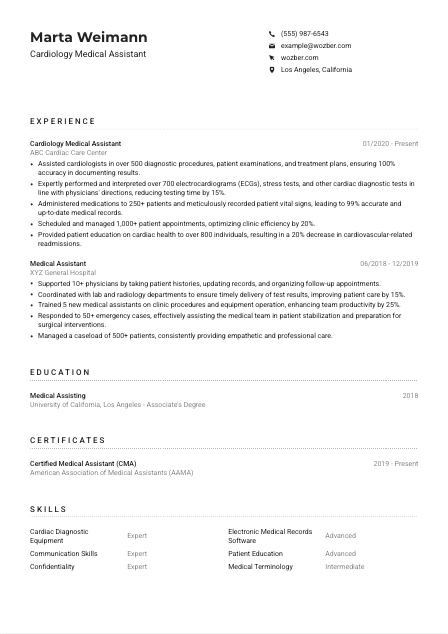
Do not stop at task lists. Show volume, accuracy, speed, or patient outcome where possible. The sample CV does this well with details like assisting in 500+ diagnostic procedures and performing 700+ ECGs and stress tests while reducing testing time by 15%. Those numbers tell a hiring manager much more than "responsible for cardiac testing."
Healthcare employers respond to metrics that reflect clinic reality. Good examples include number of patients supported, diagnostic tests completed, charting accuracy, appointment volume, reduction in wait times, or improvement in readmission-related education outcomes. Quantification works best when it is tied to patient flow, documentation quality, or clinical efficiency.
Keep older or broader medical assistant experience only if it supports the target job through transferable work like patient intake, histories, record management, physician support, or urgent care response. If you have direct cardiology experience, give it more space than unrelated duties so the CV stays aligned with the role's daily demands.
Your experience should show that you can step into a cardiology clinic and contribute on day one, from testing support to chart accuracy to patient communication.
Education matters here because the posting sets a clear baseline. Hiring teams want to confirm quickly that you meet the academic requirement before they spend more time on the rest of the CV.
If you hold an Associate's Degree in Medical Assisting or a related field, list it clearly and use the formal degree name. When the employer names a credential directly, matching that wording helps your CV align with both ATS filters and manual review.
Use a simple structure: degree, field of study, school, and graduation year or date. Healthcare CVs benefit from clarity here because the reader is often checking qualifications quickly before moving on to certification and experience.
If your education matches the requirement closely, let that show. "Associate's Degree, Medical Assisting" is stronger than a vague or shortened label. The example CV handles this well by stating the degree and field plainly, making the qualification easy to confirm.
If you are early in your career, coursework in anatomy, pharmacology, EKG procedures, medical terminology, or clinical assisting can strengthen this section. For candidates with several years of cardiology experience, coursework is usually secondary to hands-on results.
Honors, academic awards, or relevant clinical projects can add value if they support your medical training or patient care background. Keep them brief and relevant. This section should confirm preparation for clinic work, not become a long school profile.
Your education section only needs to do one job well here: confirm that you meet the required training for the role and move the reader confidently to your clinical background.
Certification is not a bonus item for this role. It is one of the first checkpoints, especially in specialty practices where medical assistants are trusted with testing support, medication-related tasks, and precise charting.
If the job asks for a current CMA or RMA, list that credential prominently and use the full certification name. If you hold both, include both, as in the example CV. That immediately answers a major qualification question for the employer.
Prioritise credentials tied to medical assisting, patient care, and outpatient clinical work. Avoid crowding this section with unrelated certificates that do not strengthen your case for a cardiology setting.
Include the year earned and, if relevant, the active date range. Current status matters in healthcare. A hiring manager should not need to guess whether your credential is up to date.
If you pursue continuing education in ECG interpretation, cardiac monitoring, HIPAA, medication safety, or advanced patient care topics, add those when they are current and relevant. Ongoing training is especially useful if you want to show deeper commitment to cardiology workflows and compliance standards.
Current, relevant certification tells the employer you meet a core requirement and are prepared for regulated clinical work in a cardiology environment.
A Cardiology Medical Assistant skills section should show that you can work confidently at the intersection of patient care, diagnostic support, and clinic operations. The best lists combine clinical tools, documentation systems, and interpersonal strengths that matter in a specialty setting.
Start with the posting. If it calls for electronic medical records software, cardiac diagnostic equipment, communication, confidentiality, and patient care, those should shape your list when they reflect your actual experience. This keeps the section relevant and helps with ATS optimisation.
Lead with the abilities most central to the job. Cardiac diagnostic equipment, ECG testing, stress test support, vital signs, EMR documentation, patient education, and medical terminology are all stronger here than broad workplace traits. In the sample CV, the mix of diagnostic equipment, EMR software, confidentiality, and communication creates a solid specialty profile.
Do not turn this into an inventory of everything you can do. Choose the skills that support the target role most clearly, and if you use proficiency levels, keep them believable. A focused list gives the employer a faster read on whether you can function in their clinic workflow.
This section should quickly confirm that you can handle cardiology-specific tools, accurate records, and patient-facing communication without needing much interpretation.
Language skills can directly affect patient comfort, education, and adherence in outpatient cardiology. When patients are receiving medication instructions or discussing symptoms, clear communication is part of safe care.
If the posting requires spoken and written English proficiency, list English clearly and note your level honestly. That requirement should be easy to verify at a glance.
Additional languages can be especially valuable in clinics serving diverse patient populations. Spanish, for example, may strengthen communication around intake questions, follow-up instructions, and cardiac health education when it matches the community you serve.
Stick with standard labels such as Native, Fluent, Intermediate, or Basic. Avoid vague wording. Healthcare teams need a realistic sense of whether you can greet patients, explain instructions, or support more detailed communication.
In cardiology, language skills are useful when discussing symptoms, reinforcing medication directions, or helping patients understand testing preparation and follow-up care. Present them as a practical patient-care asset, not just a personal detail.
If you are improving a language that is useful in your patient population, you can note that briefly. Keep it honest and concise. The main value is your current ability to support safe, respectful communication in the clinic.
List languages in a way that shows how you support real patient understanding, especially when care instructions and follow-up depend on clear communication.
The summary should read like a fast clinical snapshot. In a few lines, it needs to establish your specialty experience, certification level, and the kind of cardiology support work you handle well.
Focus on the work that defines a Cardiology Medical Assistant position: assisting with diagnostic procedures, supporting physicians during exams, documenting care accurately, educating patients, and managing cardiology clinic flow. Build your summary around the parts of that scope you have done directly.
A direct opening works best here. "Cardiology Medical Assistant with over 3 years of experience" gives the reader immediate context and sets up the rest of the summary efficiently. The sample CV uses this structure well because it establishes specialty relevance in the first phrase.
After the opening line, name the abilities that matter most for the target position. That might include ECGs and stress tests, EMR documentation, medication administration, patient education, or confidentiality. Mirror the posting's language where it matches your real experience so the summary feels tailored rather than generic.
Aim for 3 to 5 lines with no filler. This is not the place for broad claims about passion or work ethic. Use the space to show specialty experience, clinical capability, and the kind of support you bring to a cardiology team.
It gives the reader a quick, credible picture of your cardiology experience and makes the rest of the CV feel consistent before they reach the first job entry.
A well-tailored Cardiology Medical Assistant CV should make three things easy to confirm: you meet the baseline requirements, you have relevant cardiology clinic experience, and you can support both patient care and accurate documentation. If those points are clear, the CV is already doing real work for you.
Use Wozber to tighten that alignment from top to bottom. Wozber's AI CV builder, ATS CV scanner, and ATS-friendly CV format help you match certification wording, cardiology terminology, and clinic-specific responsibilities to the job posting without losing clarity. The final result should make it easy for a hiring team to see that you can handle the pace, precision, and patient interaction this role demands.




