



Use Wozber and land your dream job
Create CV
No registration required
Navigating medical charts, but your CV feels like an illegible scribble? Unwrap this Medical Support Assistant CV example, created with Wozber free CV builder. Learn how to turn your healthcare expertise into clean, organised lines, leading to a career as stable as a heartbeat!
Medical Support Assistants keep patient access and clinic flow moving. Hiring teams look closely at whether your CV shows dependable front-desk execution, accurate record handling, and steady communication with patients and clinical staff. If those basics are buried under generic administrative language, your CV can miss the mark even when your background is relevant.
For this role, tailoring changes whether your CV reads like general office support or true medical operations support. Using Wozber's free CV builder helps you mirror the posting's language in an ATS-friendly CV format, so appointment scheduling, EHR work, patient check-in, and billing support are easy to spot early. That makes it much clearer that you can handle the pace and accuracy the role requires.
The top of the CV should immediately place you in a healthcare support setting. For a Medical Support Assistant, that means clear contact details, the right job title, and any location detail that removes practical questions before a hiring manager reaches your experience.
Use your full name in a clean, readable style that fits the rest of the CV. In healthcare support hiring, clarity matters more than design flourishes. Make it easy for a recruiter or clinic manager to identify your application quickly when reviewing a stack of candidates for patient-facing administrative work.
Place "Medical Support Assistant" directly below your name if that is the role you are pursuing. Matching the posted title helps position your background correctly, especially when your previous jobs may have been listed as Medical Secretary, Front Desk Coordinator, or Medical Receptionist. It keeps your CV aligned with the opening from the first line.
Include a reliable phone number and a professional email address based on your name. This role depends on responsive communication, so your contact information should look as dependable as the way you would handle patient calls, appointment follow-ups, and internal messages.
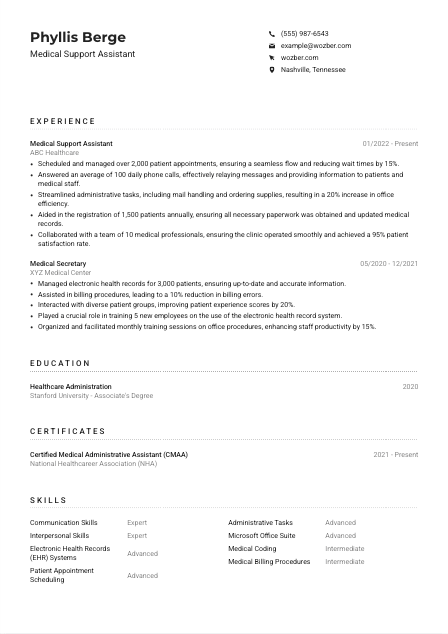
If the employer specifies a local hiring preference, include your city and state. In this example, listing Nashville, Tennessee immediately answers a stated requirement. Only do this when location is relevant to the opening, but when it is, placing it here saves the reader from guessing about commute or relocation.
A LinkedIn profile or similar professional page can support your application if it is current and consistent with your CV. For medical support work, that profile should reinforce your experience with EHR systems, patient scheduling, registration, and office coordination rather than read like a generic online bio.
This section should confirm that you are reachable, role-aligned, and ready for the clinic's day-to-day workflow. Keep it clean, accurate, and directly relevant to the position.




This is where a Medical Support Assistant CV earns attention. Employers want to see how you handled patient volume, scheduling accuracy, record maintenance, calls, registration, and daily coordination with providers or office staff. Vague office language will not carry the same weight as specific healthcare responsibilities and results.
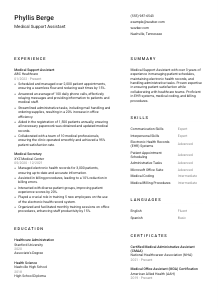
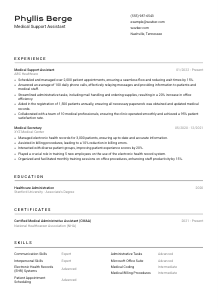
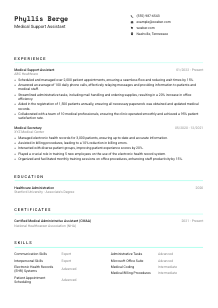
Focus first on roles where you handled patient scheduling, EHR updates, phone communication, registration, records, billing support, or other medical office duties. If your title was not exactly the same, connect the work to the target role through the bullet points. The sample does this well by pairing Medical Support Assistant and Medical Secretary experience with duties that clearly fit ambulatory office operations.
List jobs in reverse chronological order and include your title, employer, and dates in a consistent format. That structure matters in healthcare hiring because reviewers often want to quickly confirm recent experience in a medical office, clinic, hospital department, or similar patient-facing setting before reading deeper into the bullets.
Each bullet should show what you handled and what changed because of your work. Strong examples for this profession include reducing patient wait times, improving record accuracy, supporting smoother check-in and check-out, or helping the office respond faster to patient calls. In the example CV, bullets about managing appointments, aiding registration, and supporting patient satisfaction show direct operational value.
Metrics make front-desk and administrative work easier to understand. Appointment volume, daily call volume, number of patient records maintained, reduction in billing errors, faster check-in, and patient satisfaction scores are all natural measures for this field. The example's figures, such as 2,000 appointments managed and 100 calls handled daily, make the scope of work immediately credible.
When space is limited, prioritise experience that supports the employer's core needs: patient coordination, accurate documentation, communication, and workflow support. If you have unrelated administrative work, keep only the parts that transfer well, such as scheduling, records management, or customer-facing coordination. The section should read like someone ready to support a clinic, not a general office applicant.
A hiring manager should be able to picture you managing appointments, updating records, answering calls, and keeping daily operations organised. The more clearly your bullets reflect real healthcare workflow, the stronger this section becomes.
Education is usually a straightforward section for Medical Support Assistant roles, but it still helps frame your preparation for healthcare administration work. Start with the credential that meets the posting, then include any additional study that strengthens your background in medical office operations.
If the posting asks for a high school diploma or equivalent, make sure that credential is clearly listed. If you also hold a related associate degree or further study in healthcare administration, health science, or medical office support, include it as an added advantage rather than a replacement for the basic requirement.
List the school, degree, field of study, and graduation year in a simple structure. Recruiters reviewing support staff CVs often scan this section quickly, so clean formatting helps them confirm the requirement without slowing down the rest of the review.
A field such as Healthcare Administration can strengthen your CV because it connects directly to scheduling, records management, patient service, and office procedures. In the example, the associate degree adds useful context for the candidate's administrative work in a medical setting, even though the minimum requirement is a high school diploma.
Coursework is optional. Include it only when it strengthens your case, such as classes in medical terminology, health information management, billing, coding basics, or office systems. Early-career candidates can use this space to show exposure to clinical office processes when their work history is still developing.
Short courses, workshops, or training in EHR systems, HIPAA awareness, billing workflows, or patient communication can reinforce your readiness for modern medical office work. Use them selectively so the section stays focused and does not overwhelm the main education entries.
For this role, education should quickly confirm that you meet the baseline requirement and, where applicable, show added preparation for healthcare administrative work. Keep the emphasis on relevance, not volume.
Certifications matter most when they reinforce the exact kind of support work the employer needs. For a Medical Support Assistant, that usually means administrative healthcare credentials tied to front-desk operations, documentation, patient coordination, or medical office procedures.
When a job description mentions preferred credentials, list those prominently if you have them. Here, CMAA and MOA are a strong match because they support the administrative and patient-facing responsibilities in the role. This kind of alignment tells the employer you already speak the language of medical office workflows.
Only include certifications that strengthen your case for medical support work. A short, targeted list carries more weight than a long list of unrelated training. For this profession, billing, coding, medical administration, EHR, or healthcare office credentials usually matter more than broad generic certificates.
If a credential is current, ongoing, or has an active validity period, show that clearly. In healthcare environments, employers often want to know whether a certification reflects current standards and recent engagement with the field rather than older training that may no longer be active.
Medical offices change quickly through software updates, billing requirements, and documentation practices. Recent credentials or maintained certifications show that you are staying engaged with the administrative side of healthcare delivery, not relying only on older experience.
Well-chosen certifications should make your CV feel more grounded in medical office practice. They work best when they directly support the responsibilities you already demonstrate in your experience section.
A Medical Support Assistant skills section should read like the toolkit of someone who can keep a clinic organised while working calmly with patients and staff. Blend system knowledge with communication skills, and keep every item tied to actual job performance.
Start with the competencies the employer actually named. In this case, EHR systems, medical coding, billing procedures, interpersonal communication, and administrative support are all strong priorities. Use the posting to decide what belongs near the top instead of relying on a generic office skills list.
Lead with skills that are hardest to infer and most valuable in healthcare operations, such as patient appointment scheduling, EHR documentation, registration, billing support, and records management. These tell a hiring team much more than broad entries like "organised" or "team player."
The role sits between systems work and human interaction. Show both sides. Technical items might include EHR platforms, coding familiarity, billing procedures, and Microsoft Office. People-facing strengths should include phone communication, front-desk service, message handling, and working smoothly with clinicians and patients under time pressure.
This section should make it obvious that you can manage records, appointments, and communication without losing accuracy or patient focus. If a skill does not support that picture, it probably does not need the space.
Language ability can add real value in a medical office, especially when the role involves frequent patient contact by phone, at check-in, and during follow-up communication. The key is to list languages in a way that is accurate and relevant to the actual work environment.
If fluent English is stated as essential, list English clearly with an honest proficiency level. For a Medical Support Assistant, this matters because phone communication, patient instructions, message accuracy, and coordination with medical staff all depend on strong spoken and written English.
Additional languages can strengthen your application when they are relevant to the patient population or clinic setting. In some communities, even conversational ability in another language can help with patient comfort and front-desk rapport, although it should never be overstated.
Terms such as "Fluent," "Advanced," "Intermediate," or "Basic" are usually enough. Be precise. In healthcare support work, misrepresenting language ability can affect patient communication and create problems in real interactions.
A language section matters more when the job includes heavy phone coverage, check-in, scheduling, and patient-facing coordination. For a back-office administrative role it may be less central, but for front-desk medical support it can be a useful differentiator when relevant.
If you speak another language, frame it as an added communication asset rather than a decorative detail. Even basic proficiency can be worth listing when it realistically supports patient comfort, simple directions, or smoother day-to-day interaction in a diverse clinic environment.
For this profession, languages matter when they improve patient communication and office coordination. List them clearly, rate them honestly, and let them support the patient-facing nature of the role.
Your summary should quickly establish the kind of medical office support you provide best. A hiring manager should see your years of experience, your core administrative strengths, and the healthcare workflows you already know how to handle before moving into the rest of the CV.
Read the posting closely and pull out the core work: scheduling, patient records, phone communication, registration, billing support, and coordination with medical staff. Then shape your summary around the parts of that work you already do well. This keeps the opening targeted and useful.
Start with a direct description such as your title and years of relevant experience. For example, the sample CV leads with more than 3 years of experience, which immediately frames the candidate as someone who already understands healthcare administrative routines rather than a general office applicant.
Choose abilities that matter most for this profession, such as EHR management, appointment scheduling, patient registration, billing support, or patient communication. If you can reference outcomes like improved patient satisfaction, lower billing errors, or smoother clinic flow, even better. Keep the examples concise and believable.
Aim for a short paragraph, usually three to five lines. Avoid vague traits and focus on what you handle in a medical office. A summary that mentions EHR systems, patient coordination, and administrative accuracy will do more work than one filled with generic statements about being hardworking or detail-oriented.
Your summary should tell the reader, within seconds, that you can support patient flow, maintain records accurately, and communicate well in a healthcare setting. If it does that clearly, the rest of the CV has a strong opening.
A Medical Support Assistant CV works best when each section supports the same hiring picture: you can manage patient-facing administration, keep records accurate, and help the office run smoothly. That consistency matters just as much as any single bullet point.
Wozber's free CV builder gives you a practical way to organise that story in an ATS-friendly CV template, and its ATS CV scanner can help you tighten wording around scheduling, EHR work, billing support, and patient communication. Use those tools to sharpen the match without drifting away from your real experience.
When the CV is tailored well, the employer can quickly see that you are ready for the pace, accuracy, and patient service standards of a Medical Support Assistant role.




