



Use Wozber and land your dream job
Create CV
No registration required
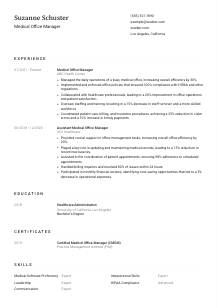
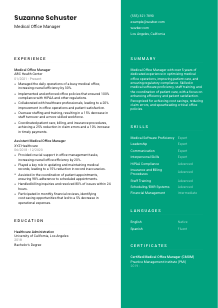
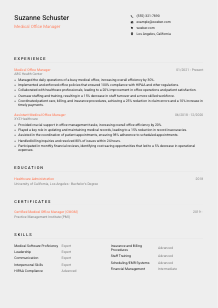
Keeping the prescriptions in order, but your CV seems disarrayed? Check out this Medical Office Manager CV example, created with Wozber free CV builder. Learn how to present your healthcare management expertise to match job needs, ensuring your career stays healthy and thriving!
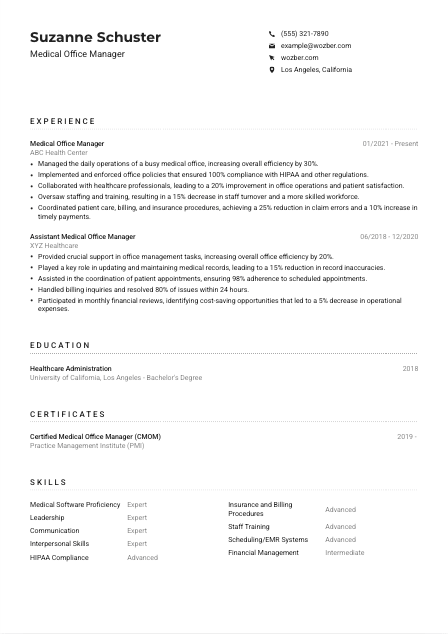
A Medical Office Manager sits at the centre of patient flow, front-desk operations, staffing, billing coordination, and compliance. Hiring teams want a CV that shows you can keep a practice running smoothly while protecting HIPAA standards, supporting physicians, and fixing the daily friction points that affect both revenue cycle performance and patient experience.
When this CV is tailored well, the first read quickly separates someone who has managed a medical office from someone with only general administrative experience. Wozber's free CV builder helps you align your wording with the posting, build an ATS-compliant CV, and make your experience with scheduling systems, EMR workflows, insurance procedures, and staff oversight easy to recognize.
This section is short, but it still carries practical weight in healthcare hiring. For a Medical Office Manager, contact details should immediately confirm role alignment and, when relevant to the posting, location and availability to work onsite.
Use your full name in a larger, clean font so it anchors the CV right away. In office leadership roles, presentation matters because you are often the person coordinating staff, handling patient concerns, and representing the practice's professionalism.
Place "Medical Office Manager" directly under your name if that is the role you are pursuing. This removes ambiguity and helps both recruiters and ATS systems connect your background to medical office operations, scheduling oversight, compliance, and billing support rather than to general office administration.
Include a reliable phone number and a professional email address, ideally in a straightforward format such as firstname.lastname@email.com. Double-check for typos. In roles that depend on responsiveness and coordination, small errors here can undermine the operational credibility you want the rest of the CV to establish.
If the employer asks for local candidates, include your city and state. In this example, listing "Los Angeles, California" helps answer a stated requirement immediately without taking up extra space. Treat location as a tailoring choice tied to the posting, not a universal rule for every application.
A LinkedIn profile or professional website can help if it reinforces your healthcare administration background, certifications, or career progression. Only include it when the content is current and consistent with your CV, especially if it mentions medical practice operations, patient service improvements, or leadership experience.
Keep personal details clean, accurate, and aligned with the posting. For this role, they should quickly confirm who you are, what position you are targeting, and whether you meet practical requirements such as local availability.




For Medical Office Manager hiring, experience is where the decision usually sharpens. Employers look for direct ownership of office operations, staff supervision, HIPAA compliance, scheduling flow, billing coordination, and measurable improvements in efficiency, claim accuracy, or patient satisfaction.
Read the job description closely and mark the work that defines success in the role. Here, that includes daily office management, staff scheduling and evaluations, HIPAA enforcement, insurance and billing troubleshooting, and collaboration with physicians. Those priorities should shape your bullet points so the CV reflects medical office leadership, not broad administrative support.
List your most recent roles first and make the title, employer, and dates easy to scan. Reverse chronology helps hiring teams see whether you have already managed a medical office, grown from an assistant office manager role, or increased your scope across staffing, compliance, and financial coordination.
A hiring manager already knows a Medical Office Manager handles schedules, policies, and patient issues. What matters is what changed under your management. The sample CV does this well with bullets such as increasing office efficiency by 30%, reducing claim errors by 25%, and lowering staff turnover by 15%. That kind of phrasing shows control over both workflow and outcomes.
Quantify impact with metrics that belong to medical office operations. Good examples include appointment adherence, claim denial reduction, payment turnaround, record accuracy, patient satisfaction, compliance rates, training completion, or staffing retention. Numbers make your contribution concrete, especially when they connect operational fixes to patient care and revenue cycle performance.
Prioritise accomplishments that show leadership in a clinical office setting. If a bullet does not support your ability to manage staff, oversee EMR and scheduling workflows, coordinate billing, maintain compliance, or improve service delivery, cut it or rewrite it. Relevance is especially important when an ATS and a practice administrator are both scanning for direct healthcare operations experience.
Your experience section should show that you can run the office, not just work in one. Use clear scope, concrete outcomes, and the language of the posting, then run it through Wozber's ATS CV scanner to strengthen ATS optimisation around the responsibilities that matter most.
Education matters here because many Medical Office Manager postings ask for a degree tied to healthcare administration or business operations. This section should confirm that you have the academic foundation for office management, compliance awareness, and the financial and organizational side of running a practice.
If the posting asks for a bachelor's degree in Healthcare Administration, Business Administration, or a related field, make that information easy to spot. In the example, a Bachelor's Degree in Healthcare Administration directly supports the requirement and reinforces the candidate's familiarity with healthcare systems and practice operations.
List the degree, field of study, school, and graduation year in a clean structure. Hiring teams do not need a long academic narrative here. They need to confirm credentials quickly and move back to the experience that shows how you applied that training in a medical office setting.
When you have multiple degrees, place the one most connected to healthcare operations or business management first. For this profession, coursework or degrees related to healthcare administration, business, practice management, or health services are usually the most useful to surface.
Honors, relevant student leadership, or projects can help if they connect to healthcare operations, patient service systems, compliance, or administration. If you are early in your career, these details can add context. If you already have several years of direct office management experience, keep this section tighter.
Education can validate your background, but Medical Office Manager hiring still leans heavily on operational experience. Treat this section as proof of foundation, then let your work history show how you handled staffing, EMR workflows, billing issues, and policy enforcement in real practice settings.
Keep education easy to verify and clearly connected to healthcare or business operations. For this role, the degree should support your management background, not compete with it.
Certifications are often a differentiator in medical office leadership roles, especially when they reinforce compliance knowledge, practice administration, or specialty office management. They are not always required, but they can strengthen your case when the employer is comparing candidates with similar experience.
Even when a certification is not listed as a requirement, it can still help if it aligns with the work. A credential such as Certified Medical Office Manager fits naturally because it supports office operations, compliance awareness, and administrative leadership in a healthcare environment.
Focus on credentials related to medical office management, healthcare administration, billing, compliance, or practice operations. A short, relevant list carries more value than unrelated certificates that do not speak to patient coordination, insurance processes, or medical office leadership.
List the issue date, renewal period, or active range when that information matters. In healthcare settings, current credentials can signal that your knowledge of regulations, office procedures, or administrative standards is up to date.
Medical offices change with payer rules, documentation expectations, software updates, and compliance standards. Recent certifications or renewals tell employers that you are keeping pace with the operational side of healthcare, not relying only on older experience.
Use certifications to reinforce the kind of medical office leadership the role requires. The right credential adds weight when it connects directly to compliance, administration, billing, or patient-facing office operations.
The best skills section for a Medical Office Manager is specific enough to match the posting and disciplined enough to stay credible. Employers want to see a blend of healthcare operations knowledge, staff leadership, patient-facing communication, and systems fluency.
Start with the terms the employer actually uses. In this posting, those include medical software, scheduling and EMR systems, medical terminology, HIPAA standards, insurance and billing procedures, leadership, communication, and interpersonal skills. These are the skills most likely to affect both ATS matching and recruiter attention.
Only include skills that show up elsewhere in your CV through achievements, responsibilities, or certifications. If you claim strength in HIPAA compliance or billing procedures, your experience section should back that up with examples such as policy enforcement, claim error reduction, or insurance issue resolution.
Lead with the skills that drive success in a medical office environment. For many candidates, that means EMR and scheduling systems, staff supervision, HIPAA compliance, insurance and billing coordination, patient communication, and workflow management before broader traits such as professionalism or multitasking.
The skills section should read like a concise operating profile of a Medical Office Manager. Keep it close to the posting, grounded in real experience, and focused on the systems, regulations, and people-management work the office depends on.
Language ability matters in medical offices because communication affects patient intake, scheduling accuracy, billing explanations, and front-desk trust. This section should reflect the posting requirements first, then any additional language strengths that are genuinely useful in the practice environment.
If the job calls for fluency in English, list English clearly and give your proficiency level. That is a stated requirement here, so it should appear before any additional language information.
After the required language, list any others that could help in patient communication or team coordination. In some practices, Spanish, Mandarin, or other commonly spoken community languages can add value, but they should support the role rather than distract from the required qualifications.
Choose simple, honest terms such as Native, Fluent, Advanced, or Conversational. Avoid vague wording. A Medical Office Manager may be expected to handle patient concerns, explain scheduling issues, or support front-desk communication, so accuracy matters.
In diverse patient populations, a second language can improve scheduling calls, check-in conversations, and billing clarification. The sample CV's English and Spanish combination is a good example of added value, especially in patient-facing environments, but extra languages are a bonus unless the posting specifically requires them.
If you are actively learning a language, include it only when you can describe the level honestly and it is relevant to the practice. For management roles, overclaiming language ability can create problems in real patient interactions, so keep this section accurate and practical.
For this role, language information should first confirm required English fluency and then show any additional communication range that could support patient service and team coordination.
The summary needs to establish your management scope quickly. In a few lines, it should show years of experience, the kind of medical office environment you have run, and the business and patient-care outcomes you influence through staffing, compliance, scheduling, and billing coordination.
Before writing, identify the themes that define the role. Here, that means medical office operations, staff leadership, HIPAA compliance, EMR or scheduling systems, insurance and billing procedures, and collaboration with healthcare professionals. Your summary should speak to those areas directly rather than using generic management language.
Start with a clear statement such as Medical Office Manager with 5+ years of experience. That immediately frames your professional level and helps distinguish you from administrative coordinators or front-office candidates who may not have led full office operations.
Choose the capabilities most central to the target job and support them with measurable or concrete results. The example summary works because it connects operational improvement, patient care coordination, compliance, cost savings, and reduced claim errors in a compact way. That gives the reader a quick view of both function and impact.
Aim for three to five lines with enough detail to show management scope, not a long paragraph of soft claims. A focused summary should mention the setting, your operational strengths, and one or two outcomes that make a hiring team want to review the rest of the CV closely.
Your summary should make one thing clear within seconds: you know how to keep a medical office efficient, compliant, and patient-centered. Use Wozber's AI CV builder and ATS-friendly CV templates to shape that message into a clean, ATS-friendly CV format that reflects the role you are targeting.
A Medical Office Manager CV works when it shows command of the office's daily mechanics and the outcomes those mechanics produce. Staffing, EMR workflows, HIPAA compliance, billing coordination, physician support, and patient satisfaction should all appear through concrete examples instead of broad claims.
Use Wozber's free CV builder, ATS-friendly CV templates, and ATS CV scanner to tailor each section to the posting and strengthen ATS optimisation. The finished CV should make it easy to judge whether you can step in and run a medical office with accuracy, efficiency, and confidence.




