



Use Wozber and land your dream job
Create CV
No registration required
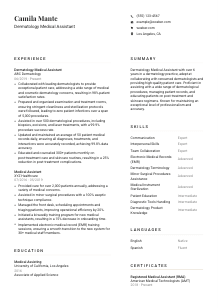
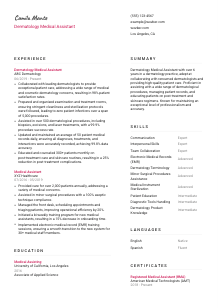
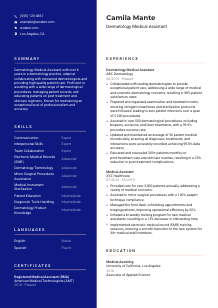
Working with skin, but your CV feels bumpy? Smooth things out with this Dermatology Medical Assistant CV example, created with Wozber free CV builder. Learn how to blend your healthcare expertise with dermatology know-how to make your career glow as bright as healthy epidermis!
Dermatology practices move quickly, but the work leaves little room for loose documentation or vague experience. Hiring teams want to see that you can keep exam rooms ready, support biopsies and excisions without breaking sterile workflow, document accurately in EMR, and speak with patients clearly about both treatment and aftercare.
A tailored CV changes how that experience lands. When your wording reflects dermatology-specific procedures, patient education, and charting work, Wozber's free CV builder helps you shape an ATS-compliant CV that surfaces the right terms early and makes it easier to recognize hands-on dermatology support rather than general medical assisting.
For a Dermatology Medical Assistant, the top of the CV should confirm the basics fast: who you are, how to reach you, and whether you meet practical requirements tied to the opening. Keep this section clean, professional, and easy to scan.
Place your full name at the top in a larger, readable font. In healthcare hiring, clarity matters more than styling. Your header should feel as organised as a patient chart, with your name immediately visible.
Add the role title directly under your name: "Dermatology Medical Assistant." This helps frame the CV from the first line and supports ATS matching when the employer is screening for dermatology-specific experience rather than broader front-office or general clinical support.
Include a reliable phone number and a professional email address. A simple format such as firstname.lastname@email.com works well. Double-check every detail. In a clinical setting where interviews can move quickly, missed calls or bounced emails can cost you a next step.
If the posting includes a location requirement, list your city and state clearly. In this example, Los Angeles, CA belongs in the header because the employer asked for candidates located there. Treat location as a tailoring point, not something to repeat throughout the CV.
Include LinkedIn or another professional profile only when it supports your application with consistent work history, certifications, or healthcare-related credibility. Make sure the title, dates, and experience there match your CV exactly.
This section does not need personality flourishes. It needs accuracy, professionalism, and any posting-specific detail that affects eligibility. If the header is clean and aligned, the reader can move straight into your clinical experience.




This is where employers look for real day-to-day dermatology work. They want to know whether you have supported procedures, kept records accurately, handled patient flow, and worked confidently with physicians in a specialty setting. Strong bullets make the scope of that work unmistakable.
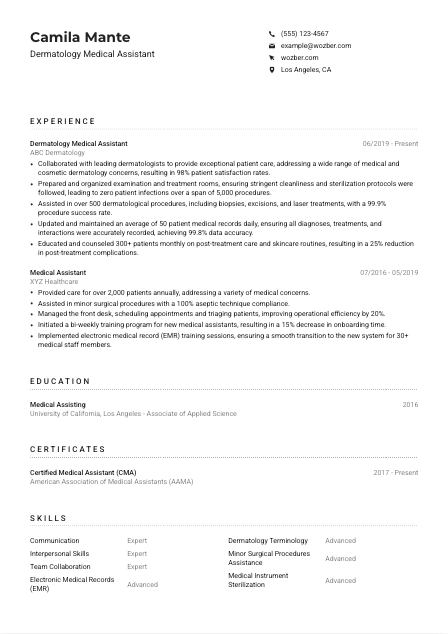
Start by emphasizing experience that matches the specialty. If the employer asks for 2+ years in a dermatology practice, bring that to the surface through job titles, workplace names, and bullets that reference dermatology visits, cosmetic and medical skin concerns, room prep, biopsies, excisions, or laser support. The sample CV does this well by opening with a dedicated Dermatology Medical Assistant role rather than making the reader infer the specialty.
List roles from most recent to oldest. For each job, include title, employer, and dates. That structure helps hiring teams quickly confirm current specialty experience, career progression, and whether your dermatology background is recent enough to be useful in a fast-moving clinic.
Each bullet should connect a dermatology task to a result. Good examples include assisting with biopsies, excisions, or laser procedures, maintaining sterilization standards, documenting patient encounters in EMR, or educating patients on post-treatment care. In the example CV, "assisted in over 500 dermatological procedures" works because it names the procedures and the volume, not just a generic support function.
Metrics make your experience more credible when they reflect healthcare operations. Use counts such as procedures assisted, records updated per day, patient volume, satisfaction scores, complication reduction, compliance rates, or training results. The strongest numbers in this field show consistency, safety, and documentation accuracy, not just busyness.
Keep older or broader medical assistant work only if it adds something useful, such as surgical assistance, patient triage, EMR implementation, or staff training. If a bullet does not support dermatology care, procedural support, documentation, or patient communication, trim it or rewrite it so the relevance is clear.
Your experience section should leave no doubt that you can step into a dermatology practice and contribute on day one. Use Wozber's ATS CV scanner to check whether your bullets reflect the procedure terms, EMR language, and patient care phrasing the posting uses.
Education matters here because the posting asks for completion of a Medical Assistant program. You do not need to overbuild this section, but you do need to present your training clearly enough that the employer can confirm the foundation behind your clinical work.
When a job asks for completion of a Medical Assistant program, make that qualification easy to find. If you hold an Associate degree or diploma in Medical Assisting, place it clearly in this section. In the provided CV, the Associate of Applied Science in Medical Assisting directly supports the requirement.
List the degree, field of study, school name, and graduation year or date. Keep the layout simple. Hiring teams are usually checking for program completion first, not looking for a long academic narrative.
If your coursework or training included dermatology-adjacent content, clinical procedures, medical terminology, pharmacology, anatomy, or patient care labs, mention that only if it adds useful context. This can help newer candidates show clinical preparation even if their dermatology experience is still building.
Add coursework only when it strengthens your application. For someone with several years of dermatology experience, the education section can stay brief. For someone earlier in their career, courses tied to sterile technique, charting, or assisting with minor procedures can reinforce readiness.
Honors, scholarships, or relevant student activities can stay if they support healthcare discipline or leadership, but they should not overshadow clinical qualifications. In this role, certification, specialty experience, and procedure support usually carry more weight than campus involvement.
This section should confirm your training without slowing the reader down. Present the medical assisting foundation clearly, then let your dermatology experience and certifications do the heavier lifting.
Certification is not a nice extra in this posting. It is part of the stated requirement. Present it in a way that quickly confirms you hold a recognized credential and that it is current.
If you hold a CMA, RMA, or another recognized Medical Assistant certification, list it clearly with the full name and issuing organisation. That direct match matters. In the sample CV, both CMA and RMA immediately answer the employer's certification requirement.
Lead with certifications tied to medical assisting, patient care, sterile technique, or specialty clinical support. If you have many certificates, keep the list focused. Employers hiring for dermatology support need to see the credentials that affect clinical trust and day-to-day practice first.
Show the issue date, renewal range, or current status when applicable. That helps the employer see that your certification is active and not outdated, especially for credentials that require maintenance.
As your career progresses, additional training in dermatology procedures, laser safety, wound care, or cosmetic treatment support can strengthen your CV. These are not universal requirements, but they can help when the practice includes a mix of medical and cosmetic services.
This section should answer one question immediately: are you properly credentialed for the role? If the answer is obvious at a glance, the employer can focus on your procedural experience and patient care background next.
A Dermatology Medical Assistant skills section should read like the work of the clinic. That means balancing clinical, procedural, documentation, and communication skills rather than listing broad traits with no connection to patient care.
Start with the language the employer already used. Here, that includes EMR proficiency, communication, interpersonal skills, dermatology terminology, and assistance with minor surgical procedures. These are high-priority keywords because they describe the actual workflow of the role.
List only skills you can back up in your experience section. For this role, that might include Electronic Medical Records, biopsy assistance, excision support, laser treatment preparation, instrument sterilization, patient education, or dermatology product knowledge. The sample CV works because the skills echo the procedures and recordkeeping shown in the experience bullets.
Do not crowd the section with every transferable skill you have. Prioritise the tools, terminology, and patient-facing capabilities that matter in dermatology practice. A shorter list with strong specialty alignment is more effective than a long list filled with generic strengths.
When this section is tailored well, the reader should be able to picture you handling patient intake, chart updates, room prep, procedure support, and aftercare guidance. Wozber's ATS-friendly CV format helps those skills stay readable for both screening software and clinical hiring staff.
Language ability can be highly practical in dermatology, where patient education, consent conversations, and aftercare instructions need to be understood clearly. Keep this section factual and relevant to patient interaction.
If the posting requires proficient English, list English first with an accurate proficiency level. That makes it easy for the employer to confirm a stated requirement without searching for it elsewhere on the page.
After English, include any additional languages you can use in a clinical setting. In some markets, Spanish can be especially useful for explaining prep instructions, follow-up care, and routine skincare guidance, but include it because it reflects your real ability, not because every role expects it.
Additional languages can support patient rapport and access, especially in diverse communities. Still, list them only if you can use them credibly in conversation or patient-facing situations.
Use straightforward labels such as "Native," "Fluent," "Intermediate," or "Basic." In healthcare roles, overstatement creates risk. Your stated level should match what you could comfortably handle with patients or colleagues.
Language skills can strengthen your application, but they do not replace clinical competence, EMR accuracy, or dermatology procedure knowledge. Present them as an added layer of patient care value.
A well-handled language section shows that you can communicate clearly where it matters most: patient questions, instructions, and follow-up care. Keep it accurate, and let it reinforce your readiness for the population the practice serves.
The summary should quickly establish your level of dermatology experience, the kind of clinical support you provide, and the tools or procedures you know well. In a specialty practice, vague summaries waste valuable space.
Centre your summary on actual dermatology medical assistant work: supporting dermatologists, preparing patients and treatment rooms, assisting with procedures, maintaining records, and guiding patients through aftercare. That focus tells the reader immediately which kind of Medical Assistant you are.
Lead with your title and years of relevant experience, such as "Dermatology Medical Assistant with 6 years of specialty practice experience." This works better than a generic opener because it establishes your level and setting right away.
Use the next sentence or two to mention the qualifications that best match the posting, such as EMR proficiency, dermatology terminology, minor procedure support, patient education, or collaboration with dermatologists. The example summary is effective because it combines specialty experience, procedural support, and record management in a compact space.
Aim for 3 to 5 lines. Every phrase should point to dermatology practice, patient care quality, procedure support, or documentation accuracy. Skip broad claims about being hardworking or passionate unless you can tie them to real clinical outcomes.
By the time someone finishes this section, they should already understand your dermatology background, your clinical support range, and the value you bring to patient care and procedure flow. That makes the rest of the CV easier to read in the right frame.
A Dermatology Medical Assistant CV works when the clinical details are easy to trust. Clear procedure support, accurate EMR work, patient education, certification, and specialty experience should all appear where a hiring team expects to find them.
Use Wozber's free CV builder and ATS CV scanner to align your wording with the posting, strengthen section-by-section ATS optimisation, and present your background in an ATS-friendly CV template. The final result should make one thing clear fast: you can support dermatology care safely, accurately, and with confidence.




