



Use Wozber and land your dream job
Create CV
No registration required
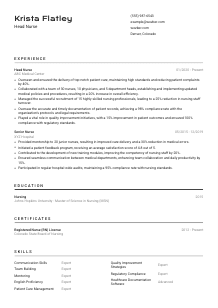
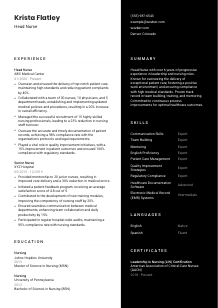
Leading the team, but your CV feels short-staffed? Sync your skills with this Head Nurse CV example, created with Wozber free CV builder. Learn how to align your nursing leadership with job demands, charting a career course that keeps your professional journey as healthy as the patients under your care.
Head Nurse hiring usually turns on one question quickly: can this nurse lead care delivery without letting standards slip. Clinical skill matters, but so do staffing judgment, documentation discipline, quality oversight, and the ability to keep a unit functioning well under pressure. Your CV should make that leadership visible through patient care results, team supervision, and process improvements that affected the floor, not just bedside duties.
When those details are tailored to the posting, your CV reads less like a general nursing profile and more like a candidate prepared to run a team. Wozber's free CV builder helps you shape that story into an ATS-compliant CV by aligning your wording with the role's language and surfacing requirements such as RN licensure, leadership scope, and compliance work. That makes it easier for hiring teams to see how you've managed care quality, staff coverage, and clinical standards.
For a Head Nurse position, the top of the CV should confirm the basics without making the reader search. This section is simple, but it still helps establish that you are local or relocatable when required, easy to contact, and already operating at the level of the job title.
Use your full name as the clearest element on the page. Keep formatting clean and professional so the focus stays on your nursing leadership background, not on decorative styling.
Place "Head Nurse" beneath your name when that matches the role you are pursuing. It creates immediate alignment for both ATS screening and human review, especially when the employer is sorting candidates across staff nurse, senior nurse, and leadership-level applications.
List a reliable phone number and a professional email address, ideally based on your name. In healthcare leadership hiring, delays in contact can slow interview scheduling, reference checks, and licensure follow-up, so accuracy matters.
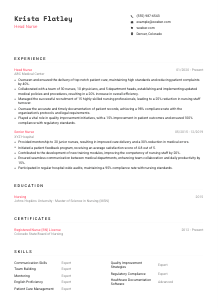
If a role specifies a city or state requirement, address it here. In the example, listing Denver, Colorado directly answers the employer's location preference and removes a practical question before it becomes an objection.
A LinkedIn profile or professional website is useful when it supports your CV with consistent dates, leadership history, certifications, or committee work. Leave it out if it is incomplete or does not strengthen your case for nursing supervision and patient care management.
Keep this section lean, accurate, and matched to the posting. It should confirm that you are reachable, properly positioned for the title, and ready to move into a Head Nurse interview without administrative friction.




This is the section most likely to decide whether your CV moves forward. Head Nurse employers want to see how you supervised patient care, guided nursing teams, handled staffing realities, improved documentation, and worked with physicians or department leaders to keep care standards high.
Start with the operational themes in the job description, then match your experience to them. For a Head Nurse role, that usually includes patient care oversight, team leadership, staffing, training, documentation accuracy, and quality improvement. Those themes should shape your bullet points more than a generic list of nursing duties.
Show your most recent work first and make each entry easy to scan with title, employer, and dates. If your path moved from senior nursing into supervision, that progression should be obvious, because leadership trajectory matters in roles asking for 5+ years of nursing experience and at least 2 years in a supervisory capacity.
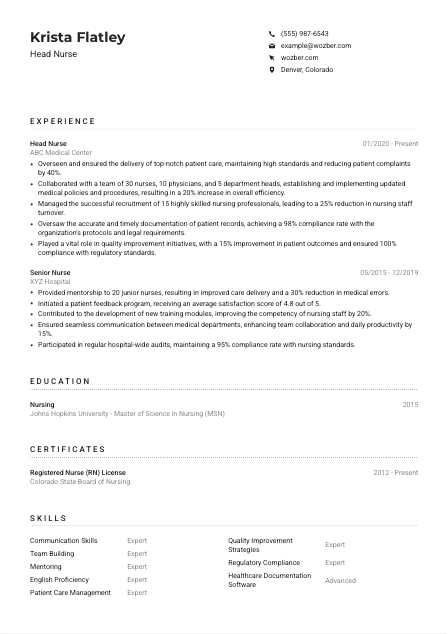
A Head Nurse CV gains traction when it shows what improved under your watch. Instead of saying you oversaw patient care or supervised nurses, show what changed: fewer complaints, stronger compliance, better retention, smoother coordination, or improved patient outcomes. The example does this well by tying care oversight to a 40% reduction in patient complaints and quality work to a 15% improvement in patient outcomes.
Numbers carry real weight here when they reflect how nursing leadership is measured. Good examples include staff turnover, compliance rates, patient satisfaction, audit results, scheduling coverage, training reach, and error reduction. A bullet such as achieving 98% documentation compliance or reducing turnover by 25% gives hiring teams a much clearer sense of your unit-level impact than broad claims about excellence.
If space is tight, prioritise work that shows staffing oversight, mentoring, policy implementation, EMR documentation standards, or cross-functional collaboration with physicians and department heads. Volunteer experience or unrelated clinical details can stay in the background unless they directly support your ability to lead a nursing team.
Your experience should show what kind of unit leader you have been. By the end of this section, a hiring manager should understand the size of teams you led, the standards you maintained, and the operational results you delivered.
Education matters in Head Nurse hiring because it confirms both clinical preparation and advancement into leadership-level responsibility. A BSN is often the baseline, and when an MSN is preferred, listing it clearly can strengthen your standing early in the review process.
If the posting calls for a BSN, make sure it is easy to spot. If you also hold an MSN, place that prominently because it signals deeper preparation for leadership, policy work, staff development, and clinical oversight. The example CV benefits from this by showing both degrees clearly.
List degree, field, school, and graduation year in a consistent structure. Healthcare employers often review many CVs quickly, and an ATS-friendly CV format helps ensure your education is parsed correctly instead of buried in design-heavy formatting.
Use the same degree language the employer uses when it accurately reflects your background, such as "Bachelor of Science in Nursing (BSN)" or "Master of Science in Nursing (MSN)." That makes your qualifications easier to match during ATS optimisation and easier to recognize during manual review.
Relevant coursework, leadership tracks, research, or honors can help if they connect to clinical management, healthcare administration, quality improvement, or nursing education. For experienced Head Nurse candidates, these details should support the main story rather than take over the section.
Honors, nursing society memberships, or capstone work in patient safety or care systems can add value when they align with leadership responsibilities. Use them selectively, especially if they reinforce a long-standing focus on nursing standards, mentoring, or operational improvement.
Keep education easy to scan and closely tied to the role's stated requirements. The section should confirm that your nursing foundation and advanced training match the level of responsibility expected from a Head Nurse.
For nursing leadership roles, certifications are not a bonus detail. They often determine whether a candidate is eligible to move forward at all. This section should confirm active licensure first, then highlight added credentials that support supervision, quality, and clinical leadership.
Place your active Registered Nurse license where it cannot be missed. If the posting specifies a state, list that state clearly. In the example, the Colorado RN license directly supports eligibility for the role and answers a legal requirement immediately.
After licensure, prioritise credentials that reinforce team supervision, patient safety, critical care leadership, staff development, or quality improvement. A nursing leadership certification is especially relevant when the role involves mentoring, policy implementation, and fostering a positive work environment.
Include issue or active dates for licenses and certifications, especially for credentials that require renewal. Current dates reassure employers that your qualifications are in good standing and that you stay compliant with professional requirements.
Head Nurse roles often sit close to audits, regulatory review, training oversight, and policy changes. Updating this section regularly helps your CV reflect current practice and shows that your professional development has kept pace with your leadership responsibilities.
Use this section to remove compliance questions early. A clear RN license entry plus relevant leadership-focused certifications strengthens your case for managing staff, standards, and patient care responsibly.
A Head Nurse skills section should read like the profile of someone who can run a clinical team, not just perform bedside tasks well. Focus on the mix of leadership, communication, documentation, and quality control that supports safe patient care and effective unit operations.
Pull out the competencies the employer names directly, then add closely related skills you genuinely use. In this case, communication, team building, mentoring, English proficiency, documentation oversight, and regulatory compliance all belong because they connect directly to how the role is performed.
Show both sides of the role. A Head Nurse may need mentoring, conflict management, and staff coordination, but also EMR knowledge, healthcare documentation software, patient care management, and quality improvement practices. The example CV handles this balance well by pairing people leadership with documentation and compliance skills.
Do not turn this section into a long inventory. Lead with the abilities most relevant to staffing, care oversight, interdisciplinary communication, patient documentation, and process improvement. A shorter, sharper list usually says more than a broad one that includes every nursing strength you have developed.
Choose skills that match the actual work of supervising nurses and protecting care quality. The final list should sound like someone prepared to lead a unit, support staff, and keep clinical standards on track.
In nursing leadership, language ability matters when it affects care coordination, patient understanding, and communication across teams. This section does not need to be long, but it should be accurate and relevant to the care environment you work in.
If the employer asks for strong English proficiency, list English clearly with an honest level such as Native or Fluent. For a Head Nurse, this supports more than conversation. It affects documentation, policy communication, training, and coordination with physicians and department leaders.
Additional languages can strengthen your CV when they are useful in the population you serve. Spanish, for example, may be valuable in many healthcare settings because it can support patient education, family communication, and smoother interactions on the unit.
Choose labels such as Native, Fluent, Intermediate, or Basic and keep them truthful. Overstating language ability can create problems quickly in patient-facing care, staff coaching, or documentation-sensitive situations.
List languages that have practical value in your work, especially if they help with patient comprehension, discharge communication, or collaboration in a multicultural team. If a language has little relevance to the role, it does not need space on the CV.
For a Head Nurse, language skills can support calmer patient interactions, clearer staff direction, and stronger trust across a diverse unit. Mention them when they genuinely expand your effectiveness in care delivery and team leadership.
Keep language entries honest and useful. When they align with the patient population or communication demands of the role, they add practical value beyond the basic credential list.
Your summary should quickly establish the level at which you operate. In a few lines, it needs to connect your nursing tenure, leadership scope, and patient care results so the reader immediately understands why you belong in a Head Nurse conversation.
Read the posting for the qualities the employer repeats or builds responsibility around. For Head Nurse roles, that often means leadership experience, patient care oversight, staff development, communication, and quality improvement. Use those themes to shape the summary instead of writing a generic nursing profile.
Start with your years of nursing experience and make your supervisory background clear. If the job calls for 5+ years in nursing and leadership experience, your first line should show that you meet that threshold without making the reader hunt for it.
Choose achievements or strengths that reflect the work of the role, such as improving patient outcomes, reducing complaints, mentoring nurses, strengthening compliance, or improving retention. The example summary works because it points to patient care oversight, team building, and process improvement rather than vague passion statements.
Aim for a concise paragraph of 3 to 5 lines. Use concrete language tied to nursing leadership, care standards, and operational results so the section lands quickly with both the ATS and the hiring team.
A well-written summary gives the reader an immediate sense of your leadership range and clinical credibility. It should set up the rest of the CV by clarifying that you can guide staff, protect care quality, and improve how the unit performs.
A Head Nurse CV should make your leadership visible in the same way your unit would experience it: through care standards, staffing judgment, documentation discipline, mentoring, and measurable operational results. When each section is tailored to those priorities, the application feels grounded in real nursing leadership rather than general clinical experience.
Use Wozber's AI CV builder to sharpen that alignment, strengthen ATS optimisation, and organise your experience in an ATS-friendly CV format that highlights licensure, leadership scope, and patient care outcomes clearly. The final CV should make one thing easy to judge at a glance: you are ready to lead nursing staff and protect the quality of care.