



Use Wozber and land your dream job
Create CV
No registration required
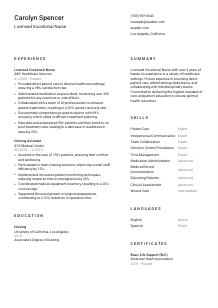
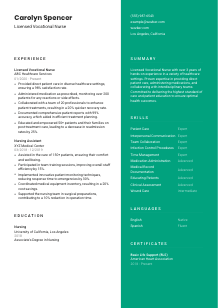
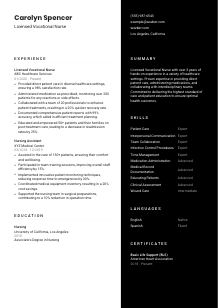
Juggling injections and charts, but your CV looks a bit feverish? Check out this Licensed Vocational Nurse CV example, created with Wozber free CV builder. It shows how to highlight your bedside skills to match job norms, paving the way for your healthcare career to stay as stable as a patient's vitals!
Licensed Vocational Nurse hiring moves quickly when a CV makes the care work visible. Managers want to see more than a nursing title. They look for signs that you can handle direct patient care, administer medications safely, document accurately, and support patients and families in busy clinical settings where small mistakes carry real consequences.
A tailored CV changes how your background is read, especially when an employer is sorting candidates through an ATS before a nurse manager reviews the file. Wozber's free CV builder helps you match the posting's language, keep the layout ATS-friendly, and bring forward the patient care experience, certification status, and clinical scope that matter first for an LVN opening.
Healthcare employers need basic information to be clear and usable right away. Your personal details section should confirm who you are, how to reach you, and whether any stated location or licensing requirement is already covered.
Use your full name as the header of the CV in a slightly larger font than the rest of the page. In nursing hiring, your name should be immediately visible above your credentials and contact details so the document is easy to reference during screenings, interview scheduling, and file sharing.
Place "Licensed Vocational Nurse" directly under your name if that is the role you are applying for. Matching the title used in the job posting helps both ATS parsing and human review, especially when employers are sorting LVN, CNA, RN, and MA candidates into different pools.
List one phone number you actually answer and a professional email address, ideally in a straightforward format such as first and last name. In a healthcare setting, hiring teams often move fast when filling shifts or coverage gaps, so inaccurate contact details can cost you an interview.
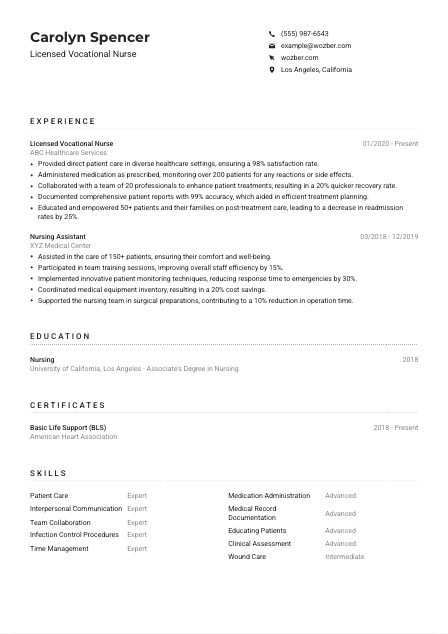
If the employer asks for candidates who are already in the area or open to relocating, show that clearly in your personal details. In the example, listing Los Angeles, California directly addresses a stated requirement and removes a common early question about availability.
Include LinkedIn or a professional profile if it supports your clinical background with consistent job titles, certifications, or work history. For LVN roles, this is useful when it reinforces your licensure, healthcare experience, or patient care setting, not when it adds unrelated content.
This section does not need personality flourishes. It should quickly confirm identity, role alignment, and hiring logistics so the reader can move straight to your clinical experience.




For an LVN CV, experience is where employers look for proof of day-to-day clinical performance. They want to understand the setting you worked in, the type of care you delivered, and whether you handled medication, charting, patient monitoring, and team coordination with consistency.
Start by identifying the work the employer named most clearly, such as direct patient care, medication administration, patient monitoring, documentation, and communication with patients and families. Then shape your bullets around those same care functions so the relevance is obvious instead of buried under general nursing language.
List your most recent role first, followed by earlier positions, with each entry showing your title, employer, and dates of employment. That format works well for clinical hiring because it lets a reviewer quickly see your current level, your progression into licensed care, and whether you meet the requested 2+ years in a clinical or hospital setting.
Each bullet should show what you did, who or what you supported, and what changed because of your work. Strong LVN bullets often mention patient populations, medication tasks, charting accuracy, interdisciplinary coordination, wound care, discharge teaching, or monitoring for side effects. The example CV does this well by pairing core responsibilities with measurable outcomes instead of listing duties alone.
Use metrics that fit healthcare work naturally, such as patient volume, satisfaction scores, documentation accuracy, reduced readmissions, faster response times, or improved recovery timelines. In the example, monitoring over 200 patients and documenting with 99% accuracy gives the employer a much clearer picture of clinical scope than a generic line about being detail-oriented.
Choose accomplishments that show how you contributed to patient care, care coordination, safety, and treatment follow-through. Teamwork matters, but in LVN hiring it carries more weight when you tie it to actual care delivery, such as collaborating with physicians and nurses, educating families, or supporting better treatment outcomes in a clinical environment.
When this section is tailored well, a hiring manager can quickly picture you on the unit or in the clinic. Your bullets should show safe care, dependable follow-through, and comfort working with patients, medications, records, and the broader care team.
Education matters in nursing because it establishes the training behind your clinical judgment and patient care skills. For an LVN CV, keep this section straightforward and make the nursing qualification easy to identify.
Put your most relevant nursing degree or program first. Even when a posting focuses more heavily on licensure and experience, employers still want to see the educational foundation that led to your clinical training and scope of practice.
Include the degree, field of study, school name, and graduation year or date. This makes the section easy to scan and keeps the emphasis on the qualification itself rather than extra formatting.
If you have multiple entries, place the nursing credential ahead of unrelated coursework or earlier education. On an LVN CV, the reader should not have to search for the program that supports your clinical role.
Clinical coursework or training in areas such as pharmacology, patient care, infection control, or medical-surgical practice can be worth mentioning if you are early in your career or if the posting points toward those areas. Keep it selective and relevant rather than turning the section into a full transcript.
Academic honors, nursing society membership, or meaningful clinical activities can add value when they support your professional direction. This is most useful for newer candidates who need a bit more context around their preparation for patient-facing work.
Your education section should confirm that your clinical background rests on formal nursing training. Keep it concise, easy to scan, and clearly tied to your licensed practice.
Certifications carry real hiring weight in nursing because they affect legal eligibility, patient safety, and start-date readiness. For an LVN role, this section should immediately show that your required credentials are current and relevant.
If the posting asks for an active LVN license and current BLS certification, those should appear at the top of this section. They are not optional extras. They are hiring filters. The example CV correctly includes BLS, and your own CV should also make state licensure easy to spot.
List credentials that support bedside care, emergency response, patient safety, or the specialty area you are targeting. Relevant examples may include wound care, IV therapy, or specialty care certifications when they genuinely apply to your background and the role.
Healthcare employers need to know whether credentials are active, current, and ready for use. Include issue dates, renewal ranges, or active date spans in a clear format so there is no doubt about certification status.
Recent renewals and newer certifications can strengthen your CV because they show you stay current with clinical standards and patient care expectations. That matters in nursing roles where procedures, compliance requirements, and care protocols evolve over time.
This section should reassure the employer that you can step into patient care without credentialing surprises. Lead with the certifications and licensure the role requires, then add only what strengthens your clinical profile.
The best LVN skills sections feel grounded in actual nursing work. They should reflect the care tasks, communication demands, and clinical routines the employer expects, not a generic mix of soft skills pulled from any CV template.
Read the posting closely and note the exact language used for care delivery, such as direct patient care, medication administration, written documentation, and communication. These phrases often reflect both ATS keywords and the nurse manager's priorities, so use them when they match your real experience.
Place the most role-critical skills first, especially those tied to patient treatment, medication handling, charting, and collaboration with interdisciplinary teams. This kind of prioritization helps the employer see quickly that your skill set fits the opening. The sample CV's mix of patient care, medication administration, documentation, and patient education is a solid model.
Include skills that connect to how LVNs actually work, such as infection control, wound care, clinical assessment, EMR documentation, patient teaching, time management during medication passes, and handoff communication. Avoid padding the list with broad terms that do not tell the employer much about your nursing practice.
A hiring manager should be able to scan this section and recognize the clinical tasks you can handle safely and efficiently. Prioritise the skills that support patient care, medication accuracy, charting quality, and dependable teamwork.
Language ability can matter in nursing because patient understanding affects medication use, discharge instructions, consent discussions, and follow-up care. List languages in a way that is honest, relevant, and easy for an employer to interpret.
If the posting states that English proficiency is essential, list English prominently and describe your level clearly. This is especially important in roles that involve charting, physician communication, patient education, and written care documentation.
If you speak another language well enough to support patient interaction, include it. In many healthcare settings, bilingual communication can help with intake, explanations of care instructions, and building trust with patients and families.
Terms such as "Native," "Fluent," "Intermediate," and "Basic" are usually enough. They give hiring teams a practical sense of how confidently you can communicate in clinical or patient-facing situations.
In some markets, an additional language can be especially useful. For example, in a diverse city such as Los Angeles, fluent Spanish may strengthen an application when it reflects real communication ability with patients and families. Treat that as targeted tailoring, not a universal requirement for every LVN job.
List languages because they help you support patients, families, and care teams more effectively. That is the value in a nursing CV, far more than the fact of speaking multiple languages on its own.
This section works best when it clarifies how you can communicate in real clinical settings. Accurate language levels can add meaningful value, especially in patient populations that benefit from bilingual support.
Your summary sits at the top of the CV, so it should establish your level, your clinical strengths, and the kind of care environment you know how to handle. For an LVN, this means leading with licensed practice and relevant bedside experience, not broad statements about passion or work ethic.
Review the posting and pull out the core requirements before writing a single line. For this type of LVN opening, that likely means licensed status, clinical or hospital experience, direct patient care, medication administration, and communication with patients and teams. Those are the ideas your summary should cover first.
Begin with a direct statement such as your role, years of experience, and primary care setting. The sample summary does this effectively by identifying the candidate as a Licensed Vocational Nurse with more than 3 years of hands-on experience across healthcare settings.
Follow your opening with the care functions you perform best, such as administering medications, monitoring patient response, documenting treatment, educating families, or collaborating with interdisciplinary teams. Choose details that reflect your actual practice and line up with the target role.
Aim for 3 to 5 lines that read cleanly and stay focused on nursing value. A summary should give a fast picture of your patient care background and workplace readiness, not repeat every section of the CV.
A clear summary helps the employer understand your nursing profile before they reach the experience section. When it is tailored well, it frames you as a licensed caregiver with the right level of patient care experience for the role.
A well-tailored Licensed Vocational Nurse CV should make your licensure, patient care experience, medication responsibilities, documentation habits, and team collaboration easy to find. Every section should support the same conclusion: you can step into a clinical setting and contribute safely from day one.
Use Wozber's free CV builder to shape that information into an ATS-compliant CV, refine wording with job-specific terminology, and check alignment with an ATS CV scanner. The final result should give a hiring team a clear read on your clinical readiness, not just your job history.




