



Use Wozber and land your dream job
Create CV
No registration required
Revving up innovation, but your CV's stuck in neutral? Cruise through this Automotive Engineer CV example, created with Wozber free CV builder. Learn how to match your engineering prowess to job specifications, steering your career into the high-performance lane it deserves!
Automotive engineering work gets reviewed through the lens of real product performance. Hiring teams want to see whether you can move from concept and CAD models to tested components, validated systems, and production support without losing sight of safety, manufacturability, or regulatory standards. Your CV should make that progression visible through the kinds of systems you worked on, the engineering problems you solved, and the results that followed.
A tailored CV changes how quickly your engineering scope comes through, especially when ATS filters are looking for terms tied to vehicle systems, CAD platforms, simulation, and compliance work. Wozber's free CV builder helps you align that language cleanly in an ATS-friendly CV format, so the hiring team can immediately tell whether your background fits the mix of design, testing, and cross-functional collaboration the role requires.
For automotive engineering roles, the top of the CV should remove practical doubt right away. If a posting has location, title, or contact expectations, your personal details need to confirm them cleanly so the reader can move straight to your engineering background.
Use your full name in a clear, readable format that stands out more than the rest of the header. In engineering hiring, this is simple presentation discipline. Keep it polished and easy to scan, just like the rest of the document.
Place "Automotive Engineer" directly under your name when that is the role you are targeting. Matching the posted title helps position your CV correctly in both ATS screening and human review, especially when employers are separating design, manufacturing, quality, and systems engineering profiles.
Include a phone number you actively answer and a professional email address. Check every character. A missed digit or sloppy email handle creates the wrong impression for a role built around precision, documentation, and technical accountability.
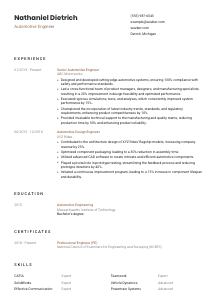
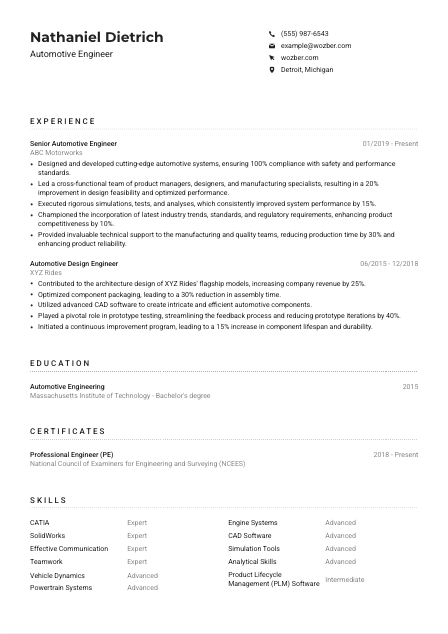
If the employer asks for someone based in Detroit or willing to relocate, show that in your location line. The sample CV does this by listing Detroit, Michigan, which immediately removes a practical objection. Treat location as a tailoring move when the posting calls for it, not as a universal rule for every automotive engineering application.
Include LinkedIn or a portfolio site if it strengthens your application. For automotive engineers, that might mean a profile with project history, CAD-heavy design work, prototype development, testing exposure, or cross-functional launch support. Make sure the content matches your CV in titles, dates, and technical scope.
This section does not need flair. It needs accuracy, professionalism, and any practical detail, such as location, that helps the employer move straight to your design and engineering experience.




This is where automotive employers look for proof that you can design, validate, and support real vehicle systems. Your bullets should show more than job duties. They should connect engineering work to safety targets, performance improvements, testing outcomes, manufacturability, or production efficiency.
Read the posting and mark the technical themes that come up more than once. Here, the emphasis is on automotive system design, CAD proficiency, vehicle and powertrain knowledge, validation through simulation and testing, and collaboration with manufacturing and quality teams. Build your experience section around those working realities rather than generic engineering language.
List your most recent position first and include title, company, and dates for each role. That structure makes it easy to follow how your scope grew, whether from component design into system ownership, from prototype work into production support, or from contributor to team lead.
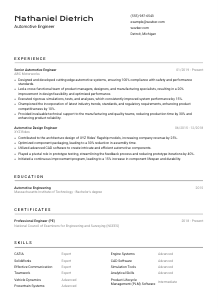
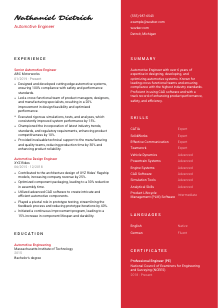
Use bullet points to show what you designed, what analysis or testing you ran, who you worked with, and what changed because of your work. The sample does this well by tying system development to outcomes like full compliance with safety and performance standards, a 20% improvement in design feasibility, and a 30% reduction in production time. That kind of framing gives hiring teams a much clearer read than task-only bullets.
Automotive engineering is full of measurable outcomes. Include metrics tied to test improvements, iteration reduction, component durability, assembly efficiency, launch support, or compliance results when you have them. Numbers such as a 15% performance gain or 40% fewer prototype iterations make your contribution easier to understand and harder to overlook.
Lead with experience that matches the target role's technical depth. For this kind of posting, that means automotive design, system development, simulation, testing, and production collaboration take priority over less related engineering tasks. If you have broader experience, keep it, but give the most space to work that speaks directly to vehicle systems and engineering execution.
A strong experience section shows how you moved designs toward performance, compliance, and production readiness. When your bullets connect CAD work, validation, and cross-functional support to measurable results, your background starts to read like a hiring solution rather than a job history.
Automotive engineering roles usually expect a formal engineering background, and this section is often checked early. Keep it straightforward, but make sure the degree and field clearly support the kind of design, systems, or mechanical work the role involves.
Check the posting for the baseline education requirement and reflect it clearly. Here, a bachelor's degree in Mechanical Engineering, Automotive Engineering, or a related field is enough to meet the requirement, so your degree line should make that qualification obvious at a glance.
List degree, field of study, school, and graduation year in a clean structure. Engineering CVs benefit from tidy formatting because hiring teams often scan this section quickly before moving back to your project and work history.
If your degree directly aligns with the posting, name it exactly. The sample CV lists a Bachelor's degree in Automotive Engineering, which closely matches the role's preferred background. If your degree is in Mechanical Engineering or another related discipline, present it honestly and let your experience carry the specialization.
Relevant coursework, senior design projects, Formula SAE work, controls projects, thermodynamics research, or vehicle dynamics studies can strengthen this section if you are early in your career or changing focus within engineering. If you already have several years of automotive experience, keep this section lean unless the project directly supports the target role.
Academic honors, engineering competition work, or technical student organizations are worth listing when they reinforce your profile. Choose details that show applied engineering thinking, collaboration, or subject matter relevance, not every campus activity.
This section should confirm that you have the academic base for the work. Once that is clear, the heavier lifting moves to your experience, technical skills, and project outcomes.
Certifications are not required in every automotive engineering hire, but the right ones can add weight when they support design authority, regulatory awareness, quality processes, or specialised technical knowledge. Use this section to show current professional development, not to list every course you have ever taken.
List certifications that support the kind of automotive engineering you do, whether that involves licensure, quality systems, safety standards, testing, or specialised software. The sample includes the Professional Engineer credential, which can strengthen credibility for roles involving design responsibility or technical review.
Only keep certifications that improve your case for the target position. A shorter list of relevant credentials is stronger than a long list of generic training. Focus on items that connect to engineering practice, compliance, manufacturing support, or vehicle system development.
Include the issue date and, if relevant, the active period or expiration date. That matters most for credentials that need renewal or indicate current standing. Clear dates help employers understand whether your knowledge is current enough for present-day tools, standards, and production environments.
Automotive engineering keeps changing through electrification, advanced simulation, lightweighting, safety regulation, and manufacturing technology. If you are actively maintaining certifications or adding new training, that shows you are staying current with how the industry actually works.
A focused certification section can support your technical profile, especially when it backs up the kind of systems, standards, or engineering responsibility named elsewhere in the CV.
Automotive engineering CVs need a skills section that is concrete and role-linked. Employers are usually scanning for a mix of design tools, system knowledge, analysis capability, and collaboration skills that fit the development cycle from concept through production.
Start with the language the employer already uses. In this case, CAD software, vehicle dynamics, powertrain, engine systems, communication, and teamwork all appear directly in the job description. Those are not filler keywords. They describe the technical and collaborative environment of the role.
List the hard skills first when they are central to the role, then support them with the soft skills that matter in automotive programs. Tools like CATIA or SolidWorks, simulation platforms, PLM systems, and system-level knowledge should sit alongside communication and teamwork because design work depends on coordination with product, manufacturing, and quality functions.
Arrange the section so the most relevant skills are easy to spot. The sample CV does this effectively by leading with CATIA, SolidWorks, vehicle dynamics, powertrain systems, and engine systems, then adding communication, teamwork, simulation tools, and PLM software. That gives a hiring manager a quick picture of both engineering depth and project collaboration range.
Keep this section specific, accurate, and tied to the work. When the skills listed match the language used in your experience bullets, the CV reads as technically grounded and consistent.
Language ability matters in engineering when it affects documentation, team communication, supplier coordination, or work across global programs. If the posting names a required language, treat it as a clear qualification and place it accordingly.
When a role requires fluency in English, list English at the top with an accurate proficiency level. For engineering roles, this often matters because design reviews, technical reports, validation documentation, and cross-functional meetings all depend on clear communication.
Use a direct label such as "Native" or "Fluent" if it accurately reflects your ability. Avoid vague wording. Employers want to know whether you can comfortably handle technical discussions, documentation, and collaboration in English from day one.
Additional languages can be useful when working with international suppliers, global OEM teams, or overseas manufacturing partners. The sample includes German, which can be relevant in parts of the automotive sector, though extra languages are an advantage rather than a universal requirement.
Rate your language ability realistically. If you claim fluency, be ready to use it in technical conversation, written updates, or project communication. Accuracy matters here just as much as it does in your engineering claims.
If the employer operates across regions or has global engineering, sourcing, or manufacturing links, language capability can support your application. Include it when it adds practical value to the role rather than as a filler detail.
For this kind of role, English proficiency may be a requirement, while other languages can expand your usefulness on global programs. Keep the section factual and directly relevant to how the work gets done.
Your summary should quickly establish what kind of automotive engineer you are and where your value shows up. Focus on technical range, years of experience, and the business or product outcomes your work has influenced.
Use the job description to decide what belongs in the first few lines. For this posting, that means automotive design, system development, testing and analysis, CAD capability, and coordination with cross-functional teams. Keep the emphasis on the work you actually do best.
Start with a concise line that states your title, years of experience, and technical focus. The sample summary does this effectively with "Automotive Engineer with over 6 years of expertise in designing, developing, and optimising automotive systems." That tells the reader right away where the candidate sits in the field.
Choose the qualifications that matter most for the target role. That could include system design, vehicle dynamics knowledge, powertrain exposure, CAD proficiency, regulatory compliance, or measurable product improvement. Keep it selective so the summary stays sharp rather than turning into a keyword list.
Aim for a short paragraph of three to five lines. Include enough detail to establish your engineering profile, but save the full story for the experience section. Specific phrasing and role-linked outcomes will do more for you here than broad claims about being hardworking or results-driven.
A good summary gives the reader an immediate sense of your engineering level, domain focus, and likely contribution. If those first lines clearly connect design expertise to tested results and collaboration across development teams, the rest of the CV has a strong opening to build on.
An effective Automotive Engineer CV shows how your work holds up under the pressures that matter in this field: design accuracy, system performance, validation, manufacturability, and collaboration across product and production teams.
Use Wozber's free CV builder to tighten that alignment, strengthen ATS optimisation, and present your experience in an ATS-compliant CV that matches the language of the role without losing technical clarity.
When each section points to real engineering contribution, hiring teams can quickly see that you are ready for the next program, platform, or vehicle development challenge.




