



Use Wozber and land your dream job
Create CV
No registration required
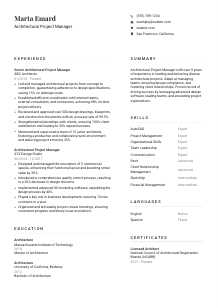
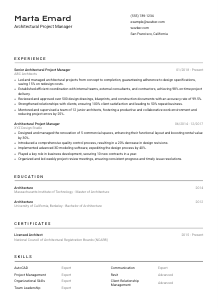
Designing blueprints, but your CV needs a structural upgrade? Check out this Architectural Project Manager CV example, created with Wozber free CV builder. Learn how to show your managerial genius in line with job requirements, setting the foundation for a career skyscraper!
Architectural Project Managers sit at the point where design intent meets delivery pressure. Hiring teams want to see that you can move a project from concept through construction documents without losing control of schedule, budget, code requirements, consultant coordination, or client expectations. Your CV should make that operating range visible, not bury it under generic architecture language.
When the CV mirrors the posting's language around project leadership, drawing review, software, and coordination, it becomes much easier to sort you into the right lane, especially in an ATS-compliant CV workflow. Wozber's free CV builder helps structure that tailoring cleanly, so both the ATS and the hiring manager can quickly recognize experience that matches architectural project delivery.
For an Architectural Project Manager, the contact section does more than identify you. It confirms practical details that can affect candidacy early, especially title alignment, professional presentation, and location when a firm needs someone on-site for meetings, site visits, or consultant coordination.
Use your full name in the largest, cleanest type on the page. Architectural hiring teams often review many CVs in one pass, so your name should be easy to locate and remember without decorative formatting or unnecessary credentials crowding the header.
Place "Architectural Project Manager" directly under your name if that is the role you are applying for. This immediately frames your background around project leadership rather than leaving the reader to decide whether you are primarily a designer, technical architect, or studio manager.
List a working phone number and a professional email address, ideally based on your name. Double-check every character. For a role that depends on coordination, clear communication, and client contact, even small errors in this section create the wrong impression.
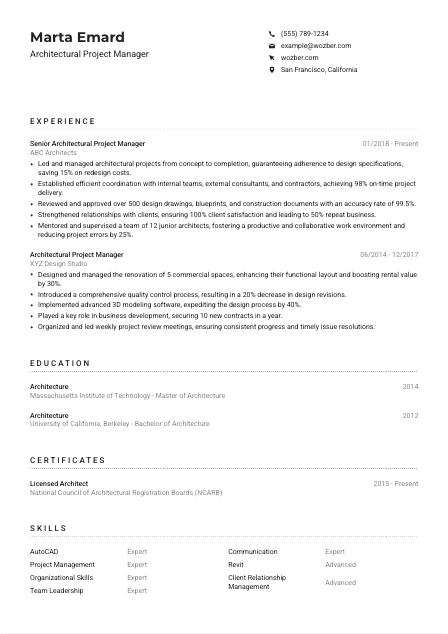
If the employer requires someone based in San Francisco or willing to relocate, reflect that in your city and state line when accurate. In the example, "San Francisco, California" works because it removes a logistical question right away. If you are relocating, state that plainly rather than hoping the employer assumes flexibility.
Add a website, portfolio, or LinkedIn profile only if it is current and consistent with your CV. For architecture roles, a portfolio link can be useful when it supports your project record with built work, drawings, or presentation materials. Make sure titles, dates, and firm names match what appears on the CV.
This section should confirm that you are reachable, professionally presented, and practically available for the role. For an Architectural Project Manager, that means no confusion about title, contact details, or location.




This is the section most likely to decide whether you move forward. Firms hiring Architectural Project Managers are looking for proof that you have led projects, coordinated people across disciplines, reviewed technical work, and delivered against deadlines and budgets. The strongest bullets show both scope and results.
Read the job description closely and pull out the real operating duties. Here, that includes leading projects from conception to completion, coordinating with consultants and contractors, reviewing drawings and construction documents, managing client relationships, and mentoring junior staff. Those responsibilities should appear in your experience section in language that reflects your actual work, not in vague management phrasing.
List roles in reverse chronological order with job title, firm name, and dates. This matters in architecture because hiring teams often want to see progression from design or production responsibilities into broader project ownership. A clear timeline helps them understand when you moved from supporting project delivery to leading it.
Choose bullets that show how you handled project execution. Strong examples include managing projects from concept through documentation, coordinating internal teams and outside consultants, reviewing design packages, resolving issues during delivery, and maintaining the client relationship. The sample CV does this well by centering each bullet on project leadership rather than general participation.
Metrics carry weight when they reflect how projects are actually measured. Use figures tied to on-time delivery, redesign reduction, drawing volume, quality control, repeat business, staff supervision, cost control, or speed of production. In the example, figures like 98% on-time delivery, 500-plus drawings reviewed, and a 25% drop in project errors make the scope of responsibility much easier to grasp.
If you are targeting Architectural Project Manager roles, prioritise work that shows coordination, design oversight, documentation review, budget or schedule accountability, and team leadership. Earlier experience in design development or space planning can stay, but frame it around outcomes that support project management. Leave out bullets that read like a generic architect CV if they do not help prove you can run projects.
A hiring manager should be able to read your experience section and understand what you led, how you coordinated the work, and what results followed. That is the core story an Architectural Project Manager CV needs to tell.
Education is usually straightforward in this field, but it still matters. Firms often need to confirm that you meet the academic baseline for architecture roles, and the degree line helps place your professional track, especially when paired with licensure and years of experience.
If the posting asks for a bachelor's degree in Architecture or a related field, make sure that qualification is unmistakable. List the exact degree name, such as "Bachelor of Architecture," so the connection is immediate for both the reader and the ATS.
List your highest or most relevant degree first, followed by earlier credentials. Include school, degree, field, and graduation year. In architecture, this section does not need extra explanation unless a specialization directly supports the role, such as urban design, building technology, or project delivery.
Avoid shortening or casually renaming your degree. "Master of Architecture" and "Bachelor of Architecture" are stronger than informal variants because they match how firms describe requirements and how licensing and professional records are commonly documented.
Most experienced Architectural Project Managers do not need course lists. Add them only if they support a transition or highlight relevant grounding in construction documentation, building systems, contract administration, or digital modeling tools. Otherwise, let experience and project outcomes carry the weight.
Academic honors can stay if they are genuinely notable and you have room for them. Once you have 8+ years of experience, they are secondary to built work, project leadership, and technical delivery, so keep them brief.
Your education section should confirm that you meet the profession's baseline without distracting from your project record. Clear degree titles and clean formatting are usually enough.
Certifications can add real weight in architecture when they reflect licensure, code knowledge, or recognized professional standing. For project management-focused architecture roles, the most valuable credentials usually support accountability, technical authority, or client confidence.
Lead with certifications that matter directly to architectural practice. In this example, "Licensed Architect" is the strongest credential because it supports professional credibility and design oversight. If you hold state licensure or NCARB-related credentials, present them clearly.
A short list of meaningful certifications is better than a long list of marginal ones. Architectural firms care more about licensure and role-relevant credentials than unrelated online course badges. Prioritise what supports project leadership, technical review, and professional trust.
Show issue dates or active ranges for credentials that remain in force. This is especially important for licenses and certifications tied to ongoing standing. Dates help the reader understand that your professional qualifications are current.
If you have additional certifications in project management, sustainability, code compliance, or specialised building systems, include them when they support the type of projects you pursue. That can be useful for firms working in complex sectors where documentation quality and coordination depth matter.
This section should quietly strengthen your credibility. For an Architectural Project Manager, the right credential can support the case that you are trusted to review work, guide teams, and represent the project with confidence.
The skills section should read like the operating toolkit behind your project record. For this role, that usually means a mix of design software, project controls, communication, and team leadership. Keep it tight and relevant to the way architecture firms actually staff project managers.
Start with the software and management skills the employer names directly. In this role, AutoCAD, Revit, SketchUp, organisation, multitasking, communication, and leadership are all worth reflecting if they match your background. This helps your CV line up with both the posting and ATS terminology.
Put the most job-critical skills first. For an Architectural Project Manager, that often means project management, construction documentation review, consultant coordination, client communication, scheduling, and the design platforms used by the firm. The sample CV handles this well by placing software and leadership skills near the top.
Group skills in a way that makes sense and avoid padding the section with every tool you have touched once. If you use proficiency labels, be honest. A concise list with real depth is far more useful than a long list that raises questions about how often you actually use each tool.
Your skills should confirm the methods, software, and leadership range already shown in your work history. If the experience says you can lead delivery, the skills section should show the toolkit you used to do it.
Language ability matters in architecture when it affects client communication, consultant coordination, documentation clarity, or work across diverse teams. Even when English is the only stated requirement, this section can still add context if your additional languages support the kind of projects or stakeholders you work with.
If the posting asks for strong English literacy, list English first and state your proficiency clearly. For an Architectural Project Manager, this matters because the role relies on precise emails, meeting notes, drawing comments, submittal review, and client-facing communication.
Add other languages if they are useful in your market, on your project types, or within your client base. In some firms, a second language can help with consultant coordination, community-facing work, or collaboration on international projects.
Choose simple levels such as Native, Fluent, Professional, Conversational, or Basic. Avoid overstating ability. The reader should be able to understand quickly how confidently you can handle meetings, correspondence, and project discussions in each language.
If another language has helped you manage stakeholders, coordinate with contractors, or support projects involving international teams, that value can be reinforced elsewhere in the CV as well. The language section itself should stay concise.
Languages are useful supporting information, not the centerpiece of most Architectural Project Manager applications. Give the section enough space to be clear, then return the main emphasis to delivery, documentation, and leadership.
For this role, language skills matter most when they help you manage people and project information clearly. List them accurately and let them support the broader story of coordination and client communication.
The summary sits near the top, so it should quickly tell the reader what level you operate at. For an Architectural Project Manager, that means years of experience, type of responsibility, and the mix of design oversight, delivery control, and team leadership you bring.
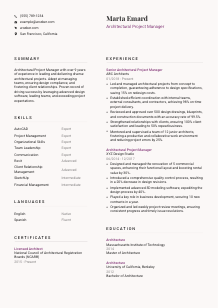
Start with your title and years of experience in architecture and project management. A line such as "Architectural Project Manager with 9+ years of experience" works because it immediately places you at the right level for a role asking for substantial project leadership.
Use the next line or two to name the work you actually lead. Focus on project delivery, coordination across teams and consultants, drawing and documentation review, client management, and staff mentorship. These are the themes that tell a firm you can handle more than design production.
Aim for a short paragraph, usually 3 to 5 lines. Skip generic adjectives and use concrete role language instead. The sample summary works best where it names leadership, design compliance, and client relationships rather than relying on broad claims.
Adjust the summary for the job you want, not the one you had five years ago. If the posting emphasizes software, project completion, budget discipline, or team supervision, echo those priorities naturally when they reflect your background. This is one of the fastest ways to sharpen alignment at the top of the page.
By the end of this section, the reader should already understand that you can manage architectural work across people, documents, and deadlines. That sets up the rest of the CV to prove it.
An effective Architectural Project Manager CV shows how you guide work from design intent to delivered project, with clear proof in your experience, software fluency, client coordination, and team oversight.
Use Wozber's free CV builder to organise that story in an ATS-friendly CV format, refine it with targeted ATS optimisation, and present your background in a way that makes project leadership easy to recognize. The final read should leave no doubt that you can run architectural projects with control and credibility.