



Use Wozber and land your dream job
Create CV
No registration required
Marrying mechanics and electronics, but your CV feels caught in a loop? Gear up with this Mechatronics Engineer CV example, created with Wozber free CV builder. Learn how to synchronize your multidisciplinary skills with job needs, and lead your career in perfect harmonic motion!
Mechatronics hiring moves quickly from broad interest to technical scrutiny. A CV that simply says you worked on robotics or automation will not carry much weight unless it shows what you designed, how systems were integrated, what failed and was fixed, and how your work improved throughput, reliability, safety, or validation results.
The first read often comes down to whether your background clearly connects mechanical design, controls, and system troubleshooting in terms an employer already uses. Wozber's free CV builder helps shape that into an ATS-compliant CV with cleaner role language and structure, so CAD, PLC, motion control, sensor integration, and prototype testing show up as relevant experience instead of getting buried.
For mechatronics roles, the header needs to settle a few practical questions fast: who you are, what role you do, how to reach you, and whether you meet any location or communication requirements. Keep it clean and factual so the reader can move straight into your engineering background.
Use your full name in a slightly larger font than the body text. Hiring teams reviewing technical CVs often scan quickly across titles, employers, tools, and project outcomes, so your name should be instantly visible without drawing attention away from the substance of the CV.
Place "Mechatronics Engineer" directly below your name when that is the role you are pursuing. This removes ambiguity between adjacent profiles such as robotics engineer, automation engineer, controls engineer, or electromechanical engineer, and it aligns your CV with the job title used in the posting.
List one phone number you actively answer and a professional email address. Accuracy matters here just as much as it does in a wiring diagram or test setup. A missed digit or outdated inbox can cost you an interview even when the technical fit is there.
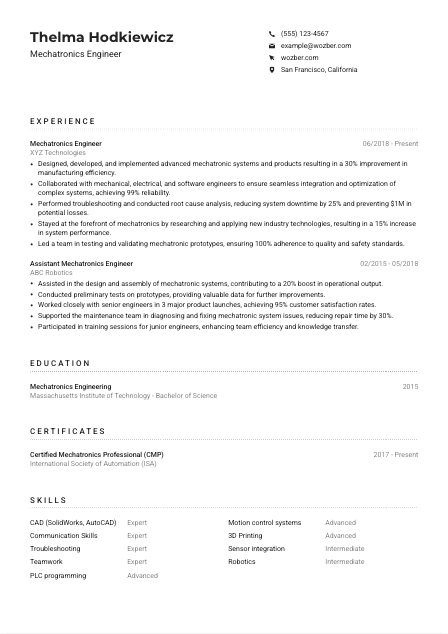
Some engineering openings are tied to lab access, prototype work, factory support, or on-site integration, so location can be a real screening factor. Here, listing San Francisco, California directly supports the stated requirement. If a future posting is remote or flexible, tailor this line to that situation instead of copying it blindly.
Include LinkedIn, a portfolio, or a personal site if it strengthens your case with project detail, CAD work, robotics builds, validation results, or system photos. The link should reinforce what the CV claims. If it is outdated or thin, leave it off.
Age, marital status, photo, and similar details do not help explain your engineering scope, tools, or results. Use the space for information that supports the role, especially if the employer is screening for technical alignment and communication clarity.
Your personal details should confirm professional identity, contact access, and any practical requirement such as location without clutter. Once that is clear, the employer can focus on whether your engineering background matches the systems, tools, and level of responsibility they need.




This section does most of the heavy lifting on a mechatronics CV. Hiring teams want to see where you worked, what kinds of systems you touched, how closely you worked with mechanical, electrical, and software partners, and what changed because of your work in production, testing, or prototype development.
Before editing bullets, identify the work that matters most in the target role. For this opening, the recurring themes are mechatronic design, robotics and automation, cross-functional integration, troubleshooting, root cause analysis, and prototype testing. Those themes should show up clearly in your experience using language you can support with real projects and results.
Start with your most recent position and include job title, company name, and dates for each role. That structure helps employers understand your progression from support or junior work into broader ownership, whether that means design authority, debugging responsibility, validation leadership, or collaboration across controls and software teams.
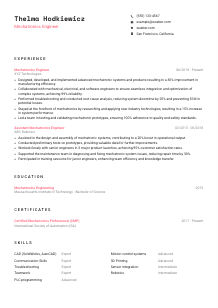
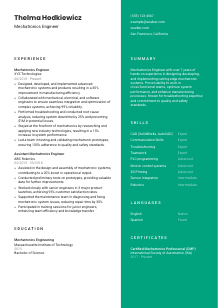
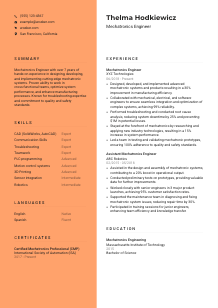
Strong mechatronics bullets show what you built or improved, what engineering action you took, and what result followed. "Designed, developed, and implemented advanced mechatronic systems" works because it names the work. It becomes stronger when paired with a result such as the 30% manufacturing efficiency gain shown in the example CV. Aim for that same pattern in your own bullets.
Numbers are especially persuasive when they reflect how engineering performance is actually measured. Reliability, downtime reduction, cycle time, scrap reduction, validation pass rate, throughput, cost avoidance, and safety compliance all carry weight. The sample CV does this well with 99% reliability, 25% less downtime, and 100% adherence to quality and safety standards.
Choose bullets that reinforce the specific version of mechatronics you are targeting. If the job emphasizes PLC programming, motion control, sensor integration, and troubleshooting, those points should take priority over less relevant achievements. Keep older or peripheral experience brief unless it directly supports automation, robotics, controls, or electromechanical product development.
By the end of the experience section, the reader should understand the systems you worked on, the engineering problems you solved, and the business or operational results you delivered. That is what turns past titles into a credible case for the next mechatronics role.
Mechatronics roles usually ask for a specific technical degree because the work crosses mechanics, electronics, controls, and software. Your education section should make that academic foundation easy to confirm without forcing the reader to search for it.
Start by checking the posting for the exact academic requirement. Here, a bachelor's degree in Mechatronics, Electrical Engineering, or a related field is requested, so your degree should be written clearly and in full. If your background is adjacent, such as mechanical engineering with heavy controls coursework, make that connection easy to understand.
List field of study, degree, school, and graduation date in a clean order. Technical recruiters usually want to confirm qualification level quickly, especially when they are screening many engineering CVs at once.
If your degree matches the job requirement closely, let that work for you. "Bachelor of Science in Mechatronics Engineering" immediately supports the role in a way that a vague line like "Engineering" does not. The example CV benefits from that direct match.
This matters most for early-career engineers or career changers. Courses in control systems, robotics, embedded systems, machine design, instrumentation, PLCs, or automation can help bridge limited work experience and show preparation for the technical scope of the job.
Capstone projects, research, robotics competitions, design teams, or academic honors are useful when they point to hands-on system design, testing, integration, or problem-solving. If you already have several years of industry experience, keep this detail brief unless it is unusually relevant to the role you want.
Your education section should quickly establish that you meet the required technical baseline. Once that is clear, the rest of the CV can focus on how you applied that knowledge in design, automation, testing, and system improvement.
Certifications are not always mandatory in mechatronics, but they can reinforce depth in controls, automation, safety, or specialised systems. When used well, this section shows that your technical development has continued beyond formal schooling.
Lead with credentials tied to automation, instrumentation, controls, robotics, safety, or quality systems. If a posting does not require a certificate, it should still earn its place by strengthening a capability the employer cares about, such as PLC work, industrial systems, or structured problem-solving.
A short list of relevant certifications is stronger than a long list of generic courses. For a mechatronics engineer, a credential like Certified Mechatronics Professional is useful because it supports the multidisciplinary nature of the role. Less relevant training can be omitted or moved to LinkedIn.
Dates help employers understand whether the credential is current, active, or tied to recent upskilling. That is especially helpful in fields where standards, software, and controls technologies change over time.
Use this section to reflect current learning, especially if you are building expertise in new automation platforms, advanced motion systems, machine safety, or newer design workflows. Mechatronics changes through tools and integration methods, so ongoing training can support your relevance in a practical way.
Certificates work best when they support the story already visible in your experience and skills. They should add technical credibility around controls, automation, or system development, not try to stand in for hands-on engineering work.
The skills section should read like the toolkit behind your project work, not like a broad catalogue of engineering buzzwords. Employers scanning for mechatronics talent are looking for a blend of design tools, control logic, integration knowledge, debugging ability, and collaboration across disciplines.
Start with the skills named or strongly implied in the role. In this case, CAD, PLC programming, motion control, sensor integration, teamwork, and communication are all central. Use the same terminology when it accurately reflects your background so both human reviewers and ATS screening can connect your CV to the job.
List the capabilities that appear in your work history, projects, or certifications. For example, SolidWorks, AutoCAD, PLC programming, troubleshooting, and robotics become more credible when your experience bullets also show system design, downtime reduction, integration work, or prototype validation tied to those tools.
Group or order skills so the most relevant ones appear first. For a mechatronics CV, that usually means design software, controls and automation, sensing and integration, testing and troubleshooting, then collaboration or communication skills. Keep the list concise enough that the employer can scan it in seconds and understand your technical range.
A useful mechatronics skills section shows how you bridge mechanical, electrical, and controls work. When the list mirrors the systems and results in your experience, it reads as practical engineering capability rather than keyword padding.
Language ability matters on engineering CVs when it affects communication on the job. For mechatronics work, that often means writing clear documentation, discussing design changes, explaining test results, and coordinating with technicians, engineers, or vendors across functions.
If the posting calls out a language requirement, place it clearly in this section. Here, strong English communication is explicitly requested, so English should appear first with an honest proficiency level.
Put the most job-relevant language at the top, then list additional languages afterward. In engineering environments, the primary language often affects meetings, test documentation, issue tracking, and cross-functional communication, so order matters.
Extra languages can help when working with global suppliers, international manufacturing teams, or multilingual customer environments. They are usually secondary on a mechatronics CV, but they can still add value when they support real collaboration contexts.
Choose standard terms such as native, fluent, intermediate, or basic. Avoid vague labels. If you may need to explain troubleshooting steps, validation findings, or design updates in that language, be realistic about your level.
Do not overstate the strategic value of language skills if the role is mainly technical and local. Include them when they support communication requirements or broader collaboration, but keep the emphasis on engineering capability and role-specific fit.
For this kind of role, languages support design reviews, documentation, and teamwork. A concise, honest language section helps confirm that you can communicate technical information clearly where the job requires it.
Your summary should give a compact read on the kind of mechatronics engineer you are. It needs to connect technical range with practical outcomes, so the employer quickly understands your level, your core strengths, and the environments where you have delivered results.
Review the posting before writing the summary so you know which themes belong in the opening lines. For this role, that includes mechatronic design, robotics, automation systems, collaboration across engineering teams, troubleshooting, and validation. Build around the most relevant two or three rather than trying to list everything.
Begin with a direct statement that names your profession and years of experience, such as "Mechatronics Engineer with 7+ years of experience." That immediately frames your level and helps the reader place the rest of the summary in context.
Follow the opener with a few strengths that are visible elsewhere on the CV. The example summary works because it ties hands-on design and implementation to system optimisation, manufacturing improvement, troubleshooting, and quality standards. Use that same approach with your own strongest themes and results.
Aim for a short paragraph, usually three to five lines. Avoid broad claims about passion or innovation unless they are backed by real work. Specific references to automation systems, motion control, prototype validation, reliability gains, or cross-functional engineering work will do more for you than generic enthusiasm.
A well-written summary should make the reader expect the right kind of evidence in the sections that follow: system design, controls knowledge, troubleshooting range, and measurable engineering results. If it does that, it has done its job.
You now have the structure for a mechatronics CV that shows technical scope, integration work, and measurable engineering results. Use Wozber's free CV builder to shape that experience into an ATS-compliant CV that stays clean, readable, and closely aligned with the target role.
You can then refine the content with Wozber's ATS CV scanner, strengthen missing terminology, and present the final version in an ATS-friendly CV template. The finished CV should make it easy to judge whether you can design, integrate, troubleshoot, and validate the kinds of mechatronic systems the employer actually needs.