



Use Wozber and land your dream job
Create CV
No registration required
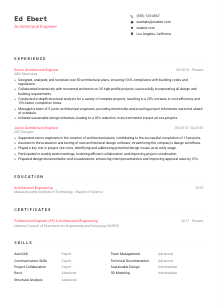
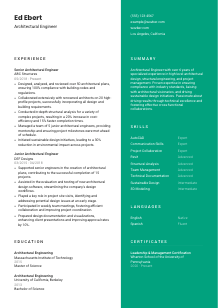
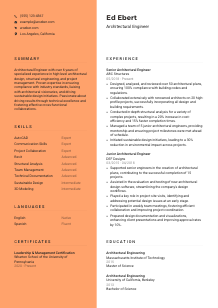
Designing grand structures, but your CV feels a bit under construction? Layer your expertise with this Architectural Engineer CV example, created with Wozber free CV builder. Learn how to blueprint your engineering skills to meet job criteria, so your career rises as skillfully as the skyscrapers you create!
Architectural engineering work sits where design intent, structural performance, code compliance, and construction reality meet. Hiring teams want to see that you can move comfortably between drawings, calculations, coordination meetings, and document review, because weak CVs often blur that range and make solid technical experience look narrower than it is.
A targeted CV helps separate architectural engineers from adjacent profiles such as drafters, architects, or general project coordinators by making your design analysis, software use, and construction-document work easier to read in an ATS-compliant CV. Wozber's free CV builder supports that process by helping you align wording, structure, and keywords with the posting so your CV shows where you have already delivered safe, buildable, and well-coordinated solutions.
For architectural engineering roles, the top of the CV should answer practical questions fast: who you are, what discipline you work in, how to contact you, and whether any location requirement is already covered. Keep this section clean and professional so the focus stays on drawings, analysis, and project delivery.
Set your name in a clear, readable style so it anchors the page immediately. Architectural engineering CVs already carry technical detail in later sections, so your header should stay simple, polished, and easy to scan.
Place the role you are pursuing right below your name when it accurately reflects your background. Writing "Architectural Engineer" helps frame everything that follows, especially if your past titles vary between architectural, structural, or building-engineering functions.
Use a current phone number and a professional email address that would look appropriate on client correspondence, permit documentation, or consultant communication. Hiring managers should not have to search for basic contact information before moving on to your project experience.
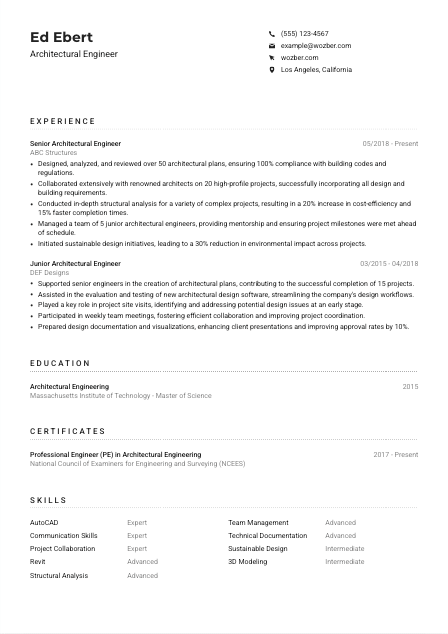
Some employers want local availability because site visits, coordination meetings, and permit-related work may happen on tight timelines. In the example posting, listing "Los Angeles, California" addresses that requirement immediately and removes uncertainty about relocation.
Include a website or LinkedIn profile only if it supports your application with consistent, up-to-date information. For this profession, that might mean project snapshots, software proficiency, technical credentials, or a clearer view of your career progression across firms and building types.
Do not spend header space on age, marital status, photo, or other details that do not strengthen your case as an engineering hire. Reserve the page for information tied to design work, technical qualifications, communication, and project responsibility.
This section should confirm that you are reachable, professionally presented, and aligned with any stated location requirement. Once that is clear, the hiring team can move straight to the work that proves your engineering value.




Architectural engineering experience is judged by what you have designed, reviewed, analysed, improved, and delivered. Your bullets should show how you handled plans, calculations, coordination, code compliance, cost or sustainability tradeoffs, and team responsibility, not just that you were present on projects.
Read the posting for the work patterns behind the requirements. Here, the employer is asking for architectural plan review, structural analysis, cross-functional collaboration, recommendations on efficiency and sustainability, and oversight of junior staff. Those themes should shape which projects and accomplishments you highlight first.
Start with your most recent position and include title, company, and dates so the reader can follow your progression from support work to independent responsibility or team leadership. In this field, title progression matters because it often reflects growing ownership over design review, calculations, consultant coordination, and mentoring.
Replace generic task language with what your work achieved. Instead of saying you reviewed plans, show what that review accomplished, such as code compliance, faster approvals, fewer design conflicts, improved constructability, or better cost performance. The sample does this well by tying structural analysis to 20% better cost-efficiency and 15% faster completion times.
Quantify the scale and impact of your projects wherever the numbers are real and useful. Strong metrics for architectural engineers include number of plans reviewed, project count, compliance rate, reduction in rework, schedule gains, cost savings, environmental impact, team size, or turnaround improvements across design documentation and coordination cycles.
Keep the spotlight on work that relates directly to building design, structural review, software-driven documentation, client or architect coordination, and leadership. Earlier or less relevant roles can stay brief unless they explain a critical skill, such as site observation, visualization support, or early exposure to construction documents that still matters for the target role.
Your experience section should make it easy to picture you handling live architectural engineering work, from analysis and documentation to coordination and team oversight. If the reader can see project scope, technical depth, and measurable results, the section is doing its job.
Education matters in architectural engineering because the role depends on formal grounding in structures, building systems, materials, and design principles. Present your degrees clearly so the employer can quickly confirm that your academic background supports the technical demands of the job.
Start by checking the exact academic requirement in the posting and make sure your degree wording covers it cleanly. For this opening, a Bachelor's degree in Architectural Engineering or a related field is the baseline, so that qualification should be immediately visible.
List each credential with the degree, field, and institution in a simple structure that is easy to scan. Architectural engineering employers do not need decorative formatting here. They need to confirm the discipline and level of training fast.
If you hold multiple degrees, lead with the ones that best support the role, especially in architectural engineering, structural engineering, civil engineering, or related building disciplines. In the sample, both the master's and bachelor's degrees reinforce strong technical preparation for analysis and design work.
Early-career candidates can strengthen this section with coursework or studio and engineering projects tied to structural analysis, building systems, CAD or BIM tools, sustainable design, or construction documentation. Once you have several years of practice, that detail usually gives way to project achievements in the experience section.
Honors, scholarships, research work, or competition results can help if they connect to engineering rigor or design performance. For experienced candidates, keep them only if they remain genuinely relevant, such as a notable structural research project or a distinction tied to building design excellence.
A well-presented education section should quickly show that you meet the degree requirements and understand the engineering fundamentals behind safe, buildable design. Then your experience can carry the deeper proof.
In architectural engineering, certifications matter most when they reinforce licensed practice, technical authority, or leadership responsibility. This section should highlight credentials that support your ability to review designs, guide teams, and work within regulated construction environments.
Check whether the posting asks for a license, certification, or registration, then place that item prominently if you have it. Here, a Professional Engineer license in Architectural Engineering is preferred, so it deserves immediate visibility.
Choose licenses and certificates that strengthen your case for architectural engineering work, such as engineering licensure, BIM-related credentials, sustainability certifications, or management training that supports team oversight. Leave out unrelated courses that do not connect to design review, project delivery, or leadership.
Include issue dates, renewal dates, or active status when relevant so the employer can understand whether the credential is current. This is especially useful for professional licensure and continuing education in a field shaped by evolving codes, standards, and software workflows.
Architectural engineering changes with code updates, modeling tools, delivery methods, and sustainability standards. Recent certifications can show that you are keeping pace, whether through licensure maintenance, leadership development, or technical training that improves project execution.
Certifications should reinforce your authority to contribute at a higher level, whether through licensed engineering judgment, stronger project leadership, or current technical knowledge. Keep the section focused on credentials that matter in building design and delivery.
Architectural engineering skills need to show both technical execution and coordination ability. Employers usually look for a mix of design software, structural or building analysis, documentation discipline, and communication skills that hold up in client meetings and cross-functional project teams.
Read the job description for tool requirements and work-style expectations. In this case, software skills such as AutoCAD and Revit sit alongside communication, collaboration with architects and contractors, structural analysis, and oversight responsibilities. Your skill list should reflect that blend.
Use the same terminology the employer uses when it truthfully describes your work. If the role asks for AutoCAD, Revit, structural analysis, and communication, list those plainly instead of substituting vague labels. The sample handles this well with direct entries like AutoCAD, Revit, Structural Analysis, and Project Collaboration.
Choose skills that support the actual work you want to do, not every tool or trait you have ever used. A focused list might combine CAD or BIM software, technical documentation, team management, sustainable design, and communication. That gives the employer a realistic picture of how you contribute across design development, review, and coordination.
The best skills lists read like the toolkit behind your experience: software you use, engineering work you perform, and collaboration strengths that keep projects moving. Keep it close to the job description and close to your real practice.
Language ability matters in architectural engineering when it affects coordination, documentation, presentations, and client communication. This section should stay concise, but it can still support your candidacy when the role mentions communication expectations directly.
If the posting specifies a required language, list it clearly with your proficiency level. Here, strong spoken English is part of the requirement, which makes it worth stating directly even if it may seem obvious elsewhere in the CV.
Order languages by relevance to the role, not by personal preference. When the job depends on clear client discussions, consultant coordination, and technical communication, place English first and mark the level accurately.
Secondary languages are worth listing when they support work with diverse clients, contractors, consultants, or local project teams. In markets with multilingual stakeholders, an additional language such as Spanish can strengthen day-to-day coordination even when it is not formally required.
Choose clear levels such as Native, Fluent, Advanced, Intermediate, or Basic so the employer can quickly judge communication range. Avoid informal phrases that leave too much room for interpretation.
For some architectural engineering jobs, language is a minor detail. For others, especially those involving frequent client contact, field coordination, or diverse local teams, it can support smoother communication and fewer misunderstandings across the project lifecycle.
List language skills when they help explain how you work with clients, consultants, and teams. Keep the section factual and relevant to the communication demands of the job.
The summary should give a quick, accurate picture of the kind of architectural engineer you are. Focus on years of experience, technical scope, and the type of outcomes you deliver so the reader can place you immediately before digging into projects and credentials.
Your summary should reflect the opening you are targeting, so review the role requirements first. For this one, that means emphasizing architectural design, structural analysis, collaboration, software fluency, and leadership or oversight where relevant.
Begin with a direct introduction that states your profession and experience level. This gives instant context and helps position you correctly for mid-level or senior architectural engineering roles.
Follow your opening with the capabilities that matter most for the target job. Good choices here include code compliance, construction-document review, structural analysis, software proficiency, sustainability improvements, or cross-functional coordination. In the sample summary, compliance work, collaboration, and sustainability are the strongest themes.
Aim for a compact paragraph, not a full career biography. Skip broad claims and focus on what you have actually handled, improved, or led. A hiring manager should finish the summary with a clear sense of your technical profile and the level of responsibility you are ready to take on.
A well-written summary should quickly establish your engineering background, your core strengths, and the kind of project contribution you bring. It sets the tone for everything that follows and should sound like the rest of your CV can back it up.
Once each section reflects the actual demands of architectural engineering, your CV starts to read less like a general design profile and more like a document for someone who can review plans, run analysis, coordinate with architects and contractors, and improve project outcomes. Wozber's free CV builder helps organise that material into an ATS-friendly CV format that stays clear under both software screening and human review.
Before you apply, run a final pass for terminology, metrics, and alignment with the posting. Wozber's ATS CV scanner can help surface missing requirements, strengthen ATS optimisation, and sharpen the match between your sections and the job description. The finished CV should make one thing easy to judge: you can contribute to safe, efficient, and well-coordinated building projects from day one.




