



Use Wozber and land your dream job
Create CV
No registration required
Rolling delicate morsels, but your CV isn't shaping up as beautifully? Sample this Sushi Chef CV example, created with Wozber free CV builder. Learn how to slice your sushi skills to fit any job platter, setting your culinary career on a path as refined as nigiri artistry!
Sushi chef hiring moves quickly because the work leaves very little room for correction once service starts. A CV has to show more than general kitchen experience. It needs to make your knife handling, fish judgment, speed on the line, sanitation habits, and consistency in plating easy to recognize before anyone invites you to a trial shift.
CV tailoring changes how that experience is read, especially when an employer needs an ATS-compliant CV that separates sushi specialists from broader line-cook or prep backgrounds. Wozber's free CV builder helps you align your wording with the posting, keep an ATS-friendly CV format, and surface role-specific strengths such as inventory control, station cleanliness, and guest-facing quality standards.
For a sushi chef, the header should confirm the basics fast and stay clean. Hiring teams do not need decoration here. They need accurate contact details, the right title, and any location information that affects whether you can realistically join the kitchen.
Use your full name in a clear, readable style so it stands out immediately at the top of the page. In hospitality hiring, CVs are often reviewed quickly between service planning, interviews, and operational tasks, so your header should be easy to scan at a glance.
Place "Sushi Chef" directly below your name when that matches the role you want. This helps position you correctly from the start, especially when employers are sorting candidates with mixed backgrounds in sushi, hot line, prep, or broader Japanese cuisine.
List a current phone number and professional email address without clutter. Double-check every character. A missed digit or typo can cost you an interview just as easily as a missed delivery or incorrect prep count can disrupt service.
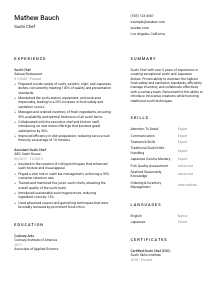
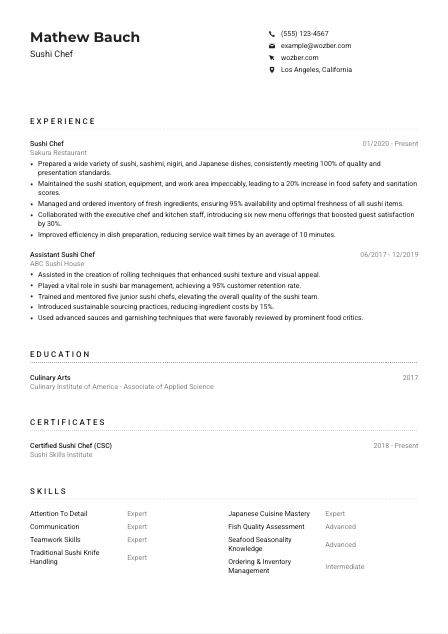
If the job requires local availability, add your city and state. In the provided example, "Los Angeles, California" directly matches the posting and removes an early screening question. Use that approach when location is specifically relevant, but do not overstate it for roles where it is not a deciding factor.
Include a portfolio, website, or professional profile only if it supports your candidacy with something useful, such as menu work, culinary credentials, media coverage, or a well-maintained professional history. If the link is outdated or thin, leave it off rather than sending employers to incomplete information.
This section should confirm that you are reachable, professionally presented, and logistically plausible for the role. Clean details at the top let the hiring team move straight to the parts that prove how you work on a sushi station.




Experience carries the most weight on a sushi chef CV because it shows how you perform under real kitchen conditions. Employers want to see the range of sushi work you have handled, the standards you maintained, and the pace, quality, and discipline you brought to the station.
Read the job description closely and identify the working priorities behind it. For a sushi chef, that usually means years of direct sushi experience, traditional knife proficiency, seafood quality knowledge, sanitation standards, inventory control, and teamwork during service. Those themes should guide which bullets you keep, cut, and rewrite.
Present your positions in reverse chronological order and include job title, restaurant name, and employment dates. That structure matters in food service hiring because it shows how recently you worked the station and whether your experience progressed from support roles, such as assistant sushi chef, into full ownership of prep and service responsibilities.
Each bullet should describe what you prepared, maintained, improved, or managed. Strong sushi chef bullets often reference sushi and sashimi production, presentation standards, station organisation, fish handling, prep discipline, collaboration with chefs, or guest satisfaction. The example CV does this well by naming the actual work, from preparing a wide variety of sushi items to maintaining the station and improving menu offerings.
Add metrics where they reflect real results. Good examples include sanitation score improvements, ingredient availability rates, reduced wait times, lower waste, menu additions, repeat guest response, or cost control through sourcing. In the sample, a 20% improvement in food safety scores and a 10-minute reduction in service wait times quickly make the candidate's impact tangible.
Remove points that do not strengthen your case for this kind of kitchen. If you mention achievements from adjacent roles, tie them back to sushi production, seafood knowledge, team training, sourcing, or guest experience. A hiring chef should finish this section with a clear picture of how you handle the board, the station, and the flow of service.
Your experience section should read like proof of dependable execution during prep and service. When the bullets show quality, pace, sanitation, and coordination with the rest of the kitchen, your background becomes much easier to trust.
Formal education is rarely the main reason a sushi chef gets hired, but it can strengthen your profile when it relates directly to culinary technique, kitchen discipline, or specialised training. Keep it straightforward and relevant to the level of role you are targeting.
Start by reviewing the posting for any degree or training requirement. This example does not require a specific credential, so education plays a supporting role rather than a deciding one. A culinary arts degree still helps by showing structured training in kitchen fundamentals, safety, and professional technique.
List your degree, field of study, school, and graduation year in a simple format. That is usually enough for culinary roles. The sample's Associate of Applied Science in Culinary Arts works well because it is easy to scan and clearly connected to the profession.
If you studied subjects such as Japanese cuisine, fish fabrication, sanitation, menu development, or food purchasing, include them when they sharpen your fit for the role. This is most useful earlier in your career or when your hands-on sushi experience is still developing.
Honors, scholarships, or leadership in culinary programs can be worth adding if they reflect discipline, consistency, or leadership potential. Keep the focus on distinctions that support kitchen credibility rather than turning this section into a full academic profile.
As your professional experience grows, shorten this section and let your station work do the talking. A senior sushi chef with years of service, inventory responsibility, and menu input does not need the same educational detail as someone just moving into the role.
Education should reinforce your technical foundation without competing with your kitchen record. If it adds context for your training and discipline, it is doing its job.
Certifications can help a sushi chef stand out when they point to recognized training, food safety discipline, or specialised knowledge. They are especially useful when they reinforce the technical parts of the role that matter most in hiring.
List certifications that connect directly to sushi preparation, seafood handling, sanitation, or Japanese culinary technique. A credential such as Certified Sushi Chef is relevant because it supports the specialised training side of the role rather than adding generic food service coursework.
Include the full certificate name, issuing organisation, and active dates if applicable. Keep the wording consistent so employers can scan the section quickly. The sample entry for "Certified Sushi Chef (CSC)" works because it provides both the credential and the issuing body without extra explanation.
If a certificate is active, renewed, or still valid, make that easy to see. In kitchen hiring, current training can matter more than older coursework, particularly for roles that emphasize food safety, sanitation, and disciplined prep standards.
Add credentials that reflect deliberate skill growth, whether that means advanced sushi training, seafood sourcing knowledge, or food safety qualifications. This helps employers see that your technique and operational standards are being maintained, not left in the past.
A short certification section can add real value when every item supports your technical credibility. Keep it focused on training that matters to sushi production, safety, and professional standards.
The skills section should read like a practical snapshot of how you work, not a generic list of personality traits. For sushi chef roles, the most useful skills combine technical preparation, product judgment, sanitation discipline, and teamwork during live service.
Start with the language in the job description, then translate it into a focused skills list. In this case, that includes traditional sushi knife handling, fish and seafood quality assessment, seasonality knowledge, food safety, communication, and teamwork. These are the capabilities the kitchen depends on every shift.
Put the most role-specific and operationally important skills first. Technical items such as knife handling, Japanese dish preparation, fish quality assessment, and inventory management usually carry more weight here than broader soft skills, though communication still matters in a fast-moving kitchen.
Resist the urge to list every kitchen or hospitality skill you have picked up. Keep the section tight and relevant. The sample CV is effective because it balances technical abilities, such as seafood seasonality knowledge, with service-critical traits like attention to detail and teamwork, without drifting into unrelated filler.
This section should confirm that you understand the technical and operational demands of the station. When the list is focused, employers can quickly see whether your strengths match the kitchen they are staffing.
Language skills matter in a sushi chef role when they support service communication, kitchen coordination, training, or guest interaction. Keep this section practical and tied to how you actually work with colleagues, managers, vendors, or diners.
If the posting specifies a language requirement, list it first with an honest proficiency level. Here, strong English is explicitly required, so English should appear prominently. That tells the employer you can follow instructions, coordinate during service, and communicate clearly with the team.
After the required language, list others that may help in the kitchen or dining room. Japanese, for example, can support menu understanding, ingredient terminology, or communication in some restaurant environments, but it should be presented as an added strength rather than a universal requirement.
Use clear labels such as "Native," "Fluent," "Conversational," or "Basic." Avoid vague wording. The sample handles this well by listing English as Native and Japanese as Fluent, which gives the employer an immediate sense of communication range.
If you use another language with suppliers, staff, or guests, it can strengthen your profile, especially in diverse markets and high-contact hospitality settings. Only include languages you can use comfortably in a work context.
Do not overstate proficiency to make the CV look broader. In a kitchen, communication gaps show up fast during prep, service, and safety procedures. Accurate language levels are far more useful than impressive-sounding claims.
For sushi chef roles, language skills are most helpful when they support cleaner communication on the floor and in the kitchen. Keep the section accurate, relevant, and easy to interpret.
The summary sits near the top of the CV, so it should establish your level quickly and in language that fits the role. For a sushi chef, that means combining experience, technical strengths, and one or two business-relevant results in a few disciplined lines.
Start with your title and years of relevant experience so the employer can place you immediately. If you have 3+ years in sushi preparation, say so directly. The sample summary does this effectively by leading with more than 6 years of experience in sushi and Japanese dishes.
Bring in the abilities the employer is actively seeking, such as sanitation standards, inventory management, seafood knowledge, knife work, or collaboration with the kitchen team. Choose the points that define how you perform, not a long list of every strength you have.
Aim for a compact paragraph that can be read in a few seconds. Three to four lines is usually enough. The best summaries give a fast picture of your station-level value and make the reader want to confirm the details in your experience section.
A sharp summary gives the hiring team an immediate read on your experience, standards, and kitchen strengths. Finish the CV with the same discipline you bring to service. Wozber's AI CV builder can help refine wording, improve ATS optimisation, and keep your CV aligned with the language of the posting so your sushi experience comes through clearly from the first lines.
A sushi chef CV works best when it shows the rhythm of the job clearly: precise prep, disciplined sanitation, product knowledge, steady service, and collaboration with the rest of the kitchen. Every section should support that picture, from your title and location details to the metrics in your experience bullets.
Use Wozber to turn that experience into an ATS-friendly CV format with sharper job alignment, cleaner structure, and stronger keyword coverage. When the content reflects the actual demands of the station, the hiring team can quickly judge whether you are ready to step in and perform.




