



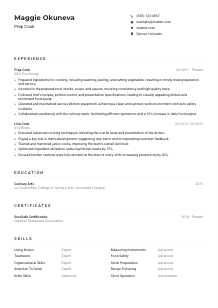
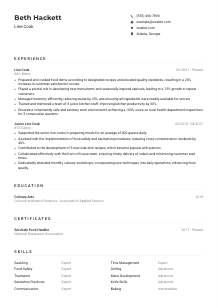
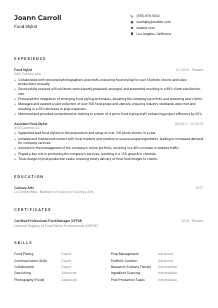
Use Wozber and land your dream job
Create CV
No registration required
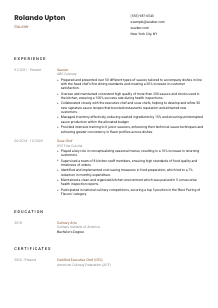
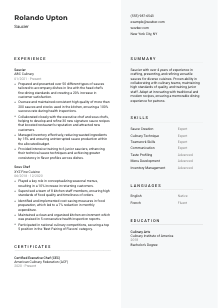
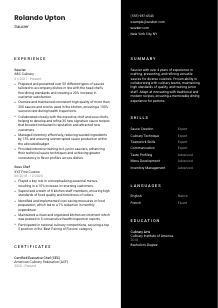
Juggling sauces, but your CV is stuck in mild mode? Check out this Saucier CV example, sautéed just right with Wozber free CV builder. Learn how to blend your culinary finesse with job flavors, ensuring your career is always simmering at the perfect sizzle!
Sauce work leaves very little room to hide. In a busy kitchen, a Saucier is trusted to hold consistency across service, protect the quality of stocks and reductions, and adjust flavor, texture, and plating to the chef's standard. Your CV should make that discipline visible, especially the parts of your background that show range across cuisines, command of classic and modern technique, and the judgment to keep sauces balanced under pressure.
CV tailoring changes how quickly a kitchen can place you at the right level. When your wording mirrors the job's language around sauce production, quality control, inventory, and training, an ATS-compliant CV gives both software and chefs a clearer read on your actual station-level value. Wozber's free CV builder helps organise that alignment so your CV surfaces the experience that matters first, from sauce execution to collaboration during service.
Kitchen hiring moves quickly, and the top of your CV should answer the practical questions right away. For a Saucier, that means clear contact details, a direct role title, and any location information the employer specifically asked for. Keep this section clean and easy to scan.
Use your full name in a larger, readable font so it stands apart from the rest of the CV. This is simple formatting, but it matters when an executive chef or hiring manager is reviewing multiple candidates before service or between interviews.
Place "Saucier" directly under your name if that is the position you are pursuing. This immediately frames your background around sauce production, stocks, flavor work, and station responsibility rather than leaving the reader to infer your specialty from later sections.
Include a current phone number and a professional email address. Double-check both. In restaurant hiring, missed calls and bounced emails can cost you an interview, especially when a kitchen is staffing for immediate needs.
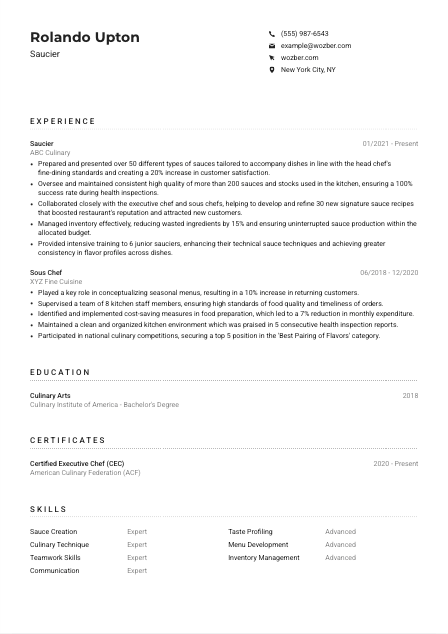
If a job asks for candidates to be based in a specific area, list your city and state. Here, "New York City, NY" directly addresses a stated requirement and removes uncertainty about availability. Use this kind of location tailoring only when the posting makes geography relevant.
A portfolio site, LinkedIn profile, or professional page can help if it reinforces your culinary background with competition work, restaurant experience, menu development, or press. Only include it if the information is current and consistent with the CV.
This section does not need flair. It needs to confirm who you are, what role you want, and how the kitchen can reach you without delay.




For a Saucier, the experience section carries most of the hiring weight. Kitchens want to see what sauces you handled, how you maintained quality, how you worked with senior chefs, and whether you improved service, consistency, or cost control. Write these bullets like service notes, specific, relevant, and tied to outcomes.
Read the posting closely, then prioritise roles and bullet points that line up with sauce execution, stock quality, recipe development, ingredient control, and team supervision. If you have broader kitchen experience, keep it, but lead with the parts that show command of the saucier station.
For every position, include your job title, the restaurant or employer name, and dates of employment in reverse chronological order. That structure lets the reader quickly track your progression, such as moving from a sous chef position into a dedicated saucier role.
Do not stop at "prepared sauces" or "managed inventory." Show scope, standard, and result. The sample CV does this well by naming responsibilities such as preparing more than 50 sauces, refining new signature recipes with the executive chef, and training six junior sauciers. Those details give a hiring team a much better picture of station ownership.
Quantify the work in ways that make sense for culinary hiring: number of sauces handled, reduction in ingredient waste, health inspection outcomes, menu contribution, customer satisfaction, or staff trained. Metrics work especially well when they show consistency and control, such as reducing waste by 15% or maintaining quality across more than 200 sauces and stocks.
If you have experience in other stations, keep only the parts that strengthen your case for a Saucier opening. A previous sous chef role can still help if the bullets show menu planning, supervision, flavor development, or cost management. Focus the section on work that proves you can handle sauce production at the standard this kitchen expects.
A hiring chef should be able to scan this section and understand your range, your consistency, and your contribution to service. If those three things are clear, your experience is doing its job.
Formal education is rarely the deciding factor for a Saucier, but it still adds useful context. Culinary school, specialised coursework, and honors can reinforce your technical base, especially when they connect to classic methods, sauce foundations, or fine-dining execution.
List your highest or most relevant education first. A culinary arts degree works well because it supports your background in technique, ingredient handling, kitchen operations, and the foundational methods behind stocks, emulsions, reductions, and finished sauces.
Include the school name, degree, field of study, and graduation year or date. That is enough for most culinary roles. Clean formatting keeps the reader focused on useful information rather than extra detail that does not affect hiring.
If your education included advanced classical cuisine, French technique, or course work tied to sauce preparation and flavor construction, mention it when relevant. Only add this level of detail if it strengthens your case for the specific opening.
Competition placements, scholarships, honors, or notable training experiences can support this section if they show discipline and technical development. Use them selectively, especially if they connect to flavor work, fine dining, or kitchen leadership.
If you already have several years in professional kitchens, keep the education section concise. For most Saucier candidates, hands-on execution, consistency during service, and collaboration with chefs will matter more than a long list of academic details.
Education should reinforce your technical foundation, not compete with your kitchen record. A short, relevant section is usually enough.
Certifications can strengthen a culinary CV when they signal advanced training, recognized standards, or continued professional development. They are especially useful when the credential is respected in the industry and aligns with the level of kitchen responsibility you are targeting.
List certifications that relate to culinary technique, kitchen leadership, safety, or recognized chef standards. A credential such as Certified Executive Chef from the American Culinary Federation can add credibility because it reflects formal professional recognition, even when the role itself does not require certification.
Place the most applicable and current certification first. A hiring team should not have to search for the qualification that best supports your readiness for a fine-dining or high-standard kitchen environment.
Include the year earned and, if applicable, the active date range. This helps the reader see whether the credential is current and still part of your professional profile.
As you add new certifications, remove outdated or less relevant ones that do not strengthen your candidacy. The section should reflect the training that best supports your current level, whether that is advanced culinary technique, supervision, or kitchen operations.
One respected, relevant credential is more useful than a long list of weak ones. Include the certifications that sharpen your profile for the kitchen you want next.
The skills section should read like the operating toolkit behind your results. For a Saucier, that means balancing technical sauce knowledge with the communication and teamwork needed to execute during service, train junior staff, and coordinate with chefs across the line.
Start with the terms the employer actually used. For this opening, that includes sauce creation, seasoning, presentation, ingredient knowledge, sensory judgment, communication, and teamwork. Those phrases are useful because they reflect the work the kitchen needs covered, not generic culinary language.
Do not list only craft skills. Include the abilities that affect execution with a brigade, such as communication, training, and coordination. A Saucier often works closely with the executive chef, sous chefs, and junior team members, so the skills section should reflect both flavor control and service collaboration.
Choose skills you can support elsewhere in the CV. A list such as Sauce Creation, Culinary Technique, Taste Profiling, Inventory Management, Menu Development, Teamwork, and Communication works because each item connects to common Saucier responsibilities and can be backed up with achievements in experience bullets.
Every skill here should connect to a real kitchen responsibility, whether that is building a stable sauce, controlling food cost, or coaching junior cooks toward consistent flavor.
Language ability matters in culinary hiring when it affects communication, written instructions, recipe work, or collaboration in a multilingual team. For this role, English matters because the posting specifically asks for clear written communication, so list it plainly and rate it honestly.
When a posting names a required language, place it first. Here, English should appear at the top of the section because it directly answers the employer's need for clear communication and written ability.
Terms like "Native," "Fluent," or "Professional" are clear and widely understood. Avoid vague descriptions that leave the reader guessing how well you can handle kitchen communication, written recipes, or chef instructions.
Additional languages can be useful in hospitality and fine dining, especially in diverse brigades or internationally influenced kitchens. French, for example, may complement classical culinary training and kitchen vocabulary, but it should remain secondary to the language the job explicitly requires.
Only list languages you can actually use in a professional setting. Overstating proficiency can become obvious quickly when communication affects prep, service coordination, or recipe documentation.
If the role involves diverse staff, cross-cultural menus, guest-facing moments, or written production notes, language skills become more than a bonus. They show that you can communicate clearly in the environment the kitchen actually operates in.
This section is most useful when it confirms that you can follow, document, and communicate kitchen work without confusion.
Your summary should quickly establish the level of kitchen you have worked in and the kind of sauce work you can own. In a few lines, show your years of experience, your technical range, and the type of results or standards you have handled so the reader knows what to expect from the rest of the CV.
Before you write, identify the main ideas in the posting. For a Saucier, that often includes creating and presenting sauces, maintaining quality, working across cuisines, collaborating with chefs, and guiding junior staff. Those are the right building blocks for a targeted opening paragraph.
State your years of experience and your core culinary focus right away. The sample summary does this effectively with "over 4 years of experience" and a clear emphasis on crafting, presenting, and refining sauces. That kind of direct opening helps the reader place your level immediately.
Mention two or three strengths that matter most for the job, such as fine-dining standards, traditional and modern recipes, quality control, inventory management, or team training. Choose details that reflect your real background rather than trying to cover every possible skill in one paragraph.
Aim for 3 to 5 sentences. That is enough room to introduce your experience, name your specialty, and point to one or two results. A summary should read like a concise chef's profile, not a full career history.
A well-written summary should tell a chef, within seconds, whether you bring the sauce knowledge, kitchen discipline, and collaborative style the role requires.
With the sections above aligned to the job, your CV should now show more than culinary passion. It should show where you have handled sauce production, protected quality standards, managed ingredients responsibly, and supported the wider brigade.
Use Wozber's free CV builder to tighten that alignment in an ATS-friendly CV format, then review every section for language that matches the kitchen's needs. The final version should make it easy to judge whether you can step onto the station and deliver consistent sauces at the standard the role demands.




