




Use Wozber and land your dream job
Create CV
No registration required
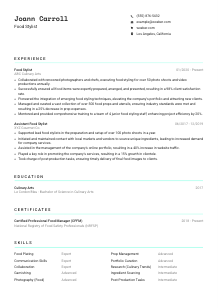
Crafting culinary visuals, but your CV lacks the presentation? Feast your eyes on this Food Stylist CV example, put together with details using Wozber free CV builder. Learn how to plate your food styling skills to match job demands, setting your career up as a mouthwatering masterpiece!
Food styling sits at the point where culinary technique meets visual production. Hiring teams want to see more than taste or kitchen experience. They want proof that you can plate for the lens, hold consistency across a shoot, adapt food for print or video, and work closely with photographers, chefs, and producers without slowing down the set.
When that experience is tailored well, the CV quickly shows whether you are a styling specialist, a general culinary candidate, or someone still closer to prep support. Wozber's free CV builder helps organise that distinction in an ATS-friendly CV format, so core terms like food plating, garnishing, prop management, and shoot collaboration are easy to read and easy to match to the brief. That makes your production value clearer from the first scan.
In food styling, presentation starts before anyone opens your portfolio. The header should give a production team the essentials fast, with no clutter and no uncertainty about your role, location, or how to reach you for a booking, fitting call, or shoot discussion.
Use your full name as the clearest element at the top of the page. Keep the font professional and readable. Food styling is a visual field, but CV design should still stay restrained enough for casting coordinators, creative leads, and ATS software to parse it without friction.
Place "Food Stylist" directly under your name when that is the role you are targeting. This immediately positions your background around styling for shoots, plating, garnishing, and visual presentation rather than around a broader chef or culinary assistant profile.
List a reliable phone number and a professional email address. Double-check both. On fast-moving productions, one typo can mean a missed callback for a test shoot or client meeting. If you use a portfolio site, make sure the link works and reflects the same branding and recent work mentioned in your CV.
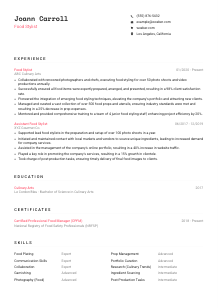
If a posting asks for a specific location, include it clearly in this section. The sample job requires Los Angeles, California, so listing Los Angeles in the header answers a practical scheduling question right away. Use location this way only when it matters to the role or production setup.
Food styling is judged visually, so an online portfolio is highly valuable. Link to a site or curated profile that shows range across still photography, video work, plating styles, ingredient handling, and prop choices. Make sure the visual work supports the experience claims on your CV, such as editorial shoots, branded content, or campaign production.
This section should confirm who you are, what role you do, where you are based when relevant, and where your work can be reviewed. For food styling, that clarity helps a hiring team move quickly from your name to your production value.




This is the section most likely to decide whether you move forward. Food styling experience needs to show camera-aware presentation, pace on set, collaboration with creative teams, and the ability to maintain visual consistency from prep table to final shot.
Read the posting like a shot list. Highlight the working requirements behind the wording, such as plating, garnishing, photography support, collaboration with chefs and photographers, sourcing ingredients or props, and keeping up with styling trends. Those points tell you what your experience bullets need to foreground.
List your most relevant positions in reverse chronological order. Food Stylist, Assistant Food Stylist, culinary content stylist, or similar visually driven kitchen roles should come first. Include employer, title, and dates, then focus your bullets on shoot execution, styling decisions, and production support rather than routine kitchen duties.
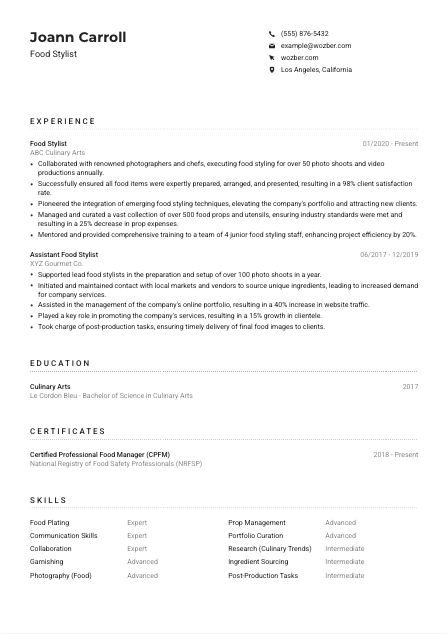
Each bullet should show what you styled, who you worked with, and what changed because of your work. The sample CV does this well by showing collaboration with photographers and chefs, management of more than 50 shoots annually, and hands-on prop oversight. That tells a hiring team the candidate can operate inside real production workflows, not just plate attractively in isolation.
Quantify where it helps the reader understand volume, efficiency, or quality. Useful metrics for this field include number of shoots, client satisfaction, size of prop inventory, reduction in prop costs, turnaround speed, or team size mentored. Figures like a 98% client satisfaction rate or a 25% drop in prop expenses make the styling work feel concrete and commercially relevant.
Keep the focus on work that reinforces your fit for styling assignments. General back-of-house tasks, unrelated hospitality duties, or broad marketing activity should only stay if they support food presentation, client delivery, sourcing, or production coordination. Hiring teams want to see that your background translates directly to styled shoots and visual standards.
A food stylist's experience section should show repeatable performance under creative direction. When your bullets connect styling technique with shoot volume, collaboration, and measurable results, employers can picture you stepping onto set and contributing immediately.
Education matters most here when it explains where your food knowledge, plating discipline, and ingredient handling started. It does not need to be overbuilt, but it should support the technical side of your styling work, especially if your degree or training is tied to culinary arts, visual presentation, or food media.
Some Food Stylist jobs focus more on portfolio and experience than on degrees, but relevant education still helps. A culinary arts degree, pastry training, or specialised study in food media can support your understanding of preparation methods, texture control, and presentation under studio conditions. In the example, a Bachelor of Science in Culinary Arts adds solid grounding without needing extra explanation.
Include degree, field of study, school, and graduation year. Keep the format simple so the section scans quickly. Production recruiters and hiring managers usually spend more time in experience and portfolio review, so the value here comes from clarity and relevance, not from decorative formatting.
If your education directly supports food styling, make that link obvious through the field of study. Culinary arts is a strong example because it connects to food preparation, plating discipline, and ingredient knowledge. If your background is adjacent rather than direct, use the clearest wording available to show how it supports styling work.
If you are still building professional credits, include selected coursework or training in areas like food presentation, photography styling, culinary fundamentals, or visual merchandising. Keep it selective. Mention only classes that help explain why you can contribute on food shoots or branded content projects.
Awards, student showcases, editorial projects, or culinary competitions can strengthen this section if they relate to presentation, precision, or visual storytelling with food. Skip general extracurriculars that do not contribute to your case as a stylist.
This section works best when it reinforces the craft behind your styling. A concise, relevant education entry tells employers you understand food beyond surface aesthetics and can work with ingredients in a controlled, production-ready way.
Certifications are secondary to styling experience and portfolio quality, but the right one can still help. In food-related production work, credentials often add confidence around food safety, handling standards, or continued professional development.
Review the posting first. If no certification is required, do not pad the section with unrelated badges. Choose credentials that support the real demands of the role, such as food safety, sanitation, or specialised culinary training. The sample's Certified Professional Food Manager credential is a good example because it reinforces professionalism in handling food on set.
A short list of well-matched certifications reads better than a long list of loosely connected ones. For food styling, the best additions usually support food handling, culinary credibility, or industry-specific learning that improves production work and presentation quality.
If a certification is active, renewable, or recently completed, show the dates. This matters most for food safety credentials and other time-sensitive certifications. It tells the reader your knowledge is current and still applicable in a professional studio or commercial kitchen environment.
Food styling changes with platform trends, client tastes, and visual culture. If you complete workshops or short programs in editorial styling, camera-ready plating, prop styling, or food photography support, include them when they strengthen your positioning for the type of work you want next.
This section should reinforce trust, not compete with your portfolio. A few relevant credentials can strengthen your CV by showing that your styling work is backed by current, professional standards.
A Food Stylist skills section should read like the toolkit behind a successful shoot. That means balancing hands-on styling techniques with the collaboration and production skills that keep a set moving and the final images consistent with the creative brief.
Start with the exact capabilities the employer names, then add closely related terms you genuinely use. In this brief, that includes food presentation, plating, garnishing, photography support, communication, collaboration, ingredient sourcing, and prop management. This helps both ATS matching and human review.
Give priority to skills that define your professional value. Food plating, garnishing, styling for print and digital, prop selection, trend research, and ingredient sourcing should usually rank above broad descriptors. Soft skills still matter, especially collaboration and communication, because food stylists work in close coordination with photographers, chefs, art directors, and junior staff.
Choose skills you can support elsewhere in the CV. The sample list works because items like prop management, portfolio curation, and post-production tasks connect back to actual experience. That kind of alignment is more persuasive than listing every kitchen or creative skill you have ever used.
Your skills section should make it easy to see how you contribute to the look, pace, and consistency of a food shoot. Keep it specific enough that a hiring manager can connect each skill to real deliverables, not just broad creative potential.
Language ability matters in food styling when it affects shoot communication, client interaction, or collaboration with kitchens and production crews. Keep this section practical and tied to the working environment rather than treating it as a decorative extra.
If the job specifies a language requirement, place it at the top of this section with an accurate proficiency level. Here, the role requires comfort in an English-speaking environment, so English should be clearly listed and easy to find.
Use straightforward labels such as Native, Fluent, Advanced, or Conversational. On set, language ability affects timing, interpretation of direction, and client-facing professionalism. Overstating it can quickly become a problem in a live production environment.
Extra languages can be useful in multicultural culinary settings, brand work, and sourcing conversations with markets or vendors. In the sample CV, Spanish broadens the candidate's range without distracting from the required English fluency.
Do not overexplain. Unless language is central to the role, a clean list is enough. The value comes from showing that you can communicate smoothly with the people involved in prep, styling, photography, and delivery.
If you specialise in a particular cuisine, regional food market, or international brand work, language skills can reinforce that niche. Include them when they support your sourcing access, cultural fluency, or collaboration style in a meaningful way.
For food styling roles, this section should quickly answer one question: can you communicate effectively in the environments where the work happens. If the answer is clear, the section has done its job.
The summary needs to establish your lane quickly. In a few lines, it should tell the reader whether you bring the mix of culinary skill, visual judgment, shoot experience, and team collaboration the role calls for.
Start with the requirements that define the role, not every strength you have. For a Food Stylist, that usually means years of relevant experience, plating and presentation ability, comfort with photography or video production, and collaboration with chefs and photographers. That foundation keeps the opening targeted.
Open with your title, years of experience, and the kind of styling work you do best. If your background centers on editorial shoots, commercial campaigns, product launches, or digital food content, say so. The sample summary gets this right by clearly identifying more than 4 years of experience and emphasizing visual appeal through styling, plating, and garnishing.
Use a brief accomplishment or specialty to separate yourself from other candidates. Strong options include shoot volume, client satisfaction, signature styling strengths, trend-driven work, prop management, or mentoring junior stylists. Keep these claims specific enough to feel earned and relevant to how food styling is evaluated.
Aim for 3 to 5 lines with no filler. Avoid generic passion statements unless they are grounded in the actual work. A hiring manager should finish the summary understanding your styling level, your production environment, and the kind of contribution you can make on a shoot.
A well-written summary gives the reader an immediate sense of your visual standards, production experience, and working range. When those points are clear, the rest of the CV has a much stronger foundation.
Food styling is detail-heavy, collaborative, and judged through results people can see immediately. Your CV should reflect that same discipline by showing styling scope, production context, tools, and outcomes instead of leaning on broad creative language.
Use Wozber to tighten the wording, align your experience with the brief, and build an ATS-compliant CV that keeps food styling keywords, portfolio links, and measurable shoot work easy to scan. The stronger your tailoring, the easier it is for a hiring team to see that you can step into the shoot and deliver the look they need.