



Use Wozber and land your dream job
Create CV
No registration required
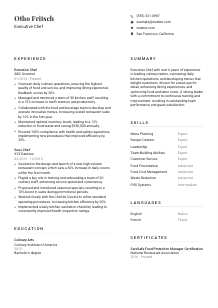
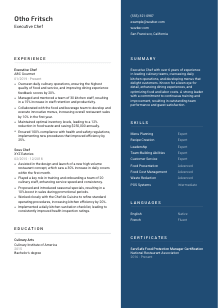
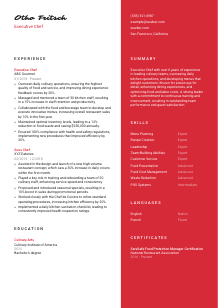
Mastering gourmet flavors, but your CV lacks culinary flair? Check out this Executive Chef CV example, created with Wozber free CV builder. Learn how to serve up your gastronomic genius to match the job recipe, crafting a career as savory as your signature dishes!
Executive Chef hiring reaches well beyond cooking skill. Restaurants, hotels, and hospitality groups want someone who can run service under pressure, keep food quality consistent across a high-volume kitchen, control cost, coach the brigade, and protect standards every shift. Your CV needs to show that level of command clearly, with examples of menu ownership, staff leadership, sanitation discipline, and operational results.
A tailored CV helps hiring teams quickly distinguish a true kitchen leader from a chef whose background is still primarily line or station focused. Wozber's free CV builder supports that tailoring with an ATS-friendly CV format, so menu development, labour oversight, food cost control, and certification details are easy to surface in both human review and ATS screening. The key is making your scope of responsibility visible from the first section onward.
In hospitality hiring, contact details do more than identify you. They also remove basic friction around availability, communication, and location, especially when a role needs an on-site kitchen leader who can step into service without delay.
Use your full name in the largest text on the page so it anchors the CV immediately. For an Executive Chef, presentation matters, and this section should feel as organised as a well-run pass.
Place "Executive Chef" directly beneath your name if that is the position you are targeting. This makes your seniority and direction clear right away, particularly if your recent background includes titles such as Sous Chef, Chef de Cuisine, or Kitchen Manager.
Include a current phone number and a professional email address that hiring teams can use quickly during active recruiting. Avoid casual usernames. In restaurant and hotel hiring, interviews and trial conversations often move fast, so your contact details should be easy to scan and easy to trust.
If the employer requires local availability or relocation, address that in your location line. Here, listing "San Francisco, California" works because the job specifically asks for it. If you are relocating, make that clear without overexplaining. This is one of the few places where a posting-specific requirement belongs front and centre.
A LinkedIn profile, portfolio site, or restaurant bio page can strengthen your application if it supports your leadership record, menu work, press mentions, or concept development. Only include it if the content is current and consistent with the CV. For chefs, visual proof and public-facing credibility can add useful context, but only when it reflects your actual level of responsibility.
By the time a hiring manager leaves the header, they should know who you are, what role you are pursuing, how to reach you, and whether location is a barrier. Keep it simple, accurate, and ready for a fast hiring process.




This is the section that carries the most weight for an Executive Chef. Hiring teams look for proof that you have led kitchens, improved service performance, shaped menus, managed people, and kept operations tight when volume is high.
Read the posting for the practical demands behind the title. In this case, the signals are clear: high-volume kitchen experience, team leadership, menu planning, recipe creation, budgeting, inventory control, and health and safety compliance. Those are the themes your bullet points should reflect, especially in your most recent roles.
List positions in reverse chronological order, starting with your current or most recent kitchen leadership role. For each entry, make the level of responsibility obvious through your title, the size or pace of the operation when relevant, and the kind of team or service environment you managed. Moving from Sous Chef to Executive Chef, as in the example, shows advancement only if the bullets also show bigger ownership over staffing, menu direction, and financial control.
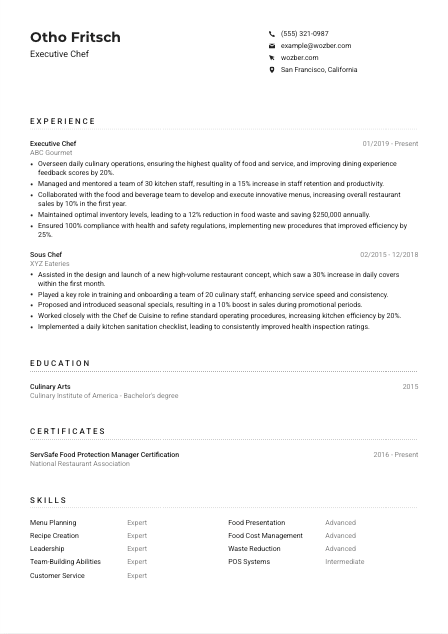
Focus on accomplishments that connect leadership to outcomes. Strong Executive Chef bullets often cover menu launches, labour or food cost improvements, reduced waste, better service consistency, stronger inspection results, higher guest satisfaction, or increased sales. The sample CV does this well with specifics such as a 20% improvement in dining feedback, a 12% reduction in food waste, and $250,000 in annual savings. Those numbers make kitchen leadership tangible.
Quantify results with measures that matter in food service. Covers, ticket times, retention, food cost percentage, waste reduction, inspection scores, banquet volume, revenue lift from menu changes, or productivity gains all carry more weight than vague claims about excellence. If your work improved procedures, say how. If you trained staff, show the effect on retention, speed, or consistency.
Choose bullets that reinforce your ability to run the kitchen, not just cook in it. Station execution and prep detail matter earlier in a chef career, but Executive Chef CVs should prioritise leadership decisions, cross-functional work with food and beverage teams, purchasing, training systems, and operational standards. The hiring team should be able to picture you owning service, not only contributing to it.
Your experience section should make it easy to understand the size of kitchen you have led, the standards you maintained, and the business results you influenced. That combination is what turns culinary experience into Executive Chef credibility.
Education matters most here when it confirms the culinary foundation or business preparation the employer asked for. For Executive Chef roles, a degree is rarely the only deciding factor, but when it is listed as a requirement, it should be easy to find and easy to verify.
If the role asks for a Bachelor's degree in Culinary Arts or a related field, place that credential clearly in this section. The example does this directly with a Bachelor's degree in Culinary Arts, which checks the requirement without forcing the reader to search for it.
List the degree, field of study, school name, and graduation year or date. Keep the formatting straightforward so the credential is readable in seconds. Education should support your candidacy, not compete with the experience section for attention.
If your degree or formal training included concentration areas that relate to the target role, mention them when they strengthen your case. Culinary management, nutrition, hospitality operations, baking and pastry, or cost control coursework can be useful if the position leans in that direction. Keep it selective and relevant.
Short courses, workshops, or continuing education can add value when they support the kitchen environment you are targeting. Wine pairing, large-scale catering, menu engineering, allergen management, or leadership development can all be worth noting if they connect to the work you want next.
Academic honors, competition recognition, or selective culinary programs can strengthen this section, especially if you are earlier in your leadership career. For a seasoned Executive Chef, keep these details brief and only include them when they add credibility rather than filler.
This section should confirm that you meet stated degree requirements and show any training that supports your kitchen leadership. Let it reinforce the CV, not distract from the operational record that will drive the decision.
Certifications carry real weight in executive kitchen hiring when they relate to food safety, compliance, and management responsibility. They tell employers that you understand the regulatory side of the kitchen, not just the creative one.
If the posting asks for a ServSafe Food Protection Manager Certification or an equivalent local credential, list it prominently. For an Executive Chef, this is not a minor detail. It supports your authority over sanitation practices, inspections, training, and day-to-day compliance.
Include certifications that support the role you want, not every credential you have collected over time. Food safety, allergen awareness, hospitality management, sommelier training, or specialised production credentials can all be relevant depending on the operation. The point is to show qualifications that matter in a senior culinary seat.
Many certifications matter because they are current. Include issue or renewal dates where appropriate so employers can see that your knowledge is up to date. The example's "2016 - Present" formatting works because it signals an active certification rather than an expired one.
Executive Chefs are often expected to set standards, train staff, and update procedures as regulations and operating practices evolve. Relevant certifications help demonstrate that you keep your knowledge current and take that responsibility seriously.
A current, relevant certification list reinforces that you can run a kitchen safely and to standard. For senior culinary roles, that operational trust matters as much as creativity on the plate.
The skills section should read like a snapshot of how you run a kitchen. Hiring teams want to see a mix of culinary judgment, operational control, and staff leadership that matches the level of the role.
Pull the most important skill language directly from the job description when it matches your background. Here, that includes menu planning, recipe creation, food presentation, leadership, team-building, budget management, and compliance. Mirroring this language helps your CV stay aligned in ATS screening and keeps the strongest priorities visible to the reader.
Executive Chef roles sit at the intersection of craft and operations. Pair technical strengths such as menu development, food presentation, inventory control, and cost management with leadership skills like staff training, scheduling, coaching, and cross-department collaboration. The example's mix of Menu Planning, Food Cost Management, Waste Reduction, and Leadership is a solid model because it covers both sides of the job.
Group or order skills by relevance so the most important ones are seen first. Avoid padding the list with broad traits that do not add much, and do not bury core kitchen capabilities under generic soft skills. A concise, role-focused list will do more for an Executive Chef CV than a long inventory of loosely related terms.
When this section is done well, it confirms that you can design the menu, manage the team, control the numbers, and hold service standards together. That is the combination employers are trying to spot quickly.
Language skills matter in hospitality when they improve communication with staff, guests, vendors, or ownership. For an Executive Chef, they are secondary to operational performance, but they can still add practical value in the right environment.
If a posting specifically requires strong English communication, list English clearly with an accurate proficiency level. For a senior kitchen leader, this speaks to more than conversation. It supports training, performance reviews, vendor communication, safety instruction, and collaboration with front-of-house or food and beverage leadership.
Extra languages can be useful when they reflect the environment you work in. In diverse restaurant groups, hotels, or international hospitality settings, they may help with team management, guest interaction, or broader culinary collaboration. The example includes French, which can be relevant in some culinary contexts, but only list added languages if they genuinely strengthen your profile.
List each language with a clear level such as Native, Fluent, Advanced, or Conversational. Avoid inflating proficiency. Accuracy matters because communication in a kitchen affects execution, training, and safety.
If your multilingual ability has practical value, let that be the reason it appears. Being able to communicate standards to a diverse brigade, explain menu concepts to guests, or work smoothly with international teams can all be meaningful. Keep the implication professional, not decorative.
Languages can strengthen an Executive Chef CV, but they will not replace weak experience in kitchen leadership, menu development, or cost control. Include them as a useful supporting detail rather than a headline qualification.
When they are relevant, language skills show broader communication range in the kitchen and dining environment. Present them clearly and let them support the leadership story built elsewhere on the CV.
The summary sits at the top of the CV, so it needs to establish your level quickly. For Executive Chef roles, that means stating your years of experience, the type of kitchen leadership you have handled, and the operating strengths you bring before the reader reaches the detailed experience section.
Start with a direct statement that identifies you as an Executive Chef or senior culinary leader and notes your years of relevant experience. If you have worked in high-volume service, multi-outlet operations, banquets, fine dining, or restaurant groups, mention the environment that best supports the role you are targeting.
Use the summary to highlight two or three strengths the employer is clearly hiring for. In this posting, strong choices would be leading kitchen teams, overseeing daily operations, creating menus, managing food and labour costs, and maintaining food safety standards. The example summary works because it combines leadership, operations, menu development, and cost awareness in a compact space.
A brief detail about how you lead can make the summary more specific. You might mention improving guest satisfaction, developing staff, reducing waste, strengthening consistency across service, or building menus around customer demand and brand standards. Keep this grounded in real work rather than personality-only language.
Aim for a short paragraph of 3 to 5 lines. Every phrase should earn its place. Avoid generic claims like "passionate professional" unless they are backed by concrete kitchen strengths. The summary should give the reader an immediate sense of your leadership level and operational focus.
Your summary should quickly establish that you can lead the kitchen, develop the food program, manage the team, and protect standards under pressure. If that is clear in a few lines, the rest of the CV has a strong starting point.
An Executive Chef CV needs to show range and control at the same time. It should present your culinary point of view alongside the operational realities employers care about most, including team leadership, food cost management, inventory discipline, sanitation compliance, and measurable service or revenue outcomes.
Use Wozber's free CV builder and ATS CV scanner to tailor your content around the role's actual language, strengthen ATS optimisation, and present your background in an ATS-compliant CV that is easy to review. When your CV makes your kitchen leadership clear at a glance, you are in a far stronger position for the next interview.




