



Use Wozber and land your dream job
Create CV
No registration required
Mastering the kitchen chaos, but your CV feels like a dish gone wrong? Check out this Restaurant General Manager CV example, made with Wozber free CV builder. Learn how to present your leadership strengths to match the job's recipe, making sure your next career move is as satisfying as a perfectly cooked dish!
Restaurant General Managers are trusted with the part of hospitality guests notice immediately and owners measure constantly. Service standards, labour discipline, food safety, inventory control, and floor leadership all show up in daily results. Your CV should make that operating range visible, with clear examples of how you improved guest experience, kept standards consistent, and ran a profitable restaurant.
Hiring teams often need to distinguish between candidates who supervised shifts and those who truly owned the business. A tailored CV, built with Wozber's free CV builder and shaped for ATS optimisation, helps surface the details that matter first, such as multi-unit or high-volume oversight, cost control, team development, and compliance with sanitation standards. That makes it easier to see whether you can lead service, staff, and financial performance at general manager level.
This section should confirm, within seconds, that you are reachable, professional, and viable for the opening. For a Restaurant General Manager, that usually means showing a clear title, clean contact details, and any location detail the employer explicitly requires, without cluttering the top of the page.
Use your full name as the most prominent text on the page. Keep the formatting clean and easy to read, the same way a well-run dining room feels organised before service even begins. A polished header sets the tone for the operational discipline the role demands.
Place "Restaurant General Manager" directly under your name if that is the role you are pursuing. Matching the title in the job ad helps position you correctly in ATS searches and signals that your background is aligned with full operational ownership, not only assistant-level support.
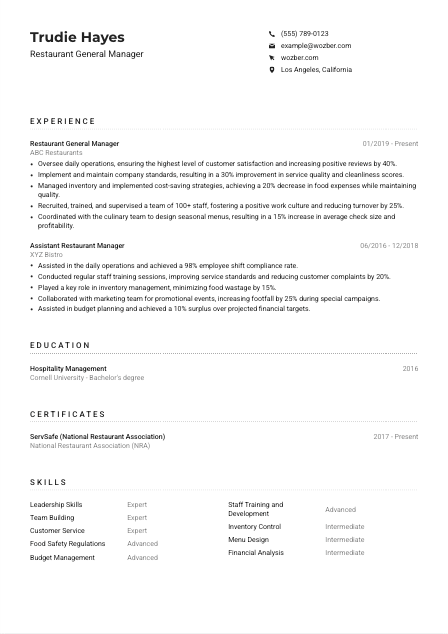
Add your phone number and a professional email address, then double-check them. If the posting calls for a local candidate, include city and state. In the example, listing Los Angeles, California immediately supports a stated requirement, but only include location when it helps answer the employer's need.
Include LinkedIn or a professional website if it reinforces your background in restaurant operations, team leadership, guest satisfaction, or business performance. Make sure the information matches your CV, especially job titles, dates, and major wins such as sales growth, labour control, or service-score improvement.
Skip details such as age, marital status, or a full street address. Restaurant leadership hiring is driven by operational history, staffing results, compliance knowledge, and financial judgment. Keep the header focused on information that helps the employer contact you and place you in the right candidate pool.
Your header should answer the practical questions first: who you are, what role you do, how to reach you, and whether you meet any stated location requirement. That gives the rest of the CV room to prove your leadership on the floor and in the numbers.




For Restaurant General Managers, experience is where hiring teams look for proof of control over service, staff, standards, and profit. Generic management bullets are easy to overlook. Specific results tied to restaurant operations are what make the section credible.
Read the posting closely and mark the responsibilities that define success in the role. For this kind of position, that usually includes daily operations, guest satisfaction, service and cleanliness standards, inventory, budgeting, profitability, hiring, training, and coordination with the culinary team. Your bullets should answer those points directly rather than describe management in broad terms.
List roles in reverse chronological order with job title, employer, and dates. Restaurant groups often hire quickly, so the structure needs to show progression at a glance, such as moving from Assistant Restaurant Manager into full general management with growing staff size, revenue responsibility, or scope of operations.
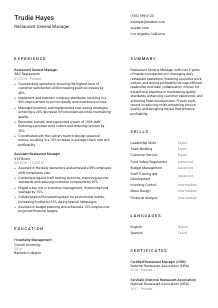
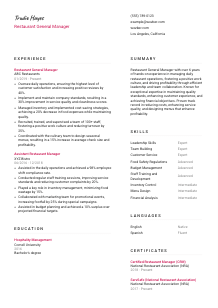
Daily restaurant tasks matter, but hiring managers already know what a GM is expected to do. Show what changed under your leadership. The example does this well by tying operations to results, including a 40% increase in positive reviews, a 30% improvement in service and cleanliness scores, and a 25% reduction in turnover after leading a team of 100+ staff.
Numbers carry weight when they reflect how restaurants are actually run. Include metrics tied to food cost, labour efficiency, guest reviews, complaint reduction, health inspection outcomes, average check size, waste reduction, retention, training completion, or profitability. In the sample CV, a 20% decrease in food expenses and a 15% increase in average check size tell a much clearer story than "managed inventory" or "helped menu planning."
If you have a long work history, give the most space to roles where you owned service execution, staffing, compliance, budgeting, and cross-functional coordination. Earlier hospitality experience can stay, but trim any bullets that do not support general manager-level judgment. Keep the focus on leadership in live operations, not every task you handled over the years.
The best experience sections make it easy to picture you running a shift, developing managers, protecting margins, and keeping standards high during busy service. If your bullets show measurable control over operations and results, the section is doing its job.
Education is usually a supporting section for experienced Restaurant General Managers, but it still matters when the employer asks for a degree in hospitality, business, or a related field. Present it clearly so the requirement is easy to confirm.
When a posting calls for a Bachelor's degree in Business Administration, Hospitality Management, or a related field, place that credential first and use the full degree wording. In the example, a Bachelor's degree in Hospitality Management aligns directly with the requirement and strengthens the match immediately.
List degree, field of study, school, and graduation year. That is usually enough for a management role in hospitality. Keep the layout straightforward so the section scans quickly and supports ATS parsing without distracting from the experience section.
If you are earlier in your career or your coursework strongly supports the target role, include relevant detail such as hospitality operations, food and beverage management, finance, or organizational leadership. For seasoned GMs, keep these additions brief unless they explain a clear strength that shows up in your career history.
If you completed workshops or programs in restaurant finance, leadership development, labour management, guest experience, or food safety, include them when they add value and do not fit better under certifications. This is especially useful when the training supports the business side of running a restaurant.
Honors, major projects, or hospitality leadership activities can help if they are relevant and recent enough to matter. Use them when they reinforce a management path, not simply to fill space. Once you have several years of restaurant leadership experience, practical operating results will carry more weight than campus involvement.
This section should quickly confirm the academic foundation the role calls for, then get out of the way. Clear degree information is usually all the hiring team needs before they return to your operational track record.
In restaurant leadership, certifications matter most when they support safe operations, regulatory compliance, and professional standards. For many openings, a current food safety credential is more than a bonus. It is part of being ready to lead the business responsibly.
If the employer asks for ServSafe or an equivalent food safety certification, list it prominently and use the exact credential name. That makes the requirement easy to confirm. The sample CV handles this well by listing ServSafe clearly, with the issuing organisation attached.
Choose certifications that support restaurant operations, compliance, or leadership. Food safety, alcohol service, restaurant management, and supervisory training usually matter more here than general online course badges. A short, relevant list reads as intentional and role-aware.
Include issue dates or validity periods, especially for certifications that expire or require renewal. Restaurant employers need to know that your food safety knowledge is current enough to support inspections, staff training, and sanitation procedures from day one.
Restaurant operations change with regulations, labour practices, and guest expectations. Recent certifications in food safety, management development, or hospitality leadership show that you stay current in the parts of the job that affect compliance, culture, and business performance.
A well-chosen certification section tells the employer you take standards seriously and can lead within them. For Restaurant General Managers, that credibility matters on the floor, in the kitchen, and during every inspection.
A Restaurant General Manager needs a skills section that looks grounded in real operations, not padded with generic management language. Focus on the capabilities that affect guest experience, team performance, compliance, and margin control.
Start with the language in the posting. If it emphasizes food safety knowledge, leadership, team building, budgeting, customer satisfaction, and communication, those themes should shape your section. This keeps your CV aligned with both the ATS and the hiring manager's priorities.
Use the same wording when it accurately reflects your background. For example, "Leadership Skills," "Team Building," and "Food Safety Regulations" fit naturally for this kind of role and match the sample CV well. Exact phrasing can help your CV surface in keyword-based screening, provided the skill is backed by experience elsewhere on the page.
If you have enough content, group your skills into categories such as leadership, financial management, operations, and guest service. That makes the section easier to scan and helps the employer quickly find what matters most, whether they are focused on labour management, sanitation compliance, menu profitability, or staff development.
Every skill you list should connect to how a restaurant actually performs. If the section reflects service execution, people leadership, compliance, and business control, it will support the rest of your CV instead of repeating vague claims.
Language ability can matter in restaurant management because the work is fast, public-facing, and team-driven. The right language section helps show that you can communicate clearly with staff, guests, vendors, and ownership, especially in diverse markets.
If the posting specifies English communication, list English first and state your proficiency clearly. That answers a direct requirement and supports core parts of the job, from coaching staff and handling guest issues to documenting procedures and discussing performance with leadership.
Include other languages when they are genuinely useful in your work environment. In some restaurant markets, bilingual communication can help with hiring, training, shift coverage, and guest rapport. The example's English and Spanish pairing is a practical illustration, not a rule for every opening.
Use honest labels such as Native, Fluent, Conversational, or Basic. Clear proficiency levels help employers understand where you can lead confidently, whether that means running pre-shift meetings, resolving customer concerns, or supporting multilingual teams during service.
For local restaurant roles, prioritise languages that are useful for the staff and guest base you are likely to manage. For broader hospitality groups or tourism-heavy markets, additional languages may carry more weight. Keep the section practical rather than aspirational.
When listed appropriately, language skills show adaptability and stronger communication range. In restaurant leadership, that can support training consistency, smoother guest recovery, and better team coordination across front-of-house and back-of-house environments.
This section works best when it reflects real communication ability that would help you lead service, coach staff, and handle guest interactions. Kept honest and relevant, it adds useful depth to your profile.
Your summary should tell the employer, within a few lines, what scale of restaurant leadership you bring and where your strongest results show up. For a Restaurant General Manager, that usually means combining operational control, people leadership, guest standards, and financial performance in one concise snapshot.
Before writing, identify the two or three themes the role emphasizes most. For many Restaurant General Manager openings, that will be daily operations, team leadership, guest satisfaction, food safety, and profitability. Build your summary around those priorities instead of trying to mention every skill you have.
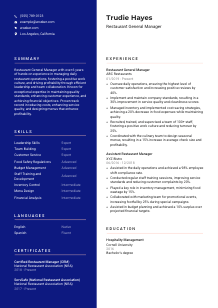
Start with a direct line that states your title or management focus and your years of experience. The example summary does this effectively by establishing more than 6 years in restaurant management, which immediately frames the candidate as an experienced operator rather than a developing supervisor.
Follow with capabilities and outcomes that matter in restaurant leadership. Mention areas such as cost control, service standards, staff development, retention, menu collaboration, or guest-experience improvement. If you include results, choose the ones most native to the role, like lower food costs, stronger cleanliness scores, or higher review ratings.
Aim for a short paragraph that can be read in a few seconds. Skip broad adjectives and focus on what you actually manage and improve. A concise summary is especially effective when the rest of the CV already carries the detailed metrics and operational examples.
A well-written summary should leave no doubt that you can run a restaurant, lead a team, and protect performance standards. Once that is clear, the rest of the CV can supply the detail behind it.
A Restaurant General Manager CV should read like the profile of someone who can lead a live operation, develop staff, protect standards, and improve the numbers that matter. When each section points back to guest experience, compliance, team leadership, and profitability, your application becomes much easier to trust.
Use Wozber's free CV builder to shape your content into an ATS-compliant CV, refine role-specific wording with its AI tools, and check alignment through the ATS CV scanner. The finished CV should make one thing clear right away: you are ready to run the restaurant well.




