



Use Wozber and land your dream job
Create CV
No registration required
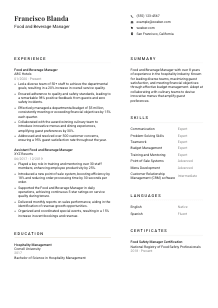
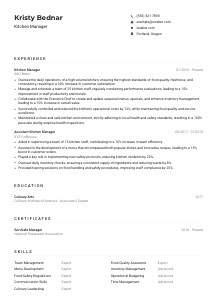
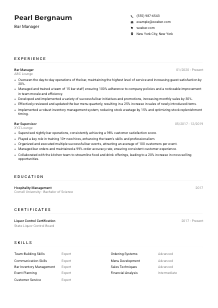
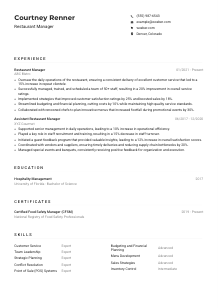
Orchestrating dining delights, but your CV feels half-baked? Sample this Food and Beverage Manager CV example, created with Wozber free CV builder. Learn how to season your management prowess and service champ creds to match the job, concocting a career that's as satisfying as a five-star feast!

Food and Beverage Managers are trusted with the parts of hospitality guests notice immediately and owners track constantly: service consistency, cost control, staff performance, safety compliance, and the overall dining experience. A CV for this role needs to show that you can run service smoothly under pressure, improve results across the floor, and work closely with culinary and front-of-house teams without losing sight of guest satisfaction or margin.
When that operational range is tailored clearly, hiring teams can quickly distinguish someone who has simply worked in hospitality from someone who has owned revenue targets, team development, and day-to-day execution. Wozber's free CV builder helps organise that experience into an ATS-friendly CV format, so the right terms, metrics, and management scope are easy to read both in an ATS and by the people deciding who can lead service from day one.
For a Food and Beverage Manager, the header should feel straightforward and professionally run. This is a management role built on reliability, communication, and operational presence, so your contact details need to be complete, accurate, and aligned with any location or language expectations named in the posting.
Use your full name at the top in the clearest spot on the page. Keep it slightly larger than the rest of the text so the hiring manager can identify you immediately. If you are using Wozber's ATS-friendly CV templates, this section is already structured to keep your header clean and easy to scan.
Place "Food and Beverage Manager" directly beneath your name when that is the role you are targeting. Matching the job title helps frame your background correctly from the first line and supports ATS alignment, especially when employers are filtering for management-level hospitality candidates rather than broader restaurant or hotel operations profiles.
Include a current phone number and a professional email address that uses your real name. This role often moves quickly from application to interview because operations leaders may need coverage for active service environments, so even a small typo can cost you a callback.
If a posting specifies location, include your city and state in the header. Here, San Francisco, California matters because the employer asked for a locally based candidate. When a job does not state a location requirement, city and state are usually enough without adding a full street address.
A LinkedIn profile can strengthen your application if it shows hospitality leadership, promotions, recommendations, or multi-unit and service-environment experience. Make sure the dates, titles, and achievements match your CV so there are no gaps between what the ATS reads and what the hiring team sees online.
This section should confirm that you are reachable, professionally presented, and properly aligned with the role before the reader reaches your experience.




This is the section most hiring teams will study first for a Food and Beverage Manager. They want to see whether you have handled live operations, led staff at scale, managed guest issues, protected standards, and delivered financial results in settings where service quality and profitability move together.
Start by marking the responsibilities that define success in the role. For this posting, the clearest priorities are daily food and beverage operations, quality and safety standards, team leadership, budget ownership, menu collaboration, and guest issue resolution. Those are the themes your experience bullets should reflect if you have done the work.
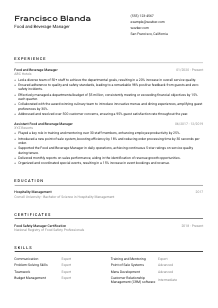
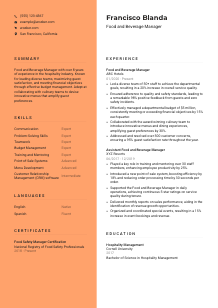
List your most recent role first, then work backward. For each position, include job title, employer name, and dates. In hospitality leadership, career progression matters. Moving from Assistant Food and Beverage Manager to Food and Beverage Manager, as shown in the example, immediately tells the reader you have grown from support responsibility into full departmental ownership.
Your bullets should show what improved because you were in the role. Strong Food and Beverage Manager bullets usually cover service scores, labour or cost performance, budget delivery, guest satisfaction, training results, event revenue, table-turn efficiency, or safety performance. The example does this well by tying leadership to a 20% increase in service quality and budget management to exceeding financial objectives by 15% each quarter.
Numbers help hiring teams judge scope quickly. Include team size, budget responsibility, outlet count, guest volume, event frequency, revenue growth, satisfaction scores, audit performance, or reductions in incidents and order time. A bullet about leading 50+ staff or managing a $5 million departmental budget gives far more context than saying you "oversaw operations."
Cut experience that does not support this management track, or rewrite it to highlight transferable value such as staff supervision, vendor coordination, inventory control, POS rollout, or guest recovery. Your CV should read like a record of operating restaurants, bars, banquets, lounges, or hotel dining environments, not a general hospitality timeline.
By the end of your experience section, the reader should understand your service environment, the size of team and budget you handled, and the results you delivered across guest experience and financial performance.
Education matters here because it gives context for your management foundation, especially in hospitality operations, business, service systems, and team leadership. Most employers will not spend long in this section, but they will look for a degree that aligns with the level of responsibility in the role.
If the employer asks for a bachelor's degree in Hospitality, Business, or a related field, make that credential easy to find. List your highest relevant degree first and use the exact degree and field wording from your records. In the example, "Bachelor of Science in Hospitality Management" maps cleanly to the requirement.
Include degree, field of study, school, and graduation year or date. That is usually enough for an experienced Food and Beverage Manager. Clean formatting helps the ATS parse the section correctly and keeps attention on the qualification itself rather than decorative detail.
Hospitality Management, Business, Hotel Administration, Restaurant Management, and similar programs all strengthen your case because they connect naturally to budgeting, service operations, staffing, and guest experience. If your degree is in a broader field, you can still show fit through experience and any hospitality-focused coursework or training.
If you are earlier in your management career, a few relevant academic details can help. Courses in foodservice operations, hospitality finance, human resources, event management, or sanitation standards can reinforce your readiness. For more senior candidates, keep this brief unless the training is unusually relevant to the target role.
Academic honors, hospitality association involvement, or student leadership can be worth mentioning if they connect to service leadership, operations, or business performance. Otherwise, let your professional track record do the heavier work.
Your education section should confirm that you meet the formal baseline for the role and support the operational credibility shown in your work history.
In food and beverage management, certifications often strengthen trust around safety, compliance, and professional discipline. Even when a posting does not require one, the right credential can support your case, especially if your role includes sanitation oversight, alcohol service compliance, or multi-outlet operations.
Some employers ask for food safety, alcohol service, or management certifications, while others leave them optional. This posting does not make certification mandatory, so any credential you include should still connect clearly to the operational demands of the job.
List certifications that strengthen your relevance as a Food and Beverage Manager, such as food safety management, HACCP-related training, responsible beverage service, or hospitality leadership programs. In the example, a Food Safety Manager Certification is a practical addition because the role includes quality and safety oversight.
If a certification expires, needs renewal, or is currently active, include the date range or renewal status. That helps the employer know whether you are ready to step into compliance-sensitive responsibilities without extra clarification.
Renewed certifications show that you stay current with standards that affect audits, inspections, and day-to-day operations. In hospitality, current compliance knowledge is useful because service environments, local regulations, and guest expectations do not stay static for long.
Well-chosen certifications strengthen your profile by showing that you take safety, standards, and operational accountability seriously.
A Food and Beverage Manager skill section should balance operational tools with management judgment. Hiring teams are usually looking for a mix of service leadership, financial control, system fluency, and people management, because the role sits at the intersection of guest experience and departmental performance.
Read beyond the obvious keywords. A posting may name communication, problem-solving, and point-of-sale systems directly, while implying other expectations such as budgeting, staff development, complaint resolution, menu collaboration, and quality control. Those implied skills are often what separate a generic hospitality CV from a targeted management one.
Choose skills that reflect how Food and Beverage Managers are actually evaluated. That usually includes POS systems, budget management, staff training, scheduling, inventory awareness, menu development support, guest relations, and safety compliance, alongside core leadership skills like communication and team management. The example balances these well with budget management, training and mentoring, POS systems, and menu development.
Use clear skill names rather than vague phrases. "Point-of-Sale Systems" will do more for ATS optimisation than a broad term like "technology." The same goes for "Budget Management" or "Customer Relationship Management software." Wozber can help you align these terms with the job description while keeping the section clean and readable.
Your skills section should confirm that you can manage the systems, people, and service pressures that come with running food and beverage operations.
Language ability matters in hospitality because managers handle guest concerns, coach staff, and coordinate with multiple teams in real time. For a Food and Beverage Manager, this section is most useful when it reflects actual communication needs in the workplace rather than acting as filler.
If the employer specifies a required language, place it first and label your proficiency honestly. This posting asks for high proficiency in English, so English should appear clearly in this section.
List the language most important for the role first, then add any others that may help with guest service or team communication. In a market serving diverse guests and staff, an additional language such as Spanish can strengthen your profile when it reflects real working ability.
Extra languages can be useful in hotels, resorts, fine dining, banquets, and tourist-heavy environments where guest interactions vary widely. Include them when they are meaningful, especially if they help with guest recovery, event coordination, or staff communication.
Choose straightforward labels such as Native, Fluent, Advanced, Intermediate, or Basic. Managers are often expected to step into sensitive guest conversations, so inflated language claims tend to show up quickly in interviews or on the floor.
For this profession, additional languages can support smoother service, clearer staff coaching, and a better guest experience during high-pressure interactions. That value is strongest when the language skill connects to the kind of operation you have actually worked in.
Done well, your language section shows that you can communicate clearly where service quality depends on fast, accurate interaction with guests and staff.
Your summary needs to establish, in a few lines, what kind of Food and Beverage operation you have managed and what results follow your leadership. This is where you give the reader a quick sense of your tenure, operating strengths, and the business or guest outcomes that define your work.
Start with a direct line such as "Food and Beverage Manager with 8+ years of hospitality experience." That immediately sets seniority and profession. If your background is concentrated in hotels, resorts, restaurants, or events, you can name that environment too.
Choose two or three strengths that match the posting closely. For this role, strong summary themes include leading diverse teams, hitting budget targets, maintaining service and safety standards, improving guest satisfaction, and collaborating on menu or dining experience updates. The example summary uses exactly that kind of focus.
Aim for three to five lines with specific management substance. Avoid broad claims like "hardworking professional" or "results-driven leader" unless you immediately back them with operational context such as team size, guest satisfaction performance, or financial ownership.
End on the contribution that defines your work, whether that is stronger service consistency, better departmental performance, improved guest retention, or effective coordination between front-of-house and culinary teams. That final line should sound like the result of your management approach, not a generic personality statement.
A strong summary should tell the reader, within seconds, that you have the experience and operational judgment to lead food and beverage service at management level.
A Food and Beverage Manager CV works best when every section supports the same story: you can lead teams, protect standards, handle guest issues, and hit financial targets in a live service environment. Keep your examples specific, use metrics that show scope and outcomes, and mirror the language of the job description where it matches your real experience.
Use Wozber to tighten that alignment, improve ATS optimisation, and present your background in an ATS-compliant CV that is easy to scan. The final result should make one thing clear fast: you know how to run food and beverage operations with both guest experience and business performance in view.




