



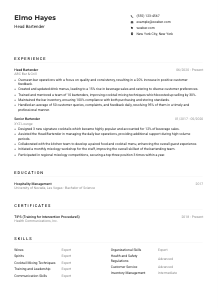
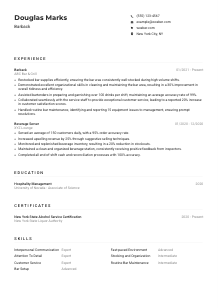
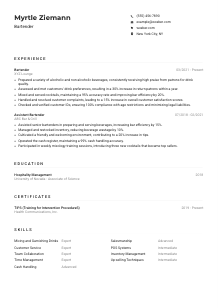
Use Wozber and land your dream job
Create CV
No registration required
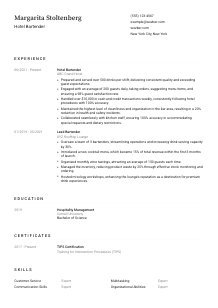
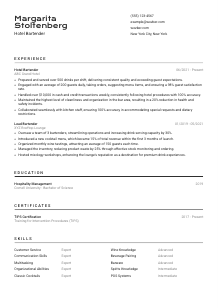
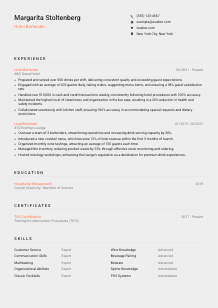
Mixing up cocktails, but your CV feels sober? Shake things up with this Hotel Bartender CV example, created with Wozber free CV builder. Learn how to blend your bar expertise with hospitality highlights, making your career path as refreshing as the drinks you serve!
Hotel bartending sits at the intersection of service, pace, and presentation. Hiring teams want to see more than cocktail knowledge. They need proof that you can keep drinks consistent during a rush, handle guests with polish, and keep the bar clean, organised, and compliant while service keeps moving.
A tailored CV quickly separates hotel bar experience from general bartending experience by making guest volume, beverage knowledge, service standards, and cash handling easy to read. Wozber's free CV builder helps you shape that into an ATS-compliant CV with the right hospitality language, so the hiring team can quickly see whether you can step into a busy bar and deliver the level of service the property expects.
Hotels move quickly when filling front-of-house roles, so your contact section needs to answer the practical questions first. Keep it clean, accurate, and aligned with any stated requirement that belongs here.
Place your full name at the top in a clear, readable format. No styling tricks are needed. In hospitality hiring, speed matters, and your CV should open with information that is immediately usable when a hiring manager is reviewing several service candidates in one sitting.
Add "Hotel Bartender" directly under your name if that is the role you are applying for. Matching the posted title helps frame your experience in the right lane from the start, especially when the employer is separating hotel candidates from restaurant, nightclub, or event bartenders.
List one reliable phone number and a professional email address. Double-check both. If a bar manager wants to schedule a trial shift or interview after a strong review of your guest service and beverage background, broken contact details can stop the process immediately.
If the posting asks for a specific location, show your city and state. Here, listing New York City, New York directly addresses a stated requirement. That does not apply to every Hotel Bartender job, but when location is named in the posting, include it so the employer does not have to guess about local availability.
A LinkedIn profile or personal website can support your application if it reflects hospitality work, leadership experience, beverage programs, or customer-facing achievements. Leave it off if it is outdated or thin. The goal is to reinforce your CV, not distract from it.
This section should confirm that you are reachable, local when required, and applying for the exact role. Save the personality for your experience and summary, where hotel service standards and bar results matter more.




This is the section that carries the most weight for bartending roles. Employers want to see the environment you worked in, the pace you handled, the service standard you maintained, and the results you delivered with guests, transactions, and team coordination.
Before rewriting bullets, identify the operating demands in the posting. For this role, that includes at least 2 years of hotel or upscale bar experience, classic and contemporary cocktail knowledge, wine and spirits familiarity, guest service, multitasking, cash handling, cleanliness, and coordination with kitchen staff. Those points should shape which achievements you keep and how you phrase them.
List jobs in reverse chronological order and make each entry easy to scan with title, employer, and dates. For hotel bartending, the employer name matters because the venue type signals service level. "Hotel Bartender" at a grand hotel reads differently from a general bar role because it suggests brand standards, guest expectations, and cross-team coordination.
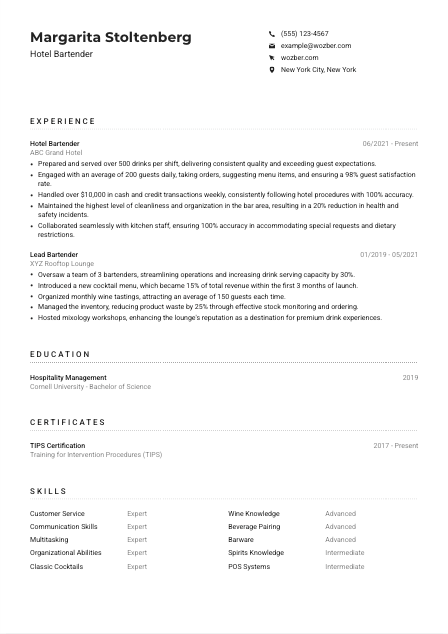
Do not stop at "prepared drinks" or "served customers." Show the scale and quality of your work. The sample CV does this well with details like serving more than 500 drinks per shift and maintaining a 98% guest satisfaction rate. Metrics like guest volume, transaction accuracy, upsell contribution, reduced waste, or inspection improvements give real shape to your bartending performance.
Strong bartending metrics are operational, not generic. Quantify drinks served, guest counts, revenue from a new cocktail menu, weekly cash and credit volume, waste reduction, or speed gains during peak service. In the example, handling over $10,000 in weekly transactions and reducing health and safety incidents by 20% tells the employer you can manage both service pressure and bar discipline.
Prioritise experience that supports hotel bar work. Roles that show premium guest service, beverage knowledge, POS handling, inventory control, menu recommendations, or team leadership deserve space. Leave out unrelated jobs unless they add something directly useful, such as high-volume customer service or cash accountability. Every bullet should move you closer to the requirements in the posting.
A hiring manager should be able to picture you working a busy service window, talking with guests, preparing drinks to standard, handling payments correctly, and coordinating with the floor or kitchen. That is the level of detail your experience section needs to deliver.
Education rarely outweighs bar experience for this role, but it can still strengthen your profile. Hospitality programs, business coursework, or food and beverage training can signal that you understand service operations beyond the bar top.
Some Hotel Bartender roles do not ask for a degree at all, so keep this section proportional. If you have formal study in hospitality, hotel operations, business, or food and beverage management, include it because it adds context to your service background even when it is not required.
List your degree, field of study, school, and graduation year. Simple formatting helps maintain an ATS-friendly CV format and keeps the focus on information that matters. The sample education entry works because it is direct and easy to scan.
A degree such as Hospitality Management can support your CV by showing familiarity with guest relations, service standards, and hotel operations. That is useful context in hotel environments, where bartenders often work within broader brand and service expectations rather than as standalone bar staff.
If you are early in your career, selected coursework in beverage management, hospitality operations, customer experience, or food safety can help. If you already have several years of strong bar experience, keep the section lean and let your service metrics carry more weight.
Awards, hospitality competitions, or relevant student leadership can support your profile if they connect to service, event operations, or beverage work. If they do not strengthen your case for a busy hotel bar environment, leave them out and keep attention on your experience and certifications.
Education should add context to your hospitality background, not compete with your bartending record. If it helps explain your training or service foundation, include it clearly and move on.
For bartending jobs, certifications often carry direct operational value. They can show legal readiness, service responsibility, and current knowledge of safety practices, which matters in guest-facing hotel environments.
Read the posting carefully and place any required credential in this section. Here, TIPS certification is specifically requested, so it should appear clearly. If you do not have it yet and the employer allows a short completion window, be ready to note that you can obtain it within the required timeframe.
Prioritise certifications that support responsible alcohol service, food safety, wine knowledge, or hospitality operations. A short, relevant list is stronger than a long list of unrelated courses. For this opening, TIPS carries far more weight than generic training with no connection to bar work or guest safety.
Include the date earned and, if relevant, show that the certification remains current. Employers want to know whether your training is active, especially for compliance-related credentials tied to alcohol service and guest protection.
Upscale hotels may value added training in wine service, premium spirits, or responsible service standards, especially if the bar program leans toward elevated guest experiences. Ongoing certification can also help if you are trying to move from general bartending into hotel, resort, or luxury properties.
Certifications should tell the employer that you are prepared to serve responsibly and work within hotel standards from day one. When a credential is named in the posting, make sure it is impossible to miss.
A Hotel Bartender skills section should read like the toolkit behind a successful shift. Focus on the mix of beverage expertise, guest-facing ability, and operational control that the role requires.
Pull skills directly from the posting and from the kind of work the role involves every day. For this job, that means classic and contemporary cocktails, wine and spirits knowledge, customer service, communication, multitasking, organisation, and transaction handling. These are not filler terms. They point to the actual work of serving guests accurately and smoothly under pressure.
Bartending in a hotel requires both product knowledge and front-of-house presence. Include beverage skills such as cocktail preparation, beverage pairing, POS systems, and barware handling alongside service skills like guest engagement, menu recommendations, and communication. The sample CV gets this balance right by pairing drink expertise with customer service and multitasking.
Do not overload this section with every skill you have ever used. Choose the abilities most relevant to the target property and service style. If you rate skills, be realistic. The skills section should align with your experience bullets so the employer sees the same strengths repeated in actual bar results, not just listed in isolation.
When someone reads this section, they should understand what you can execute on the floor and behind the bar. Clear skill selection makes your experience easier to trust.
Language ability can be a genuine advantage in hotels, where guest traffic is varied and service interactions move quickly. Include languages when they improve your ability to serve, explain, recommend, or resolve issues with confidence.
If the employer asks for fluent English speaking and writing, state your English proficiency clearly. This role does, so listing English as "Native" or "Fluent" directly addresses a requirement tied to guest communication, order accuracy, and coordination with the team.
Additional languages can strengthen your application in hotels that serve international travelers or diverse local guests. Spanish, for example, may help with guest rapport, clearer service interactions, or smoother communication during busy periods. Include extra languages when you can actually use them in a service setting.
Use honest labels such as "Native," "Fluent," or "Intermediate." If a guest asks about ingredients, allergies, or spirit recommendations, language skill becomes practical very quickly. Overstating your level can create problems in both the interview and the role itself.
In hospitality, language skills are not decorative. They can help with guest comfort, upselling, special requests, and issue resolution. If multilingual ability helps you deliver a smoother bar experience, it deserves a place on the CV.
For hotel bartending, language skills matter when they improve communication at the bar and support the guest experience. List them clearly and rate them honestly.
Your summary should give a quick, credible snapshot of the kind of bartender you are. In a few lines, it should establish your environment, your strengths behind the bar, and the level of guest experience you are used to delivering.
Start with your title and years of experience, then name the type of environment you know well. For example, "Hotel Bartender with over 5 years of experience in high-end hotel and upscale bar environments" works because it immediately places the candidate in the right service tier.
Use the next sentence or two to highlight the abilities most relevant to the role, such as classic and contemporary cocktails, wine and spirits knowledge, high-volume service, or guest engagement. The sample summary also references collaboration and a welcoming atmosphere, which suits a hotel setting where service depends on both bar execution and team coordination.
Aim for 3 to 5 lines with no filler. Avoid vague claims about passion or people skills unless they are backed by the rest of the CV. A hiring manager should finish the summary knowing your service environment, your beverage capability, and the kind of guest experience you consistently deliver.
A good summary gives the employer a fast read on your level, your style of service, and your relevance to the property. Keep it specific enough to sound earned and short enough to invite a closer look at your experience.
A Hotel Bartender CV works when it shows how you handle real service conditions: drink quality, guest interaction, payment accuracy, cleanliness, and teamwork during busy shifts. If those details are clear, the hiring team can picture you working their bar.
Use Wozber's free CV builder to shape your content into an ATS-friendly CV template, then refine it with the ATS CV scanner and AI CV builder features to align your wording with the posting. The finished CV should make it easy to judge one thing: whether you can deliver polished, reliable bar service in a hotel environment.




