



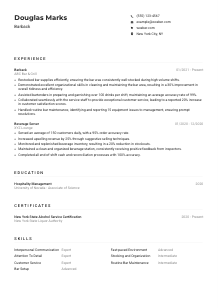
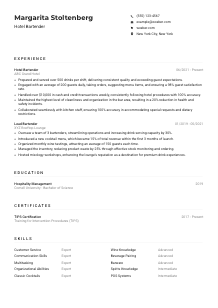
Use Wozber and land your dream job
Create CV
No registration required
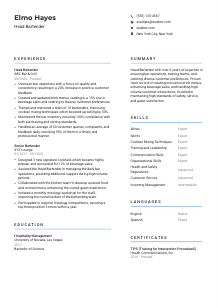
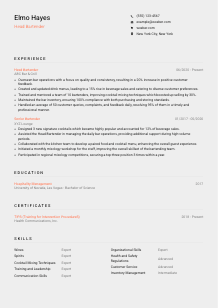
Manning mixology, but feeling shaken not stirred by your CV? Whip up cocktail coherence with this Head Bartender CV example, created with Wozber free CV builder. Learn how to blend your leadership libations with job requirements, crafting a career journey as memorable as your signature drink!
Running a bar means controlling pace, quality, and guest experience at the same time. Head Bartender hiring usually turns on whether your CV shows that you can lead service during busy shifts, keep drink execution consistent, manage inventory without waste, and coach bartenders to work to the same standard.
A tailored CV helps separate bar leadership experience from general bartending work. When the language reflects menu development, stock control, staff training, and safe service practices, hiring teams can quickly read you as someone ready to oversee operations, not just work a station. Wozber's free CV builder supports that kind of ATS optimisation, making it easier to align your CV with the posting and show where you've already improved service, sales, and team performance.
For a Head Bartender, the top of the CV should read like someone ready to run the floor. Keep this section clean, professional, and aligned with the basics the employer will check first before moving on to your bar leadership experience.
Your name should be the most visible text at the top of the CV. Use a clean, readable format so the document feels polished from the first glance, much like a well-organised bar setup before service begins.
Place "Head Bartender" under your name if that matches the role you are pursuing. This immediately frames your background around supervision, menu input, service quality, and team leadership rather than a general bartending position.
Include a current phone number and a professional email address with no distractions. Hiring managers often move quickly when filling hospitality roles, so make it easy for them to reach you for a trial shift, interview, or follow-up conversation.
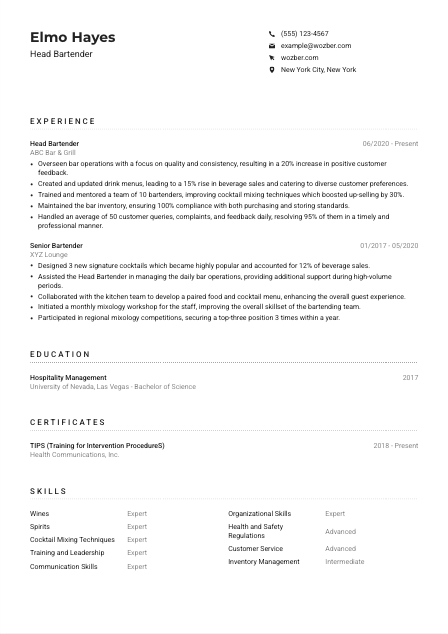
If the posting requires local availability, say so clearly. In the example, listing New York City, New York helps confirm alignment with a location-specific requirement. For other Head Bartender roles, include city and state when it helps show you are available for the venue's scheduling and hiring needs.
A LinkedIn profile or professional site can help if it backs up your hospitality background, leadership history, competition work, or beverage program experience. Skip it if it is empty or outdated. Every detail here should support the impression that you are ready to lead bar operations.
This section does not need flair. It needs accuracy, professionalism, and clear alignment with the role so the employer can move straight to your service record, leadership scope, and bar results.




This is the section that carries the most weight for a Head Bartender. Employers want to see how you managed service, trained staff, handled guest issues, built drink programs, and kept bar standards steady during real operating hours, especially in high-volume environments.
Read the job description and identify the operating responsibilities behind the title. For a Head Bartender, that usually includes overseeing service quality, updating drink menus, training bartenders, managing inventory, and resolving customer concerns. Use those themes to choose which roles and achievements deserve the most space.
Start with your most recent position and include job title, venue name, and dates. That structure lets employers quickly track your progression from bartender to senior bartender to bar lead or Head Bartender, which is often a key distinction in hospitality hiring.
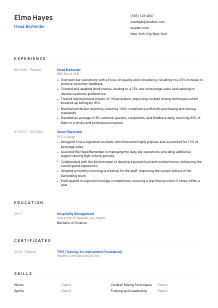
Bullet points should show what changed because of your work. Use metrics that make sense for bar operations, such as beverage sales, guest feedback, upselling, inventory accuracy, complaint resolution, staff size, or service volume. The sample CV does this well by linking menu updates to a 15% rise in beverage sales and team training to a 30% boost in upselling.
Prioritise experience that shows command of the bar, not just familiarity with service. Supervising shifts, enforcing standards, maintaining stock, building menus, coordinating with kitchen teams, and mentoring junior bartenders all carry more weight than unrelated work, unless that work clearly supports hospitality leadership.
Extra context can sharpen your profile when it is relevant. Signature cocktails, mixology workshops, food and beverage pairing work, or competition placements can all help, especially when they connect to guest experience or revenue. In the example, monthly workshops and successful signature cocktails show both technical credibility and influence on the team and menu.
By the end of this section, the employer should understand the scale you handled, the team you led, and the standards you maintained. That is what moves you from experienced bartender to credible Head Bartender candidate.
Education is rarely the deciding factor for a Head Bartender, but it can strengthen how your experience is read. Training in hospitality, business, food and beverage, or related service fields can reinforce your grasp of guest operations, management standards, and commercial awareness.
Check whether the role mentions a degree or formal study. Many Head Bartender jobs do not require one, but relevant education can still add value. A Hospitality Management degree, like the one in the example, supports experience in service operations, guest relations, and venue standards.
List your degree, school, field of study, and graduation year or dates attended. Keep it easy to scan so employers can absorb the information quickly without losing focus on your work history and operating results.
If your studies connect directly to bar leadership, beverage management, hospitality operations, or customer service, you can make that relevance clear. There is no need to overbuild this section if your experience already shows strong bar performance.
Honors, leadership roles, or hospitality-related activities can help early-career candidates or anyone whose education is a stronger selling point. If you have several years of bar leadership behind you, keep these details brief and only include what adds real context.
For most Head Bartenders, education should support the application, not dominate it. If your strongest proof comes from running shifts, improving sales, and coaching teams, let this section stay concise and relevant.
A short, relevant education section works well here. It should complement your operational experience and reinforce that you understand hospitality beyond the mechanics of making drinks.
Certifications matter in bartending because they connect your service experience to safety, responsibility, and professional standards. For leadership roles, they also show that you can uphold house policies and train staff in practices that protect guests and the business.
Start with any credential named in the posting. In this case, TIPS or an equivalent certification should be easy to find because it directly supports responsible alcohol service and bar compliance. If you are still in the process of obtaining it, say that clearly when the role allows for it.
List certifications that reinforce your value as a Head Bartender, such as responsible service training, wine or spirits education, health and safety credentials, or beverage program coursework. Skip unrelated certificates that do not support bar operations, guest service, or team supervision.
Add the year earned and, when relevant, whether the certification is still active. This matters for credentials tied to compliance or service standards. The example's TIPS entry works because it shows the certification is current and ongoing.
As your career grows, new certifications can support movement into stronger venues or larger beverage programs. Advanced spirits education, wine studies, or management-focused hospitality training can all add credibility when paired with real operating results.
Certifications help hiring teams trust that you understand both the guest-facing and compliance side of the bar. For a Head Bartender, that matters almost as much as cocktail knowledge.
The best Head Bartender skills sections balance beverage expertise with floor leadership. Employers expect technical knowledge, but they also need to see whether you can train staff, maintain standards, and keep service smooth when the bar is busy.
Start with the capabilities the job asks for and the work you have already done. Deep knowledge of wines, spirits, cocktail mixing techniques, inventory control, health and safety regulations, team training, and customer handling all belong here because they connect directly to day-to-day bar leadership.
A Head Bartender needs both craft and management range. Pair hard skills such as beverage knowledge, menu development, and stock management with leadership skills like coaching, communication, conflict handling, and shift coordination. The sample skill list gets this balance right by combining cocktail technique with training and leadership.
Do not crowd this section with every hospitality skill you have ever used. Choose the ones that support the target role most clearly. A shorter list built around bar operations, service consistency, compliance, and staff development will read far better than a long generic inventory.
This section should confirm that you understand the drinks, the people, and the operational discipline behind a successful bar. That combination is what employers look for in a Head Bartender.
Language ability can matter more in hospitality than candidates sometimes realize. In a bar setting, it affects guest comfort, upselling, complaint handling, and the pace of service, especially in busy or international markets.
If the role requires English speaking proficiency, make that easy to see. For a Head Bartender, fluent spoken English matters for managing service, training staff, communicating with guests, and handling issues in the moment.
Additional languages can be a real advantage in venues with diverse clientele or tourist traffic. They can help with order accuracy, rapport, and service recovery. In the example, Spanish adds useful range without distracting from the primary requirement.
Use clear labels such as Native, Fluent, Intermediate, or Basic. In customer-facing roles, overstating fluency can backfire quickly, especially when the job involves live guest communication and team direction.
Not every bar needs multiple languages, but some do. If the venue serves a multilingual neighborhood, luxury clientele, or international guests, make that strength visible. If not, keep the section straightforward and brief.
Improving a second language can expand the kind of guests and teams you can work with confidently. For hospitality professionals, that is less about decoration and more about service range, guest connection, and smoother communication on shift.
For a Head Bartender, language skills matter when they improve service, clarity, and rapport. Present them honestly and in the order that best supports the role.
Your summary should quickly establish your level, your specialty, and the kind of results you deliver. For a Head Bartender, that means going beyond passion for mixology and showing leadership, service standards, and measurable contribution to the venue.
Start with a direct professional snapshot. Mention that you are a Head Bartender or bar leader and include your years of experience in bartending or supervisory work. This gives immediate context for the rest of the CV.
Use concise, role-relevant wins such as increased beverage sales, stronger customer feedback, improved upselling, successful menu development, or better team performance. The sample summary works because it points to menu creation, sales growth, and high-volume guest handling rather than vague enthusiasm.
A hiring manager should see both sides of the role in a few lines. Mention training bartenders, maintaining service quality, handling customer issues, or upholding safety and compliance standards. That gives the summary operational weight.
Aim for three to five lines with no filler. This section should read like the clearest version of your candidacy, using the same language the employer uses when it reflects your real experience. That makes the summary stronger for both human review and ATS parsing.
A sharp summary should make one thing clear right away. You know how to run a bar, develop a team, and deliver a guest experience that holds up under pressure.
A well-tailored Head Bartender CV should show more than cocktail knowledge. It should make your leadership, beverage program input, inventory discipline, guest handling, and compliance awareness easy to spot in a quick review.
Use Wozber's free CV builder to shape those details into an ATS-friendly CV template, then refine the wording with Wozber's ATS CV scanner so your experience lines up with the job description in a natural, credible way. When the CV is finished, the hiring team should be able to see exactly how you would run the bar, train the staff, and protect the guest experience from day one.