



Use Wozber and land your dream job
Create CV
No registration required
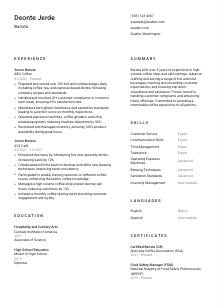
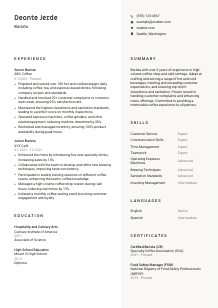
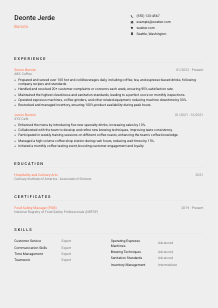
Brewing up caffeinated wonders, but your CV seems bitter? Blend in with this Barista CV example, made with Wozber free CV builder. It shows how to match your coffee artistry to job criteria with ease, making your career as rich and satisfying as a perfect latte!
Barista hiring moves quickly, but the work itself is anything but casual. Coffee shops look for people who can keep drink quality consistent through a rush, handle equipment confidently, and stay warm with customers even when the line is deep. Your CV needs to show that you can work clean, fast, and accurately in a service environment where every order, recommendation, and remake affects the guest experience.
When barista CVs are tailored well, the first scan tells a manager whether you have the right kind of café experience or if your background is too general. Wozber's free CV builder helps you shape that story into an ATS-compliant CV by aligning your wording with the posting's language, from espresso machine use to sanitation and customer service, so the hiring team can quickly see that you are ready for a high-volume bar.
In café hiring, small details matter. If your contact section is clean and complete, it immediately tells the employer that you understand presentation, follow directions, and can match the basics of the posting before they even reach your experience.
Use your full name at the top in a clear, readable format. Keep the styling simple and professional. For a barista CV, this section should feel tidy and deliberate, much like a well-kept station during service.
Place "Barista" directly under your name if that is the role you are applying for. This helps hiring managers and ATS systems connect your CV to the opening right away, especially when they are reviewing many service candidates in a short window.
Add a current phone number and a professional email address. Double-check for typos. Coffee shop hiring often moves fast, and missed calls or bounced emails can cost you an interview even if your café experience is solid.
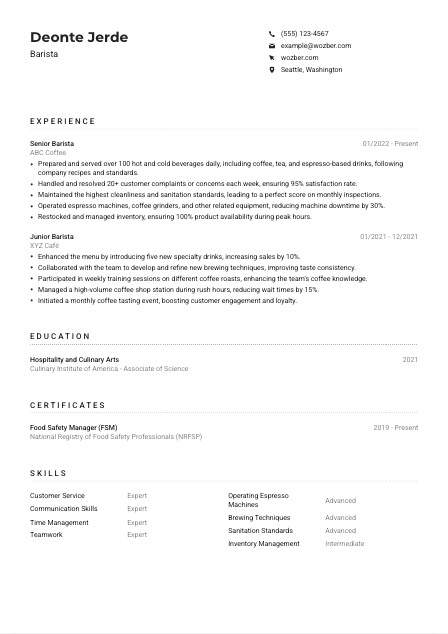
If the employer wants someone already based in a certain area, show that clearly. In the example posting, listing "Seattle, Washington" helps confirm local availability and removes an easy screening question early in the process.
A LinkedIn profile or portfolio link can be useful if it supports your application, especially if it reflects hospitality work, certifications, or steady customer-facing experience. Skip extra links that do not strengthen your case for bar service, beverage prep, or café operations.
This section should confirm who you are, how to reach you, and whether you meet any straightforward requirements such as local availability. Once that is clear, the rest of the CV can focus on drink volume, service quality, and day-to-day café performance.




For baristas, experience carries the most weight when it shows pace, consistency, and customer handling under pressure. Hiring managers want to see the kind of shop you worked in, the volume you handled, the equipment you used, and how you contributed beyond simply taking orders.
Read the description closely and mark the repeated themes. For this opening, the priorities are high-volume café experience, espresso machine and grinder use, beverage preparation, customer service, sanitation, inventory support, and handling concerns at the counter. Those are the points your bullets should answer directly.
Start with your most recent position and include job title, employer, and dates. That simple structure helps the manager quickly see your progression, whether you moved from junior barista work into lead station coverage, training support, or more demanding shift responsibilities.
Do not stop at "made coffee" or "served customers." Show what the work looked like in practice. The example CV does this well with bullets such as preparing 100+ beverages daily, operating espresso equipment, and maintaining top sanitation scores. That kind of detail tells an employer you can handle volume while still following recipes and standards.
Barista metrics are often straightforward and persuasive. Include drink counts, customer satisfaction results, reduced wait times, inspection scores, sales lift from new drinks, or fewer equipment issues. In the sample, a 95% satisfaction rate, 30% less machine downtime, and 15% faster rush-hour flow all give the reader a concrete sense of pace and impact.
Prioritise roles that prove beverage prep, front-counter service, cleaning discipline, upselling, and teamwork during busy shifts. If you have older or unrelated jobs, keep them brief unless they add something useful such as cash handling, food safety, or high-volume customer interaction.
Your experience section should make it easy to picture you on bar: making drinks to standard, keeping the workspace clean, supporting the team through rushes, and handling customers professionally. That is the level of clarity most café managers want before they decide to interview.
Education is usually not the deciding factor for a barista role, but it still adds context. It can support your application when it reflects hospitality, food service, culinary training, or the kind of discipline that carries over into customer-facing shift work.
Many barista postings focus more on café experience than on formal education. If the job description does not require a specific degree, include your education clearly but let it support your practical background rather than compete with it.
List the school, degree or diploma, field of study, and graduation year. Keep it easy to scan. For a hospitality role, straightforward formatting helps the reader move quickly from background to the experience and certifications that matter more in day-to-day café work.
If you studied hospitality, culinary arts, food service, or a related field, that is worth naming clearly. In the example, an associate degree in Hospitality and Culinary Arts reinforces familiarity with service standards and food-handling environments.
Coursework, honors, or projects are useful if they relate to operations, sanitation, customer service, or food preparation. Leave out filler. For most barista candidates, one relevant detail is enough if it helps connect your education to café work.
Your education section should support the message already established by your experience. If schooling gave you useful foundations in hospitality or kitchen safety, make that visible. If not, keep the section concise and let your shift performance carry more of the CV.
A short, relevant education section can reinforce professionalism and training, especially when paired with strong café experience. It works best when it backs up the service, sanitation, and operational discipline the role requires.
Certifications matter more in food and beverage hiring than many candidates realize. They show that you can work within health rules, handle products safely, and step into a café environment with less ramp-up on compliance and basic standards.
If the posting mentions food handling or safety credentials, include them clearly and use the exact name of the certification. In this case, a food safety credential directly answers a stated requirement, so it should be easy to spot.
List certifications that support the actual job: food safety, barista training, coffee education, allergen handling, or related hospitality credentials. The example CV pairs Food Safety Manager with Certified Barista, which covers both compliance and coffee craft in a way that feels directly relevant.
If a certificate is current, renewable, or still valid, show that. Expiration dates and active ranges help hiring managers understand whether your training is up to date, especially for regulated food-service requirements.
Additional training can strengthen your CV when it improves what you do on shift, such as espresso extraction, milk texturing, latte art, sensory basics, or food safety updates. Add new credentials when they reflect real capability, not just extra lines on the page.
A well-chosen certification section tells the employer you are ready for the safety, sanitation, and beverage standards of the café floor. For food-service roles, that can move your CV forward quickly.
A barista skills section works best when it reflects the actual rhythm of the job. That means balancing technical coffee preparation with customer interaction, cleanliness, speed, and teamwork during busy service windows.
Pull skills straight from the job description where they match your real experience. Here, that includes customer service, communication, espresso machine operation, coffee knowledge, brewing techniques, sanitation, and inventory support. This improves both relevance and ATS optimisation.
Choose skills that connect to bar performance and front-of-house work. "Operating Espresso Machines," "Brewing Techniques," and "Sanitation Standards" say more than vague terms on their own because they point to actual daily tasks. Pair them with service strengths such as communication, teamwork, and time management.
Do not overload the section. A concise list of strong, role-specific skills is more useful than a long inventory of broad traits. The example CV keeps a solid balance between technical beverage prep and customer-facing strengths, which is exactly what many café managers want to see at a glance.
Your skills section should show that you can do both sides of the job: make drinks correctly and keep the customer experience smooth. When those two areas are clear, the CV reads as practical and job-ready.
Language skills matter in coffee shops because the work is immediate and customer-facing. Taking orders, explaining drink options, resolving mistakes, and communicating with teammates all depend on clear spoken communication.
If the posting asks for clear English communication, list English prominently and label your proficiency accurately. For this role, that requirement is explicit, so make it easy for the reader to confirm.
Additional languages can strengthen a barista CV when they help you serve a wider customer base or communicate smoothly in a busy neighborhood café. In the example, Spanish adds practical value without distracting from the required English proficiency.
Stick with plain terms such as Native, Fluent, Advanced, Intermediate, or Basic. Hiring teams do not need elaborate descriptions here. They need to know quickly how confidently you can take orders, explain menu items, or respond to questions.
Some cafés serve a highly varied local community, office crowd, tourist traffic, or student population. In those settings, another language can be a real front-counter advantage, especially when speed and friendly interaction matter.
Only list languages you can actually use in a work setting. If you are still learning, include the language with the right level instead of overstating it. Accuracy matters when communication is part of daily service.
This section does not need to be long. It just needs to confirm that you can communicate clearly with customers and coworkers, and that any added language ability is a practical bonus in service.
The summary sits at the top of the CV, so it needs to quickly establish what kind of barista you are. A useful summary gives the hiring manager a fast read on your café environment, service style, and strongest operational strengths before they reach the bullet points below.
Start with your title and years of relevant experience. Mention the setting if it matters, such as high-volume coffee shops, café service, or specialty coffee environments. The example summary does this well by leading with more than 3 years in high-volume café work.
Focus on the skills the employer is hiring for: preparing hot and cold beverages, using espresso equipment, serving customers well, and maintaining cleanliness standards. Keep the wording close to the posting when it reflects your actual background.
A short summary becomes much stronger when it includes proof. You might mention customer satisfaction, sales growth from new drinks, strong sanitation records, or success during rush periods. The sample's achievements around satisfaction and menu improvement are the kind of details that make a short opening feel credible.
Aim for a short paragraph that sounds specific, not overloaded. Four to five lines is usually enough. The summary should make the reader expect strong café experience below, not repeat every detail already covered in the experience section.
A good barista summary should quickly answer three questions: how much relevant experience you have, what kind of café work you know, and why customers and managers trust you on shift. Once that is clear, the rest of the CV has a strong lead-in.
A barista CV works best when it shows the real conditions of the job: volume, drink quality, customer interaction, cleanliness, and consistency. If those points come through clearly, hiring managers can picture you behind the machine, on register, and in the middle of a rush without needing to guess.
Wozber's free CV builder, ATS CV scanner, and ATS-friendly CV templates can help you tighten that message, match the language of the posting, and build an ATS-friendly CV format that stays easy to read. The final result should make one thing obvious: you can step into café service and perform from day one.